At a Glance
- Narration: Eric Jason Martin's controlled, detail-steady delivery is a direct strength match for this dense, name-heavy scholarly biography.
- Themes: modern Chinese history, political reform and repression, one leader's fifty-year arc
- Mood: Weighty, methodical, historically rich
- Verdict: An exhaustive, essential biography for serious history listeners willing to commit thirty-three hours to a genuinely complex political figure.
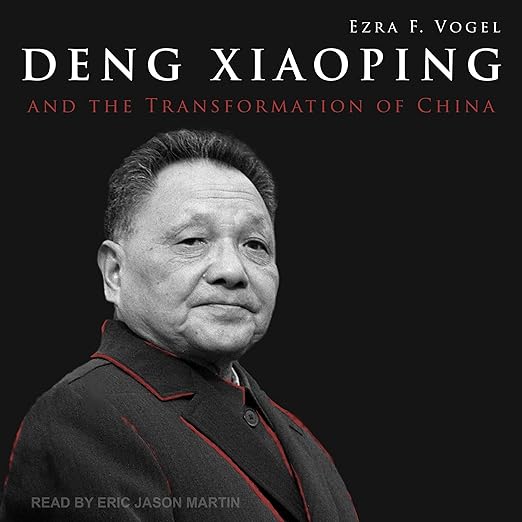
Mao Zedong once described Deng Xiaoping as a 'needle inside a ball of cotton,' and that image does more to explain this thirty-three-hour audiobook than any plot summary could. Ezra Vogel, the Harvard scholar behind this exhaustive biography, traces how Deng survived multiple purges and years of exile to become the man who opened China's economy to the West and, within the same decade, ordered the crackdown at Tiananmen Square. This is not a quick survey. One listener called it Vogel's 'massive 700-page tome' after finishing the print edition it's based on, and the audiobook runs to match: thirty-three hours and forty-eight minutes tracking five decades of one man's rise, fall, and rise again.
Preeminent From 1978 to 1989, Then Again in 1992
Deng's political commitment took shape early and far from home: the synopsis places his formative Communist Party involvement in Paris during the early 1920s, among a group of Chinese student-workers that also included Zhou Enlai, before he returned to China in 1927 to join the revolution 'on the ground floor.' Vogel spends real time on this half-century arc rather than rushing to the reform-era headlines, tracking accusations, purges, and exile before Deng ever reached the top, which gives the eventual transformation of China's economy the weight of decades rather than the feel of a sudden turn.
The paradox at the book's center, Deng as both the architect of China's modernization and the man who ordered tanks into Tiananmen Square, gets treated with real complexity rather than flattened into simple hero or villain framing. T. Graczewski's review quotes Vogel's own closing question directly: 'Did any other leader in the twentieth century do more to improve the lives of so many? Did any other twentieth-century leader have such a large and lasting influence on world history?' That's the scale of argument this biography is actually making.
The synopsis is precise about the shape of Deng's actual power, listing him as China's preeminent leader 'from 1978 to 1989 and again in 1992,' phrasing that hints at a more complicated timeline than a simple continuous reign. That gap and return, stepping back from the absolute center of power and then reasserting decisive influence once more in his late eighties, is exactly the kind of political nuance a lesser biography would flatten into a single unbroken narrative, and Vogel's willingness to track it precisely is a mark of real scholarly seriousness.
Deng's economic reforms get credited in the synopsis with having lifted hundreds of millions of his countrymen out of poverty, a policy outcome large enough that its effects reshaped global manufacturing and trade patterns for decades, not just China's own domestic economy. That global ripple effect is part of why a biography this detailed about one national leader still earns a listener's attention well beyond anyone specifically interested in Chinese history alone.
Martin's Established Strength for Dense Political History
Eric Jason Martin narrates, and this genre, dense scholarly political biography with a large cast of named historical figures across a very long runtime, is squarely inside his established strength rather than a stretch for him; his prior work on comparably detailed wartime biography confirms a controlled, measured delivery built for exactly this kind of sustained, detail-heavy material. Thirty-three hours of Chinese Communist Party history, purge cycles, and economic reform requires a narrator who won't lose momentum or blur names together, and that specific stamina is the job here.
thebowl's review praises the book as 'a thorough treatment of the career of a man whose influence on China was arguably as great as anyone's in the 20th Century, Mao included,' crediting Vogel with capturing 'good judgment,' skillful politics, and genuine pragmatism in Deng's character. Steven Peterson's review adds texture on the human cost, noting Deng 'was a survivor, having been purged twice by Chairman Mao Zedong,' who kept Deng 'on the backburner in case he needed his skills later on.'
This is the kind of exhaustive archival work only a career China scholar could produce, and Vogel's Harvard credentials show up in the book's methodical, evidence-driven approach rather than in dry academic prose; multiple reviewers specifically praise the storytelling quality alongside the rigor. For a listener without a strong prior background in Chinese Communist Party history, that combination matters: the book teaches its own context as it goes rather than assuming a listener already knows who Zhou Enlai or the Gang of Four were.
The book's own title promises transformation, not just biography, and Vogel honors that scope: this isn't only the story of one man's career but of an entire nation's economic and social system being rebuilt around him, which is part of why the book earns its unusually long runtime rather than simply padding a straightforward political career narrative.
A Reference-Grade Biography to Sit With
Steven Peterson's review flags a real structural choice worth knowing in advance: the book gives noticeably more emphasis to Deng's later years than his earlier ones. Listeners expecting equal, chronological weight given to Deng's childhood and early revolutionary years may find the book accelerates through that material to spend more time on the reform era and its consequences, a defensible choice given how much of Deng's historical significance rests on the post-1978 period, but a real pacing decision nonetheless.
Thirty-three hours and forty-eight minutes is a genuine commitment, closer in scale to Robert Caro's multi-volume political biographies than to a single-sitting popular history. This rewards sustained, serious investment rather than casual browsing, and listeners should plan for it the way they would a long-term reading project rather than a weekend's entertainment.
Listeners should think of this less as a single continuous narrative to consume passively and more as a reference-grade biography to actually sit with, the kind of book worth pausing on and returning to across weeks rather than powering through in a handful of long sessions. Thirty-three hours rewards that slower, more deliberate pace far better than it rewards a rushed binge, given how much specific political and economic detail accumulates across the runtime.
Frustration Sets In Around Hour Ten
Readers of major political biography, students of modern Chinese and Asian history, and anyone trying to understand how a single leader's decisions still shape global economics today are the clear audience. The 4.6 rating across 644 reviews signals a book that has satisfied exactly the serious, sustained readership a project this size requires.
Casual listeners hoping for a breezy overview of Chinese history, or a shorter single-sitting biography, should look elsewhere first; this book's entire value proposition rests on its thoroughness, and shortening the commitment mentally before starting will only produce frustration around hour ten.
Is this audiobook a good introduction to modern Chinese history, or does it assume prior knowledge?
It works as an introduction through the lens of one figure's life, though its sheer length and detail level assume a listener genuinely committed to the subject rather than someone wanting a brief overview.
Does this audiobook cover Deng Xiaoping's early life in as much depth as his later career?
No. Reviewer Steven Peterson notes the book emphasizes Deng's later years more than his earlier ones, so expect more depth on the reform era than the childhood and early revolutionary period.
How long is this audiobook, and is that runtime justified by the content?
It runs thirty-three hours and forty-eight minutes, matching the roughly 700-page print biography, and reviewers consistently describe the length as earned by the thoroughness of Vogel's research.
Does the audiobook address the Tiananmen Square crackdown directly?
Yes. The synopsis states plainly that Deng ordered the June 1989 crackdown, and the book treats it as a central, unresolved tension in his legacy alongside his economic reforms.