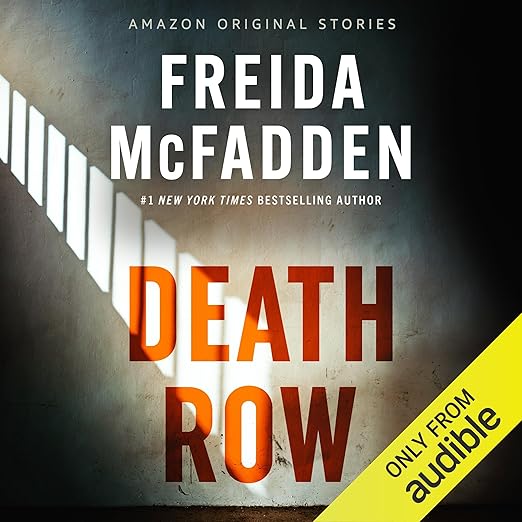
I was driving home from an evening errand when I queued up Death Row, expecting something that would fill the forty minutes without demanding much of me. Freida McFadden's short story, part of Amazon Original Stories' Alibis collection, is under two hours long, and I figured I would finish it before I got back to the house. I finished it in the driveway with the engine running because I needed to hear the epilogue twice, and then I sat there in the dark for a moment doing nothing, which is its own kind of recommendation for a thriller that runs barely 105 minutes.
McFadden built her reputation with The Housemaid and the novels that followed it, all of which share a particular structural signature: the confident setup, the methodical development, and then the turn that reframes everything you thought you understood. Compressing that into a short story is a technically demanding exercise, and whether it works depends almost entirely on whether the twist is earned rather than imposed. Here, it is earned. The epilogue, which multiple reviewers specifically called out as the critical final element, closes a loop that the story opens in its first few pages with a precision that the full novel form rarely achieves quite as cleanly.
Talia Sees Her Dead Husband Alive Again
The premise is stripped down to its essentials in a way that only short fiction can sustain at this compression level. Talia Kemper is on death row for the murder of her husband. She has maintained her innocence throughout. Her appeals are exhausted. And then, in the visiting area, she sees a man she is certain is her husband. Not someone who looks like him. Him.
What McFadden does with that recognition, the question of whether Talia is losing her grip on reality or has actually spotted proof of her innocence, and whether anyone will believe her before her execution date arrives, is the engine of the story. One reviewer described it as blurring the lines between reality and delusion, which captures the experience of listening during the middle section. Another described the epilogue as the icing on the cake, and that framing understates it; the epilogue is not decoration but structural resolution, the element that transforms a good thriller premise into a complete McFadden story with the signature satisfaction of the form.
No Room Here for Elaborate Subplots
McFadden is primarily a novelist, and the question that always arises with writers who move between forms is whether the short story functions as a compressed novel or as something with its own different internal logic. Death Row mostly succeeds in operating as the latter. The character economy is tight: Talia, her husband, the question of what happened, and the people who control whether she lives or dies. There is no room for the elaborate secondary plotting that McFadden's novels use, and she does not try to import it, which is itself a sign of a writer who understands what each form requires and can adjust her instincts accordingly.
The aggregate 3.8 rating on Audible is slightly lower than her novel work typically achieves, which reflects a broader pattern with Amazon Original Stories: some listeners find the short format unsatisfying as a standalone purchase regardless of the quality of the writing, because the brief runtime at a full audiobook price point creates expectations that a short story cannot meet by definition. For listeners who approach it as what it is, a tightly constructed thriller short story rather than a condensed novel, the rating undersells the achievement considerably.
Lauryn Allman Sustains the Story's Disorientation
Lauryn Allman handles the narration across the one hour and forty-four minutes, and she is a good match for McFadden's stripped-down style. There is no room in a story this short for the narrator to establish atmosphere gradually; Allman has to create tension from the opening pages and sustain it without false notes through a story that actively works to disorient the listener's sense of what is real. She manages this with a focused, slightly wound-up delivery that keeps the listener oriented through the story's reality-questioning middle section while still allowing the disorientation to do its work. The epilogue she delivers with appropriate restraint, and it lands correctly with the weight the moment requires.
One Sitting Is All This Story Needs
For McFadden fans who have not yet sampled this format, Death Row is an efficient and satisfying introduction to a writer at her technical best under real constraint. For thriller readers who are new to McFadden and looking for a low-commitment entry point before committing to a full novel, this is well suited to that purpose. The approximately 105-minute runtime makes it genuinely finishable in a single sitting, which is exactly what the Alibis collection was designed for. Readers who find the short form structurally unsatisfying regardless of execution will want to go directly to The Housemaid instead, where McFadden has more room to develop her signature structural moves across a full narrative span without the compression forcing shortcuts. But for the listener who appreciates what the short form can do when handled by someone who understands its particular demands, Death Row is a model of the genre. McFadden did not simply compress a novel concept into fewer pages; she built something that works specifically at this length, and that distinction matters for how satisfying the experience of listening actually is from beginning to epilogue.
Good to Know
Why does Death Row have a lower rating than Freida McFadden's novel-length audiobooks?
The 3.8 aggregate likely reflects listener reactions to the short format rather than the quality of the writing. Several reviewers noted that the story is sharp and the twist effective, but the one hour and forty-four minute runtime at a standard audiobook price creates dissatisfaction for listeners expecting something closer to novel length.
Is the twist in Death Row the kind that requires a re-listen to appreciate fully?
Based on reviewer descriptions, the story rewards a second listen with the ending in mind, though it functions as a complete experience on a first pass. The epilogue that multiple reviewers highlighted as the key final element changes how the preceding story reads, which is a signature McFadden structural move executed cleanly in the short form.
Does Lauryn Allman's narration hold up across such a compressed format where atmosphere has to be established quickly?
Yes. The short runtime means Allman cannot rely on gradual tonal development, and her delivery reflects that: the tension is present from the opening and her handling of the reality-questioning middle section is focused and controlled. She delivers the epilogue with the restraint the moment requires.