In Brief
- Voice: Lisa Rost-Welling handles the procedural pace and the personal stakes of Amanda Steele's fifteenth case with consistent control, keeping the tension calibrated through the book's many reversals.
- Big ideas: Divided loyalties in a murder investigation, the cost of proximity to a crime when the suspect is family, corporate secrets and professional betrayal
- Atmosphere: Tightly wound and propulsive, with personal stakes layered under every procedural beat
- Worth it?: A reliable and well-constructed entry in a long-running series, carrying the weight of fifteen books' worth of character investment while still being readable as a standalone crime thriller.
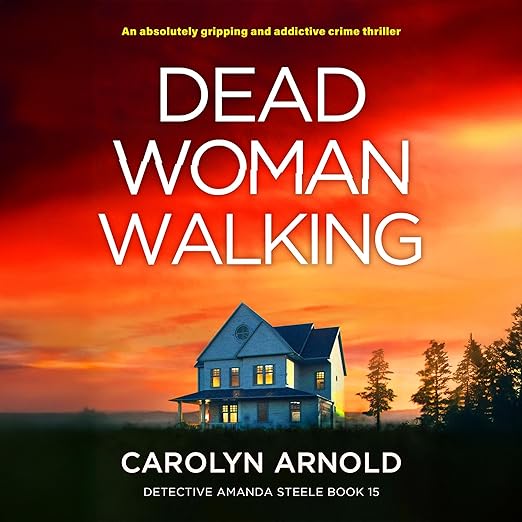
I finished Dead Woman Walking at just past midnight, which is the kind of ending an Carolyn Arnold novel tends to produce. I had started it the previous evening thinking I would listen for an hour before sleep. That is not what happened. Amanda Steele has a way of getting under the deadline. By the time I reached the point where the investigation into realtor Christine Lane's murder began to implicate someone in Steele's own professional network, there was no credible argument for stopping.
This is the fifteenth book in the Detective Amanda Steele series, set in Woodbridge, Virginia. The setup is efficient: Christine Lane, a real estate agent desperate to close a sale, shows an empty house at night and ends up dead in one of the most affluent properties in town. Steele arrives on the scene and learns almost immediately that Christine was dating her half-brother Spencer, making him an immediate suspect. That personal complication is the engine of the book, and Arnold uses it more carefully than most procedural writers would.
The Review
Half-siblings in crime fiction tend to function as either pure emotional obstacles or pure narrative device. Cochet uses Spencer with more nuance than that. Steele and her half-brother are not close, and the book does not require them to be. What it requires, and delivers, is the specific texture of having to investigate someone you are not attached to but whose guilt or innocence has consequences for people you are attached to. The emotional landscape here is not simple love or loyalty but something more complicated: the obligation to follow the evidence wherever it goes against the equally strong obligation not to become an instrument of someone else's wrongful targeting.
This tension runs through the procedural investigation in ways that feel earned rather than manufactured. When Steele is ambushed outside the crime scene by Dominique Sharp, the lawyer who owns the house and had expected it sold before her return from Washington, the investigation opens into a second set of possibilities. Was Christine the intended victim, or was Dominique the actual target? That question restructures the case and gives Steele and her partner Trent a direction that moves away from Spencer and toward a corporate network of disgruntled employees and buried secrets.
The Best Parts of Dead Woman Walking
At just over eight hours, Dead Woman Walking moves at the pace of an investigation that is always one development ahead of where you expect it to be. Rost-Welling's narration handles this well. She does not oversell the tension with vocal theatrics; the accelerations in the plot are carried by the writing, and her narration stays steady enough to let the reversals land with their own weight. The character differentiation across the principal players, Steele, Trent, Dominique, Spencer, and a cast of corporate witnesses, is clear without being exaggerated.
Reviewers have consistently praised Arnold's ability to maintain surprise across a long series, and this installment justifies that reputation. The identity of the person behind Christine's death is concealed with genuine craft. The clues are present and visible in retrospect, but the misdirection is skillful enough that the reveal at the climax carries real force. One reviewer noted that Carolyn Arnold never fails to keep you guessing who the villain is until the end, and that is precisely the contract Dead Woman Walking honors.
The Caveats
The question of series entry point is worth addressing directly. Dead Woman Walking does not require reading all fourteen preceding entries, but it benefits significantly from them. The relationship between Steele and Trent, the dynamics within the Woodbridge police department, and the specific history of why Steele and Spencer are only half-siblings with a complicated relationship are all more resonant if you have been with the series for a while. Arnold writes each book to function as a standalone crime thriller, and she largely succeeds. But the emotional freight carried by the personal stakes in this installment, particularly around the half-brother dynamic, is heavier for readers who have seen Steele navigate family complications before.
For new listeners, the book works as a competent and well-structured crime thriller with a strong sense of place and a protagonist who is easy to invest in quickly. Steele is capable and fallible in roughly the right proportions: skilled enough to be worth following, human enough to make mistakes that create genuine jeopardy. The Woodbridge setting, used across fifteen books, has the specificity of a place the author knows well. The affluent-neighborhood crime scene, the Washington professional orbit that Dominique inhabits, and the quiet domestic details of Christine's ambitions for her daughter all contribute to a world that feels inhabited rather than generic.
The Right Listener for Dead Woman Walking
Dead Woman Walking rewards readers already invested in the Detective Amanda Steele series most fully. The satisfaction of watching a character you have followed across fourteen books navigate the most personal conflict yet, a case where following the evidence to its conclusion means accepting that someone close to her could be responsible, is the kind of payoff that long-running series are built for. Arnold has constructed the case to make that conflict as sharp as possible without melodrama.
For new listeners, the book serves as a perfectly functional entry point if you are willing to accept that some of the emotional resonances will be thinner than they would be for established series readers. The procedural plotting is strong enough to carry the narrative independently, and Rost-Welling's narration is consistent across both the case and the character dimensions. Fans of authors like Mary Burton, Elle Gray, and A.J. Rivers, all mentioned in the book's own positioning, will find the tone and pace familiar and the craft reliable. This is a book that does exactly what it sets out to do, and after fifteen books, doing it with this level of consistency is itself an achievement.