- Narrator: Alice Oswald performs a poem assembled from recorded speech, so the interviewer and the reader are the same person
- Subjects: A river from source to sea, working lives on the water, myth and the drowned
- Tone: Fluid and disorienting, closer to overheard talk than to recitation
- Bottom line: A major poem you can hear twice in an afternoon, and should
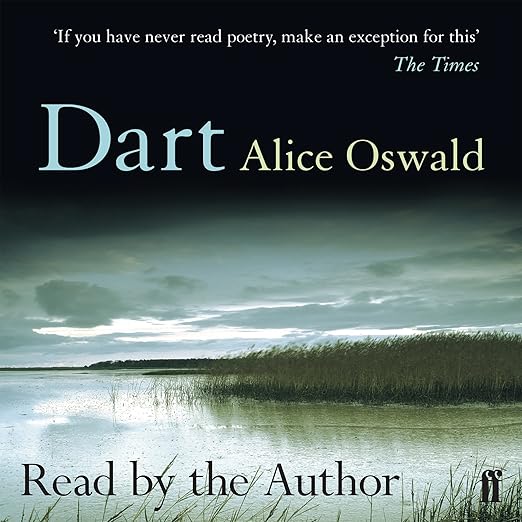
Rivers have been written about badly for centuries, mostly by people standing beside them looking thoughtful. Alice Oswald did something else. She spent three years recording conversations with the people who actually live and work on the River Dart in Devon, and built a poem out of what they said. The Dart audiobook runs one hour and seventeen minutes, is read by Oswald herself, and follows the water from source to sea through the mouths of everyone it passes.
Poachers, Ferrymen, and Drowned Voices Share the Poem
Oswald calls the method a poetic census, which is exactly right and slightly misleading. A census counts; this collects. The publisher lists the speakers as "a poacher, a ferryman, a sewage worker and milk worker, a forester, swimmers and canoeists", and then adds the ones no recorder could have caught: "drowned voices, dreaming voices and marginal notes which act as markers along the way". Living speech and inherited myth get the same footing, and the poem never announces which is which.
Voices are the whole architecture, and the form moves with them. JeanfromOttawa, one of five people who left written comments, put a finger on the technique better than most criticism does, praising "the way Oswald shifted the work's form to suit the different voices, the different feel of various parts of the river". A canoeist does not sound like a sewage worker, and the lines on the page change shape to register the difference before you have processed the content.
One reviewer, posting as roundheadslovene, gives the most concrete description of what the reading experience is like. The poem is "Told in the voice of the river", assuming the speech "of various workers (some illegal), industry, recreationists, geology, fish, flora" and, further down, "and the dead, lives that the river has taken". That same notice adds the sentence any prospective listener should sit with: "It flows like the river, and often changes course very quickly".
Oswald Reads the River She Spent Years Recording
Seventy-seven minutes buys you a complete book-length poem, which is close to unheard of in this format. JeanfromOttawa calls it "this marvel of a book" and describes finishing it in a sitting. You can hear this on a single walk and then hear it again the same afternoon, and repeated listening is not a luxury here but the actual method, because a poem that changes course quickly does not surrender on one pass. Very few serious works of literature can be absorbed twice inside three hours.
Alice Oswald reading her own poem is not a marketing nicety here. It is arguably the correct format for the thing itself. The source material was recorded human speech. The finished poem impersonates that speech, moving between a poacher and a forester and a drowned voice without announcing the change. Any hired reader would have to guess where each shift lands and how far to push it. The person who conducted the interviews and built the transitions does not have to guess at all.
Marginal notes are the interesting production problem, and they are named in the description as devices that "act as markers along the way". On the page they sit outside the poem, telling you who is speaking now. A recording cannot put anything in a margin. Whatever solution this edition arrives at, the choice is structural rather than decorative, and it is one of the few places where hearing a poem and reading it genuinely diverge rather than simply differ.
An Ovidian Experiment or Water to Wash Over You
Print objects are what the written comments are mostly about, which limits how much they can tell you. Frances "purchased this copy as a gift". roundheadslovene measures the work physically, calling it "A 48 pp prose poem to the River Dart". Kerry Abrahamsen contributes three words, "great! Cane perfect", which concern something other than the poem. The 4.5 average across 189 ratings is a verdict on a celebrated text, gathered largely by people holding it in their hands.
Poetry of this kind resists the passive listening most audiobooks invite. Attention wanders for ten seconds and you surface inside a different speaker, a different century, possibly a different species. That is a feature of the writing rather than a flaw in it, but a listener treating this as background while doing something else will get very little. Sit down for it, or walk with nothing else competing. The reward for that attention is disproportionate, since the poem is short enough that full concentration costs you almost nothing.
Difficulty is worth naming honestly, since the enthusiasm in this pool can obscure it. The reviewer em frames the two ways in, either as an experiment in "what an Ovidian approach might do for ecopoetics" or simply as "a beautiful poem about a river to wash over you". The second door is real and it is open. Even so, the syntax breaks and reassembles constantly, and readers who need a poem to resolve into statements will find this frustrating.
Walkers and Swimmers Should Hear This Before Anything Else
Walkers, swimmers, anglers and anyone who has a particular stretch of water they think about too much should hear this before anything else in the genre. Frances describes a poem that "brings a place and community to light in a subtle and generous way", and JeanfromOttawa finished it feeling "as if I have visited the Dart". Place writing rarely earns that. The specificity is the reason: real people, named occupations, a named river, and three years of listening behind every line of it.
Teachers and students working on ecopoetics, documentary poetry or the long poem have an obvious reason to choose the audio over print, since the author performing her own transitions between voices is primary evidence about how the piece is meant to move. An hour and a quarter also makes it the rare set text you can assign in full and still expect a seminar to have heard it twice. The interviews behind the poem give it a documentary dimension that most contemporary verse cannot offer a classroom.
Skip it if you want narrative, or if you want a poem you can follow while half occupied. Nothing here resolves into a story with people you track from beginning to end. What you get instead is a river and everyone standing in it, talking at once, which is either the most interesting thing on your shelf or an hour of confusion depending entirely on what you came for. At this length the gamble costs almost nothing, which is the best argument for taking it.
How long is the Dart audiobook, and is that really the whole poem?
One hour and seventeen minutes, and yes, that is the complete work. One reviewer describes the print edition as forty-eight pages. The brevity is a feature: this is a poem built for rereading, and the runtime makes a second or third pass entirely practical.
Does Alice Oswald reading it herself change the audiobook?
Materially. The poem was assembled from three years of recorded conversations with people on the river, and it shifts between speakers without announcing the change. The author knows where every transition sits and how far to push each voice, which no hired reader could reconstruct from the page alone.
Will I follow it without the printed text in front of me?
Mostly, though the page carries marginal notes that mark who is speaking, and a recording has no margin. Expect some passages where the speaker is deliberately unclear. That ambiguity is part of the design rather than a failure of the format, and rereading resolves more than concentration does.