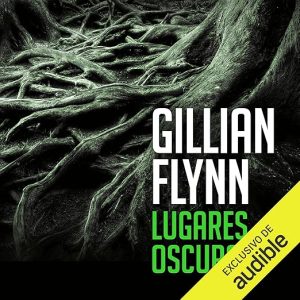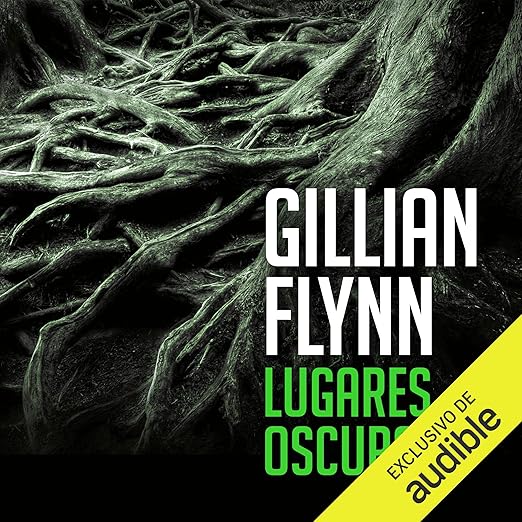
Gillian Flynn's second novel occupies an interesting position in her catalog. Gone Girl arrived later and became the cultural event; Sharp Objects came first and has a rawness that feels like discovery. Dark Places sits between them in more ways than one: more plot-driven than Sharp Objects, more emotionally claustrophobic than Gone Girl, and, in the estimation of some readers, the one that gets overlooked. This Spanish-language edition, narrated by Carlos Torres and published by Audible Studios para Penguin Random House Grupo Editorial, gives Spanish-speaking listeners full access to a novel that Flynn's international audience has been slower to discover than her other work.
I spent a rainy Friday afternoon with the first several hours, getting to know Libby Day through Torres's narration, and the experience is genuinely unsettling in the way Flynn's best work tends to be. Libby is not a sympathetic protagonist in any conventional sense. She survived the massacre that killed her mother and two sisters when she was seven years old. She testified against her brother Ben, who has spent twenty-five years in prison as a result. And she has coasted since then on the proceeds of a charitable fund that's nearly depleted, making her complicity in the Kill Club's investigation partly, honestly, financial.
What Gillian Flynn Delivers
The conceit of the Kill Club, a secret society of true crime obsessives who believe Ben Day was wrongly convicted, is one of Flynn's more sharply observed satirical strokes. The group's obsession with famous crimes, their collection of crime-scene artifacts, their certainty about a case they know only from a distance: all of this is rendered with the kind of specific detail that makes it uncomfortably recognizable. Flynn wrote Dark Places in the post-Satanic Panic era, and the novel's engagement with how group hysteria constructs its own evidence is still resonant.
The dual timeline structure, Libby in the present, Ben and his mother Patty on the day of the murders in 1985, is where the novel's real complexity lives. Flynn moves between these lines with confidence, and the 1985 sections carry a particular weight because you're reading them knowing how they end. The novel asks you to hold two pictures simultaneously: what happened, and what the official story says happened. The gap between them is where everything interesting lives. Spanish-speaking reviewers note that the novel kept them hooked from the first chapter, though a few note that the ending didn't fully satisfy them, a response that's common with Flynn's second novel, which aims for revelation rather than resolution and sometimes catches readers expecting the latter.
What Gillian Flynn Gets Right
One of the genuine challenges of translating psychological thriller fiction is preserving the particular texture of the prose without losing momentum. Flynn's style in Dark Places depends on a kind of controlled ugliness, Libby's voice is blunt and self-aware about her own damage in ways that require careful calibration. The Spanish edition maintains the novel's essential rhythm. Carlos Torres's narration keeps the pacing taut without rushing the longer interior passages, which is where a less careful reading could easily lose the listener.
Reviewers in Spanish note that the novel touches on addiction, peer pressure, family dysfunction, and satanism, calling the latter somewhat underdeveloped relative to its potential. That's a fair observation: the Satanic Panic element is more atmospheric than thoroughly examined, serving the plot machinery more than the thematic argument. But it's Flynn, and the machinery works. The novel keeps you reading even when it's making you uncomfortable, which is what she's aiming for.
Where Gillian Flynn Loses Some Ground
The consensus among Spanish-language reviewers is that Dark Places is entertaining and well-constructed but doesn't reach the heights of Gone Girl or, for the more devoted readers, Sharp Objects. That's probably fair as a hierarchy, though it risks underselling what the book actually does. Dark Places has a protagonist who is genuinely morally compromised in ways that Flynn doesn't resolve with late-act redemption. Libby does not become a better person because she uncovers the truth. She becomes someone who knows more about what happened to her family, and what that knowledge does to her is complicated and not entirely comfortable.
For listeners who have already worked through Flynn's other two novels in Spanish, Dark Places is worth your time. For listeners new to Flynn in Spanish, Gone Girl is still the stronger entry point, but Dark Places has pleasures that the more famous novel doesn't, a slower burn, a more deliberately sympathetic figure in Ben Day, and a more direct engagement with American poverty and rural desperation as conditions that make violence possible.
Who Should Pick Up Dark Places
This edition runs nearly thirteen hours, which for Flynn's dense plotting feels appropriately paced, unhurried enough to let the 1985 sections breathe, compact enough that the dual timeline doesn't lose momentum across the full runtime. Carlos Torres's narration is consistent and controlled. Listeners who prefer their psychological thrillers in Spanish will find this a well-executed edition of a novel that has more going on beneath its genre surface than a casual summary suggests.
Questions Listeners Ask
Is this edition of Dark Places entirely in Spanish?
Yes. The audiobook is narrated in Spanish by Carlos Torres, and the synopsis is in Spanish. The audiobook page notes this explicitly. English-language listeners should seek out the English edition.
How does Dark Places compare to Gone Girl and Sharp Objects in terms of difficulty and pacing?
Dark Places moves more slowly than Gone Girl and is more plot-reliant than Sharp Objects. It uses a dual timeline alternating between Libby in the present and the night of the murders in 1985, which requires patience but pays off in the third act.
Is the satanism element in Dark Places developed as a serious thematic concern?
Several reviewers note that the Satanic Panic angle functions more as atmospheric backdrop and plot mechanism than a deeply examined theme. It captures the hysteria of the era without fully interrogating it.
Does Dark Places work as a stand-alone or do you need to have read Flynn's other novels first?
Completely stand-alone. Flynn's three novels share stylistic DNA but no characters or settings. Dark Places requires no prior familiarity with her other work.