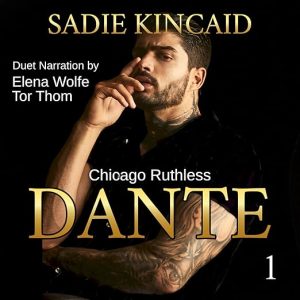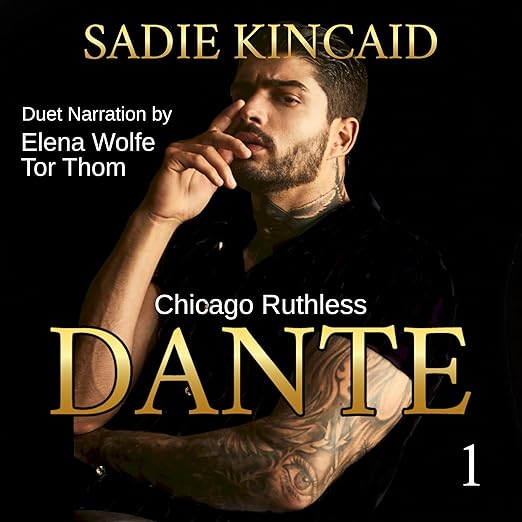
In Brief
- Read by: Elena Wolfe delivers Katerina's interiority with conviction - the push-pull between fear and desire comes through without tipping into melodrama.
- At its heart: Power and captivity, enemies-to-lovers transformation, dark desire versus self-preservation
- Vibe: Tense, heat-driven, and emotionally consuming
- Short version: A committed entry into the dark mafia romance subgenre that delivers on its promises for readers who know what they are signing up for.
Dark mafia romance is a subgenre with extremely clear expectations on both sides of the transaction. Readers who come to it know what the tropes are - the forced proximity, the morally compromised male lead, the captivity arrangement, the slow burn that is actually quite fast. Readers who do not come to it voluntarily tend to find the premise indefensible. Sadie Kincaid's Dante, the first book in the Chicago Ruthless series, is very much in the former camp, and the most useful thing I can do in reviewing it is be specific about what it does well within those conventions rather than adjudicate the genre itself.
The setup is as direct as the synopsis suggests. Katerina is taken by Dante Moretti as payment for a debt her brother owes. Dante is cold, calculating, and established early on as the kind of man who destroyed his former fiancee and her family on the eve of their wedding. The story then traces what happens between captive and captor as proximity does its work. Kincaid is not trying to disguise or complicate these dynamics - she is leaning into them with full commitment, and that commitment is actually what separates a functional dark romance from an incoherent one.
The Verdict, Briefly
What Kincaid does particularly well is the internal tug-of-war in Katerina's perspective. The synopsis describes Dante as suffocating, all-consuming, and intoxicating in quick succession, and that is not purple prose - it is accurate to how Katerina's experience is rendered. She is not simply swept away by circumstance; she is aware of what is happening, resistant to it, and losing ground anyway. That tension is what sustains the nine-hour listen. One reviewer described Dante as "possessive in a way that was incredible to read," and another noted the book gave them a "book hangover" - both reactions suggest Kincaid has achieved the emotional intensity the genre requires.
The pacing across nine hours is generally solid. The middle section slows to allow for what readers of the genre call soft moments - scenes where Dante's ice begins to fracture - and they land because Kincaid earns them rather than rushing to them. The HEA ending, promised in the series description, delivers. Each book in the Chicago Ruthless series is described as a standalone with a happy ending, which means there is no cliffhanger frustration at the close of this one.
What Makes Dante Worth Hearing
Elena Wolfe narrates in the first person as Katerina, and the casting decision works. She handles the contrast between Katerina's outward defiance and internal confusion with a naturalistic quality that keeps the emotional beats from tipping into operatics. Dark romance can go very wrong in audio when the narrator plays the intensity at maximum volume throughout - Wolfe modulates it, which means the genuinely charged scenes land with more force because they are not competing with everything that came before them. For a book with a 4.3 rating on 44 reviews, listener response skews strongly positive, with multiple five-star reactions from readers who specifically call out the setup and the heat level.
Points to Consider
The content warnings in the synopsis are serious ones. The book contains explicit sexual content and scenes of a violent nature - both are integral to the plot rather than incidental. Readers who have not encountered dark romance before should know that the consent framework is deliberately complicated here; that is not a flaw in the execution, it is the premise. A reviewer who gave it three stars was responding to a damaged physical copy rather than the content, which suggests the story itself is not generating meaningful critical dissent among its intended audience. The concern worth naming is the one a reader raised about Dante's history: he is established as having killed his former fiancee and her family. Kincaid does not rehabilitate this in the traditional sense - she asks you to hold it alongside the love story, which requires a certain suspension that not every reader will grant.
Who Should Pick Up Dante
Listeners who already enjoy dark mafia romance - particularly books that lean into possession dynamics and morally complex male leads - will find this a strong entry in the subgenre. Readers new to dark romance who are curious about it should know that this is not an introductory text; it goes to places that require genre familiarity to appreciate rather than alarm at. If those dynamics are not for you, this is not the title to change your mind. But for its intended readership, Kincaid delivers a story that several reviewers describe as the beginning of a genuine series obsession.
Frequently Asked Questions
Is Dante a true standalone or does it end on a cliffhanger requiring the next book?
It is a standalone with a full HEA ending. The Chicago Ruthless series follows different Moretti siblings across installments, so you get a complete story arc for Dante and Katerina here without needing to commit to the rest of the series.
How explicit is the content, and how much violence is in the book?
Both are significant. The synopsis explicitly labels this a spicy dark mafia romance with scenes of an explicit sexual nature and scenes of a violent nature. The heat level, based on reviewer descriptions, is high. This is not a cleaned-up version of the premise.
Does Elena Wolfe's narration work well for a first-person female protagonist in a dark romance?
Yes, based on available context. She keeps Katerina's voice grounded rather than over-performed, which serves the pushed-and-pulled emotional arc of the character. The delivery lets the charged scenes carry their own weight without the narration competing with them.
How does Dante compare to other books in the dark mafia romance subgenre?
Several reviewers place it favorably - one described it as one of their first dark romances and said it cemented their interest in the subgenre. Comparisons are made to Beautiful Torment. It sits confidently in the middle of the genre's spectrum: committed to its tropes, well-paced, and genuinely emotionally engaging for readers who are already on board with the premise.