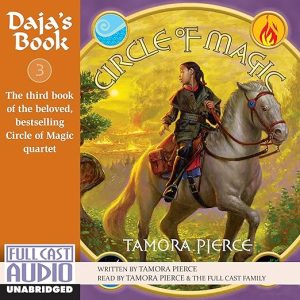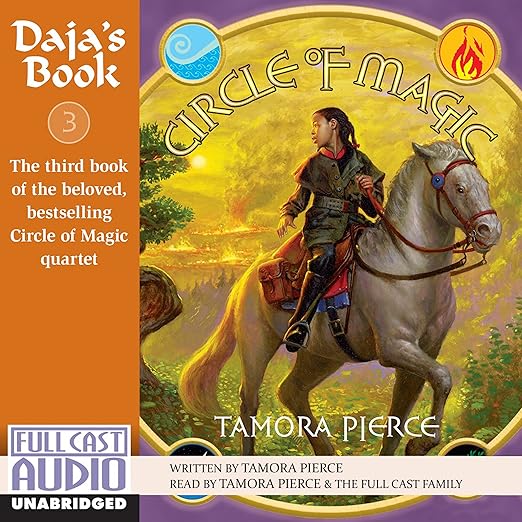
I came to Tamora Pierce's Circle of Magic quartet as an adult reader catching up on a body of work I should have found twenty years earlier. Daja's Book is the third in the four-part series, and having listened to the first two on consecutive evenings, I arrived at this one with considerable investment in the found-family unit that Sandry, Tris, Briar, and Daja have built together under their unconventional mentors at Winding Circle. What I did not anticipate was how much this third installment would refocus the entire series around a single character's most painful question: what do you owe a community that cast you out when that community suddenly needs you?
Tamora Pierce narrates her own work across this series, which creates an interesting dynamic. The performance is not the technically polished product of a trained audiobook narrator, and there are moments where a professional might have handled a difficult passage more smoothly. But Pierce knows these characters the way only an author knows their own people, and that knowledge shows in small moments throughout: in the way she voices Daja's internal conflict, in the rhythm she brings to the dialogue between the four young mages, in the weight she gives to moments that a narrator working from the page alone might not know to emphasize.
Where This One Lands
Daja is a Trader, a member of a culture that defines belonging and exclusion in absolute terms. When her family died in a shipwreck at the beginning of the series, she was declared trangshi, outcast, because Traders believe that such a catastrophic death indicates divine disfavor with the entire family line. This is not abstract cultural texture. Traders she encounters in the course of the story refuse to look at her, refuse to speak to her, treat her as literally absent from the social world. The cultural logic is internally consistent and thoroughly presented, which makes it more rather than less painful to watch in operation.
When Daja's Book brings her back into contact with Traders during a journey through drought-afflicted lands, the question of what she does with her considerable magical power in relation to people who consider her less than nothing becomes the book's emotional core and driving tension. Reviewer Anonymous described this as a story about celebrating diversity and finding yourself in the most trying of times, and added the crucial detail: the people who cast you out may want you back, and maybe you will have changed enough not to need them. That is exactly what Pierce is working through, and she handles it without sentimentality or false resolution. Daja's choices about what to give and what to withhold from the Traders are her own, earned through specific experience rather than arrived at through a lesson.
Why Daja's Book Works as an Audiobook
The practical crisis driving the plot is a severe drought affecting the kingdom the young mages are traveling through with Sandry's uncle the Prince as he surveys the problems of his lands. The drought produces fires, and the fires produce both genuine danger and a showcase for what the four complementary magic systems can do when they work in combination. Pierce is better than most YA fantasy writers at making magical systems feel physically consequential rather than abstractly convenient, and the fire sequences here have an urgency that reviewer Murph01 specifically singled out as the book's strongest element. They feel dangerous in ways that matter, and the danger lands because Pierce has built up the stakes through the preceding books rather than manufacturing them in this one.
The introduction of Polyam, a Trader woman with a physical disability who navigates a complex position between her own community's customs and her practical need for assistance, gives the book an additional layer of social texture that distinguishes it from most of its YA fantasy contemporaries. Reviewer Jacqueline Hertz noted that Polyam's role is refreshing because her disability is integrated into the plot rather than being used as a symbolic function or a source of easy pathos. She is a fully realized character whose specific circumstances matter to what happens and why.
What Gives Us Pause
Multiple reviewers across the series describe Daja's Book as their favorite entry, which reflects both the quality of Pierce's characterization in this particular volume and the way its emotional stakes feel more consequential than the more episodic earlier books. At 5 hours and 19 minutes, it is the shortest in the quartet, which means Pierce is operating at maximum compression. Every scene is doing work, and the accumulation of small observations about Trader culture, about what exile does to a person over time, and about the difference between a chosen family and the one that originally chose you, produces an emotional payoff that the brief runtime does not prepare you for. For listeners new to Pierce, start with book one of this series and let the context build. For those already invested in the four young mages, Daja's Book is the installment that most fully earns the found-family framework the series has been constructing.
Who Should Pick Up Daja's Book
The found-family dynamic in the Circle of Magic series is worth examining because Pierce handles it with more honesty than the trope usually receives. The four young mages do not simply choose each other freely; they are assigned to each other by circumstance and by their teachers' recognition that their magic is entangled in ways that require them to develop together. That involuntary beginning is important. The family they build is genuinely chosen, but chosen over time and through specific experience rather than through immediate recognition and affinity.
Daja's Book tests that chosen-family framework at its most fundamental level. The Traders' definition of family, from which Daja has been permanently excluded, represents the opposite model: belonging that is assigned by birth and withdrawn by catastrophe, with no mechanism for recovery or renegotiation. Pierce sets these two models against each other throughout the book and lets the tension between them do the emotional work that a simpler story might have resolved too quickly. The resolution Daja reaches is specific to her situation and her choices, not a general lesson, which is why it lands as powerfully as it does.
Key Details
- Narration: Tamora Pierce narrates her own work across the Circle of Magic series, and the intimacy of an author reading her own characters produces a warmth that no professional performance could replicate.
- Themes: Exile and the question of belonging, the ethics of loyalty to a community that rejected you, disability and representation in YA fantasy
- Mood: Warm and emotionally textured, with genuine urgency in the fire and drought sequences that gives the book more physical immediacy than its predecessors
- Verdict: The most emotionally complex entry in the Circle of Magic quartet, and for many readers the best of the four books, anchored by one of YA fantasy's most carefully drawn protagonists.
Does Tamora Pierce narrating her own books create problems for audio listeners, such as inconsistent pacing or uneven character voices?
The performance is warm and direct rather than technically polished, but Pierce's intimate knowledge of her characters compensates effectively for any rough edges. Most listeners find that the author-narrator dynamic adds rather than subtracts from the emotional experience of the story.
Can Daja's Book be understood without having read the first two Circle of Magic novels?
Not fully to maximum effect. The emotional stakes of Daja's relationship with the Trader community, and the found-family dynamic at the center of the series, have been building since book one. New listeners can follow the plot but will miss the accumulated context that makes this entry's resolution so satisfying.
How does Pierce handle the portrayal of Trader culture without making it feel like a simplistic exotic other?
Pierce builds Trader culture with genuine internal logic and presents it through Daja's ambivalent, complicated perspective rather than through a detached narrator's judgment. The culture's treatment of Daja is presented as genuinely harmful while remaining comprehensible within its own framework, which is the harder and more honest approach.
Is Daja's Book appropriate for adult readers, or is the Circle of Magic series primarily aimed at children?
Pierce writes for older middle-grade and young adult readers, but the Circle of Magic series has a substantial adult following. The emotional complexity, the treatment of disability, and the cultural dynamics in Daja's Book particularly give the series depth that holds up to adult reading without being inappropriate for younger audiences.