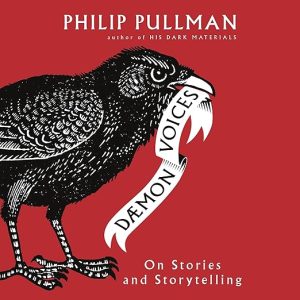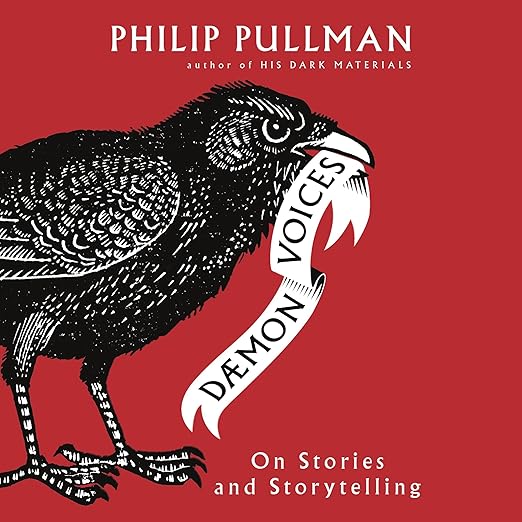
His Dark Materials made Philip Pullman a defining voice in modern fantasy, but Daemon Voices sets fiction aside for something more direct: an audiobook collection of his own essays, lectures, and introductions about where stories come from and how they actually work on a reader. The pieces span decades of thinking rather than a single sitting's worth of ideas, and Pullman narrates all of it himself, which matters more here than it would for a novel. This is a writer explaining his own methods in his own voice, tracing his enchantment with story back through Blake, Milton, Dickens, and the Brothers Grimm, then following it forward into questions about what story is doing inside education, religion, and science.
Defending Pictures in Books and Other Craft Fights
Essay collections built from years of separate lectures and introductions usually show their seams, and Daemon Voices doesn't fully escape that problem. Some pieces clearly began as a talk delivered to a specific room, a teachers' conference, a literary festival, and retain that occasion's shape even once collected between covers. What holds the whole project together is less a single argument than a recurring temperament: Pullman keeps circling back to the idea that story is a tool for making sense of experience, not decoration applied after the fact. Reviewer Steven Ramirez, who came to the book without having read His Dark Materials at all, still found it useful purely as craft instruction, purchasing it, in his words, to 'get better at my craft.'
The book's most interesting passages are the ones where Pullman defends specific, sometimes contrarian critical positions rather than offering general inspiration. Reviewer W. L. Hunt singles out 'the defense of pictures in books' and a discussion of 'the difference between the path and the forest' as two of the collection's sharper turns, both arguments about craft mechanics rather than general encouragement to keep writing. That specificity is the book's real value: not motivational talk about creativity in the abstract, but a working novelist naming the actual decisions, structure, viewpoint, the presence or absence of illustration, that separate a story that lands from one that doesn't.
Pullman the Teacher Makes the Case for Story
Pullman's argument about story's role outside fiction, in education specifically, is where Daemon Voices earns its widest relevance. He treats storytelling as a cognitive tool children need for making sense of a chaotic world, not decoration bolted onto a curriculum, and that argument connects to his own history: Pullman taught in schools for years before his writing career took off, which gives his classroom-focused essays a practitioner's specificity rather than an outside theorist's generalization. The religion and science essays extend the same logic outward, treating myth and origin story as instruments people reach for to organize experience, regardless of whether a given culture calls the result faith or physics.
Pullman Narrates Himself Into a Single Throughline
The case for the audio format here is almost circumstantial: Pullman is a genuinely skilled reader of his own prose, controlled and unhurried, the kind of self-narration that trusts the text rather than performing it. He doesn't try to differentiate voices or build dramatic tension the way a narrator would for a novel, because these are essays, not scenes, and that steady delivery is exactly right for the material. Listeners who already know his fiction narration, he reads portions of His Dark Materials himself, will recognize the same instinct here: minimal theatrics, real trust that the ideas can carry the room on their own.
The audiobook also solves a structural problem the print edition has: a book assembled from lectures and introductions can feel disjointed on the page, chapter after chapter with different origins and different intended audiences, but hearing one consistent voice deliver all of it creates a throughline the material doesn't fully have on its own. siduri, reviewing the collection, called each essay one that 'opened a world of thinking,' and credited the pieces with being 'intelligent and kind,' a combination she noted isn't always guaranteed in criticism about craft. That warmth comes through more in audio than it likely would in silent reading, since Pullman's own delivery softens what could otherwise read as a series of lecture transcripts.
The specific writers Pullman keeps returning to, Blake, Milton, Dickens, the Brothers Grimm, are not a random syllabus; each represents a different problem he's working through, Milton especially, since Paradise Lost's moral ambiguity shaped His Dark Materials directly, down to the trilogy's own title. Listeners who already sense how much that poem runs underneath Pullman's fiction will find the connective tissue made explicit here.
Nearly Thirteen Hours, Better Read by Chapter
This is not an introduction to Pullman for someone who has never read a word of his fiction, and the synopsis doesn't pretend otherwise. Steven Ramirez's review is useful context here: he came to Daemon Voices having read none of His Dark Materials, and still found real value, but he also noted the trilogy was 'now sitting on my ever-expanding reading pile,' which suggests the material works best for readers who already care about story-craft as a subject in its own right, not necessarily existing Pullman fans hunting for trilogy trivia or worldbuilding backstory. Anyone expecting insider details about Lyra or the Subtle Knife specifically will find much less of that than the title might suggest.
At nearly 13 hours, the audiobook runs long for an essay collection, and the density compounds that length: this is material that rewards attention rather than background listening, closer to a semester of craft lectures than a breezy memoir. siduri flagged one specific limitation worth repeating here, a single reservation inside an otherwise five-star review, that at least one essay didn't fully land for her, a useful reminder that a book this wide-ranging, education, religion, science, literary history, will inevitably connect with a given listener less in some sections than others. Dipping in and out by chapter, rather than a straight cover-to-cover binge, may suit the material better.
For Working Writers, Not a Breezy Memoir
Working writers and serious students of craft are the clear audience, especially anyone drawn to hearing a major novelist explain his own instincts in his own words rather than filtered through a biographer or critic. Teachers who use story in the classroom will find real material here too, since Pullman spends real time on story's role in education specifically, not just its role in entertainment. Longtime His Dark Materials readers curious about the thinking behind Lyra's world will get plenty, even if that isn't the book's central purpose.
Listeners who want a memoir, a linear account of Pullman's life and career, should look elsewhere; this is organized by idea and theme, not by chronology, and it jumps between decades without much scene-setting. Anyone hoping for a breezy, casual listen should also adjust expectations: at 12 hours and 53 minutes of essay-dense material, Daemon Voices asks for the same patient attention a good seminar would, and it rewards that patience rather than punishing a listener who wanted something lighter.
Questions Listeners Ask
Do I need to have read His Dark Materials before listening to this audiobook?
No. Reviewer Steven Ramirez started Daemon Voices without having read any of the trilogy and still found real value in it as craft instruction, though longtime fans will catch more references to Pullman's own fiction along the way.
How long is the Daemon Voices audiobook, and is it better in one sitting or spread out?
It runs 12 hours and 53 minutes. Given the density of the material, dipping in by chapter suits it better than one long, continuous binge.
Does Philip Pullman narrate the entire audiobook himself?
Yes, Pullman narrates the full collection, reading with the same controlled, unhurried delivery he brings to his own fiction narration.