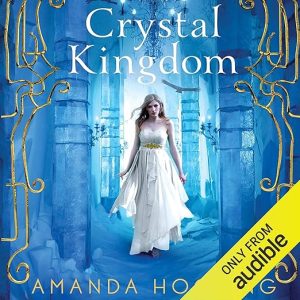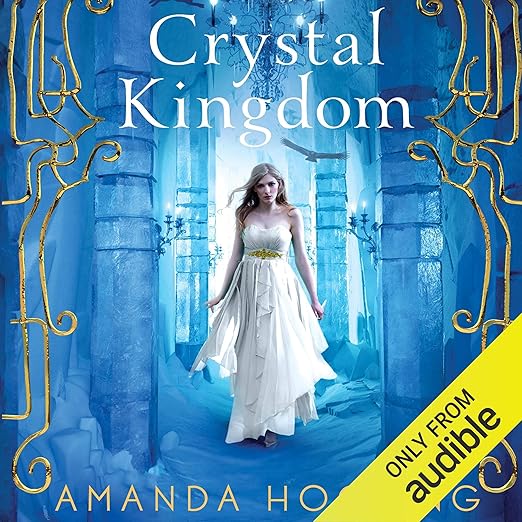
Bryn Aven is already running when this book starts, and Amanda Hocking never slows down to explain why. Crystal Kingdom opens on a fugitive charged with murder and treason, cast out of her own kingdom, whose only available ally is the person the copy itself calls her greatest enemy. It closes The Kanin Chronicles as volume three, the audiobook runs nine hours and twenty-three minutes, and Eileen Stevens is the credited reader. Nothing about the opening pretends you might be arriving new.
Where This One Lands
Trust is the mechanism of this volume, and the plot is built so that Bryn cannot dodge the question. Konstantin Black is described in the copy as her greatest enemy and her only ally in the same breath, which is clean engineering: every step toward clearing her name requires handing more of herself to somebody who has already betrayed her. A five-star from December 2015 states the stakes accurately, noting that Bryn is on the run after being mistakenly charged with treason and murder and must work with her enemy to save her kingdom, then recommends the series to anyone wanting a strong female lead alongside adventure, fantasy and romance. That is the right shelf for it.
Cover design by Lisa Marie Pompilio is the final line of the description, and it has no business being on an audio listing. That is a print jacket credit carried over wholesale, and its presence tells you the copy was lifted from the physical edition with nobody adjusting it for the format. The same paste-in explains a second problem. The synopsis asks whether Bryn can join forces with Finn Holms and the Trylle kingdom, two proper nouns the page never glosses, referenced as though a shopper already knows what the Trylle kingdom is and why Finn Holms matters, by a description that also credits the designer of a cover no listener will ever see.
Why Listen to Crystal Kingdom
Troll politics are what hold this series together, and the third book is where the culture pays off. A five-star from November 2015 puts it plainly, describing the pleasure of reading more about the troll culture, praising the characters, and reporting that the story moves at a good pace and ends very well. Hocking's trolls are political rather than monstrous: kingdoms, bloodlines, succession, alliances, and a war that has been gathering since the beginning. The payoff structure of a final book depends on exactly that groundwork, and the war here arrives as a consequence of things already established rather than as an escalation invented to give a finale something to do.
Momentum is what the recording has to protect. A book that opens mid-flight, with no recap and a cast carried over from two earlier volumes, leaves a listener nowhere to look anything up: no page to turn back to, no character list to check, no way to confirm whether Ridley Dresden was mentioned an hour ago or three. Eileen Stevens carries nine hours and twenty-three minutes of it, with invented proper nouns arriving at speed, among them Kanin, Trylle, Aven, Holms and Konstantin Black. What the material asks for above everything is consistency, since a name has to sound identical in the ninth hour and the first, and the listener has no other index to consult.
What Gives Us Pause
Entry point is the thing to settle before buying, and the pool agrees this is not one. A four-star from June 2016 calls it the final book in The Kanin Chronicles, describes being sad to see it end and wishing for twenty more, then summarizes what it wraps up: the ever-growing turmoil in the Kanin kingdom, plus a full-fledged war that Bryn finds herself in the heart of. All of that describes an ending, and endings require beginnings. Arriving here first means meeting Konstantin, Ridley and Finn already loaded with a history you do not have.
Not one of the five signed responses says anything about the recording. All five were written after this file was published in August 2015, between that month and August 2017, so chronology cannot account for the gap; the audio existed throughout and the writing simply never engaged with it. One five-star from August 2015 describes reading by the light of an e-reader and falling asleep holding the books, which is a print picture printed on an audio page. The five visible grades come to 4.8 between them, comfortably clear of the 4.6 the badge prints, so even the sample you can read is not the sample being counted. Out of 651 ratings, everything readable grades the story, the series and the author, and goes no further.
Should You Listen to Crystal Kingdom?
Close out the sequence here if you already own the first two, and expect the story to be genuinely finished when you do. An August 2017 five-star is emphatic to the point of comedy, admitting to rarely writing reviews at all, insisting the series delivers action, drama and more besides, and warning that the moment you think you know what happens it throws a twist at you. Underneath the enthusiasm sits a real observation: this volume keeps reversing, which is correct behavior for a book that has to resolve a war, a wrongful charge and a romance it has been deferring.
Wait on this if you have not read the first two Kanin books, because nothing in the packaging will orient you and the description leans on a second set of characters as well. Wait too if you want young adult fantasy without a body count, since this is the volume where the war becomes literal and the copy promises that nothing will ever be the same afterward. And if the recording itself is what you are trying to judge, take a sample rather than the star bar, because 651 ratings have produced nothing whatever about how these nine hours actually sound.
- Narration: Eileen Stevens credited alone for nine hours and twenty-three minutes of invented names, with no glossary or companion listed.
- Themes: Exile and false accusation, troll politics and succession, an enemy as the only ally, a war arriving on schedule
- Mood: Propulsive, cold, series-closing
- Verdict: A strong finish for readers already two books deep, and no place whatsoever to start.
A Few Questions About Crystal Kingdom
Do you need the earlier Kanin Chronicles books before this audiobook?
Yes. Crystal Kingdom opens with Bryn already charged, already fleeing and already dependent on an enemy, and no recap is offered at any point. The relationships that supply the tension were built in the first two volumes, and arriving cold means watching consequences resolve without knowing what earned them.
Who are Finn Holms and the Trylle kingdom?
The listing never says. The copy asks whether Bryn can join forces with them and then moves on, offering no gloss on the Trylle kingdom and no introduction to Finn Holms. Since the series fields point only to The Kanin Chronicles, working out where that material comes from is left entirely to you.
Is Crystal Kingdom the last book in the series?
Yes. The series fields mark it as number three in The Kanin Chronicles, and the copy promises an epic battle after which nothing will ever be the same. No fourth book appears in any field here, and the description is written as a conclusion rather than a pause.
Is the audiobook suitable for younger teenagers?
The genre field says teen and young adult, and the content runs to a war, a murder charge and a romance rather than anything graphic. No age band, content note or reading level appears on the listing, so a parent choosing for a younger reader gets nothing beyond that shelf label.