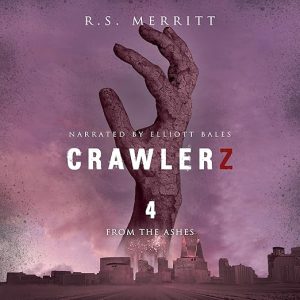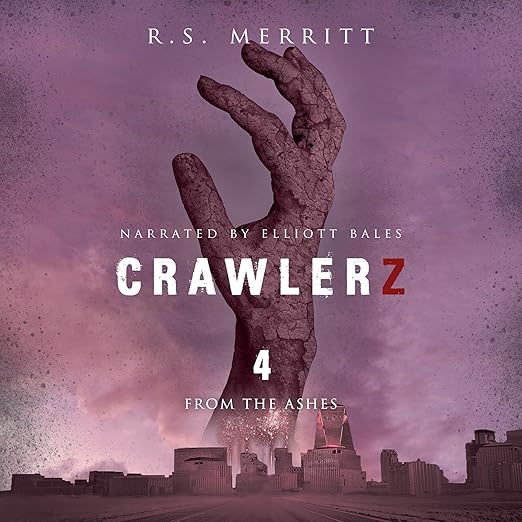
I came into Crawlerz at book four, which is not the ideal entry point for a series where the character relationships are as central as the world mechanics, and I knew that going in. What I found was something interesting: R. S. Merritt writes with enough ongoing momentum that the book functions as an action narrative even without the prior context, while clearly being designed for readers who have spent three volumes with Yue, Drew, and LeBron and know exactly what's at stake for them as people rather than as plot drivers. I'll acknowledge that context for everything in this review.
The premise has the clean, high-concept clarity that distinguishes the best YA speculative fiction from work that's merely using the genre as a coat rack for other ambitions: monsters imbued with superhuman strength and psychic terror, three siblings committed to fighting them even when the arithmetic of the fight suggests it's unwinnable. The soup spoon draining the ocean image from the synopsis is self-aware about the scale of what Yue, Drew, and LeBron are attempting, and that self-awareness is part of what makes the series work. These characters are not operating under the illusion that their efforts are proportionate to the problem. They're doing it anyway.
A Closer Look at Crawlerz
What distinguishes Crawlerz from the post-apocalyptic genre's default structure is the centrality of the sibling trio as a genuine social unit rather than an individual protagonist with loyal supporting characters. Merritt distributes agency among Yue, Drew, and LeBron rather than building the narrative around one hero whose moments of doubt and triumph carry the full emotional weight. This is harder to execute than it looks; the temptation in action-driven YA is always to let one character's arc dominate while the others provide support, humor, and occasionally sacrifice. Merritt largely resists this, which gives each sibling a distinct function and voice that extends beyond the immediate narrative moment.
Reviewers consistently noted that the book introduces new characters and advances multiple ongoing plot threads without feeling crowded, and that the core group continues developing rather than simply repeating their established dynamics. The political layer, which at least one reader found heavier than their taste, serves a real narrative purpose: the president who hopes the protagonists fail is a meaningful antagonist precisely because institutional failure and political betrayal are as real a threat as the Crawlerz themselves. Merritt is writing a post-apocalypse in which human systems are as dangerous as monsters, and that's a more sophisticated premise than most books in this genre operate with.
What Makes Crawlerz Worth Hearing
The Crawlerz broadcast waves of psychic terror in addition to their physical threat, and this element is the series' most interesting piece of genre worldbuilding. Horror that operates on a psychological level simultaneously with a physical one changes the nature of the protagonists' challenge in ways that keep the action sequences from becoming repetitive across four volumes. The siblings can meet physical threats with ammunition, planning, and preparation; psychic terror requires a different kind of resistance, something closer to internal resolve or collective will, and Merritt is thoughtful about how that distinction shapes what his characters have to develop over the course of the series.
The limited-ammunition constraint is not just a plot mechanism for generating tactical interest but a genuine structural feature of the book's conflict logic. The siblings cannot simply overwhelm the Crawlerz with firepower; they have to be strategic in ways that keep each engagement feeling specific rather than formulaic. This is the difference between a genre series that's thought through its mechanics and one that's inventing solutions to plot problems as it goes.
Things to Know Before Starting Crawlerz
One of the challenges of narrating YA post-apocalyptic fiction is maintaining access to the genre's characteristic energy, that forward momentum and emotional openness that distinguishes YA from its adult equivalents, while handling material that is genuinely dark in terms of its premise, its body count, and its implications about what human civilization can and cannot recover from. Bales manages the range with consistent skill. The sibling banter sounds authentically young without being condescending or cloying; the action sequences have the right kinetic quality; and the moments where the book slows down to let its characters reckon with what they're doing and why they're doing it are given appropriate weight without the performance becoming heavy-handed.
The narration handles the more overtly political passages, where Merritt is engaging with institutional betrayal and the question of who gets to define what survival means, with a clarity that keeps the ideas accessible rather than getting lost in the action around them. At over eight hours, this is a solid audiobook commitment, and Bales earns the time by keeping the energy consistent across the full runtime.
Who R S Merritt Is Writing For
Readers who have followed Yue, Drew, and LeBron from the beginning will find book four a satisfying and substantive continuation that develops both the world and the characters without losing the energy that made the early volumes work. One reviewer described it as a zombie apocalypse road map for survival with actual insight, which captures the combination of practical imagination and human understanding that makes the series function when it's at its best. Another described the book as a rollercoaster of neverending hope, which also captures something true about Merritt's tonal commitment: this is a series that refuses to give up on the possibility of human recovery even while documenting human catastrophe at scale.
First-time listeners should start with book one. The series has built something real across its volumes, and entering at book four means missing the foundation that makes the current stakes legible. But if you've been with these characters, book four does exactly what a good series installment should: it makes the next volume feel necessary.
Before You Listen
Is Crawlerz book four accessible as a starting point for the series, or is reading from book one essential?
Starting from book one is strongly recommended. The sibling relationships, world mechanics, and ongoing plot threads are developed across the earlier volumes, and jumping in at book four means missing the accumulated character investment that the series runs on.
How does the psychic terror element of the Crawlerz affect the book's genre classification, given that it's listed as YA?
The psychic element adds a psychological dimension to what is primarily a YA action-survival narrative. The book reads as YA adventure rather than horror, with the psychic threat functioning as a tactical and thematic complication rather than a source of sustained dread.
How does Elliott Bales handle the series' tonal range between sibling banter and genuinely dark material?
Bales maintains the series' characteristic forward energy while giving the more emotionally serious passages enough space. The balance between the YA register and the genuinely dark premise is handled without the performance feeling tonally inconsistent across the runtime.
Does the political subplot about an actively hostile government affect the main action narrative significantly?
It functions as an active obstacle and thematic concern rather than pure background. The institutional hostility the siblings face from their own government is a genuine plot driver, and Merritt uses it to make the post-apocalyptic stakes about human systems as well as monsters.