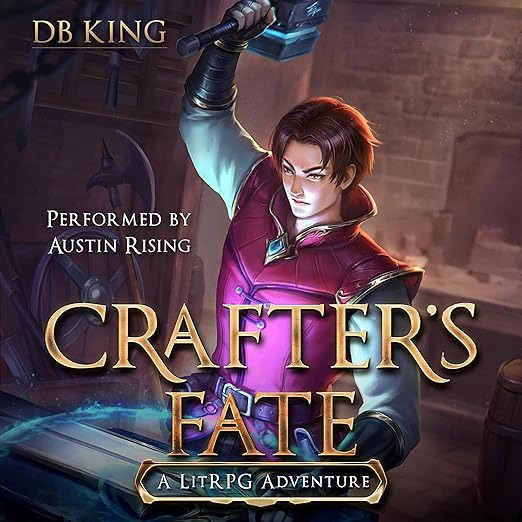
I was catching up on my LitRPG backlog on a Friday evening when I put on Crafter's Fate 1 by DB King, and I found myself still listening past midnight, not because the book is groundbreaking, but because it gets the fundamentals right in a way that a lot of genre entries don't. The crafting focus is the distinguishing feature here, and King uses it to build something that feels genuinely differentiated from the standard combat-heavy progression narrative.
Published by Royal Guard Publishing in December 2025 and narrated by Austin Rising, the first volume in the Crafter's Fate series runs to thirteen hours and thirty-eight minutes. It's a substantial investment for an opening book, but the length is used well, the world-building earns its space, and the system underpinning the crafting mechanics is developed with enough interiority that listeners feel they understand what Alastair can and can't do.
What DB King Delivers
The setup is familiar enough: a village decimated by a monster attack, two young men gifted with divine Fates, Alastair the Crafter, Damon the Hunter, and a world of monsters, rare materials, and other Fated individuals to navigate. What King does with this premise is where the book earns its readership. The crafting system is the star, not the combat. Alastair's ability to create enchanted gear of increasing complexity and rarity is the axis around which everything else turns, and the author invests serious attention in making that system feel internally consistent and satisfying.
The buddy structure between Alastair and Damon is one of the more functional friendships in the genre. They are genuinely complementary, the Crafter and Hunter classes are explicitly designed to balance each other, and their dynamic has an earned quality that distinguishes it from the expedient partnerships that populate lesser LitRPG series. One reviewer called their bond the book's real engine, which is right: the system is interesting, but the relationship is what makes the long listening experience feel personal rather than mechanical.
What DB King Gets Right
Austin Rising's narration is a confident match for the material. He brings energy to the action sequences without losing the quieter character moments, and his differentiation between Alastair and Damon, in tone, in pace, in the quality of attention he brings to each character's voice, helps the dual-protagonist structure feel clear rather than confusing across thirteen-plus hours. The production quality is clean, and Rising's voice has the right register for YA-adjacent LitRPG: energetic but not manic, accessible but not condescending.
A reviewer noted that the book is "young adult friendly, PG-13, but still deals with moral and social issues that need answered", this is worth flagging for listeners calibrating expectations. The violence of the origin story (a village massacre, the deaths of people Alastair and Damon know) is present but not graphic. The moral questions that arise from the boys' choices as they gain power are handled in a step-by-step reveal that feels appropriate to a coming-of-age story. Adult LitRPG readers should not expect the grittier or more explicit content that some series in the genre include.
Where DB King Loses Some Ground
One reviewer identified a real tension in Alastair's characterization: he acquires considerable power through his crafting ability but consistently fails to deploy it imaginatively. The reviewer's observation, that Alastair "limits himself severely because he won't use the full power", points to a character whose restraint can read as narrative convenience rather than genuine motivation. King resolves some of this by the end of the volume, but the criticism holds through the middle section. Listeners who like protagonists who press their advantages to the limit may find Alastair's caution frustrating.
There's also some unevenness in the emotional register. Reviewers note that characters alternate between "stilted and fully emotive", moments of genuine character development sit alongside exchanges that feel perfunctory or wooden. This is partly a genre characteristic: LitRPG often prioritizes system clarity over dialogue naturalism. But King's best moments, particularly in the relationship between the two leads, show enough potential that the uneven stretches feel like a craft issue rather than a fundamental limitation.
Who Should Pick Up Crafter's Fate 1: A LitRPG Adventure
This is well-suited to LitRPG readers who want their progression fantasy to emphasize creation and support roles rather than pure combat, and to listeners who prefer their genre fiction to stay YA-appropriate in content even as it handles genuine themes. Fans of dual-protagonist adventure narratives will find the Alastair-Damon dynamic more satisfying than many similar setups. Experienced LitRPG readers who want a more aggressive or complex protagonist may find Alastair's restraint limiting, and those looking for adult-oriented content should look elsewhere in the genre.
- Narrator: Austin Rising handles the dual-protagonist structure cleanly, differentiating Alastair and Damon without overplaying the distinction; his energy suits the action-driven pacing.
- Subjects: Crafting and progression systems, friendship forged through shared trauma, the balance between creation and combat
- Tone: Propulsive and cheerful, with darker edges at the origin
- Bottom line: A solid LitRPG debut that leans into crafting mechanics and buddy-adventure dynamics more than most entries in the genre.
Common Questions
Is the crafting system in Crafter's Fate 1 explained clearly enough to follow in audio format?
Yes. The system is introduced progressively, with enough internal logic that the audio format handles it well. Unlike some LitRPG series where status screens and stat tables become difficult to follow without visual formatting, King's crafting mechanics are described through action and outcome rather than dense tabular data. The audio experience is smooth.
Does Crafter's Fate 1 work as a standalone or is the ending a hard cliffhanger?
Based on reviewer responses, the first volume provides enough resolution to function as a satisfying read-in-isolation while clearly establishing setup for the series. No reviewer describes being left on a disorienting cliffhanger, though the world and characters are clearly positioned for continuation.
Is this series appropriate for younger listeners given the YA-adjacent content?
Yes. Reviewers explicitly describe it as young adult friendly and PG-13 in content. The origin story involves violence but handles it without graphic detail, and the moral questions raised by the progression of the two protagonists are addressed thoughtfully rather than exploitatively. It's been recommended as suitable for teen readers as well as adults.
How does Austin Rising's narration handle the distinction between Alastair and Damon across a 13-hour runtime?
Rising maintains clear vocal differentiation between the two leads throughout the runtime. Reviewers who note the book's enjoyability as an audio experience credit the narration with making the dual-protagonist structure easy to follow. The distinction is in tone and energy rather than exaggerated character voices, which suits the material's naturalistic approach.