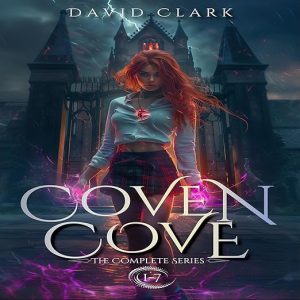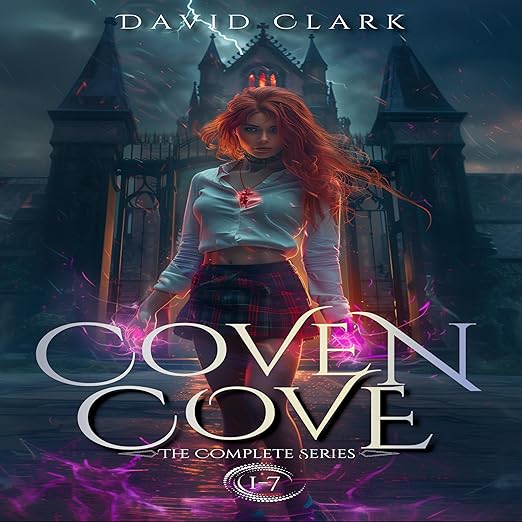
Larissa Norton's predicament at the opening of David Clark's Coven Cove series is one of the more dramatically loaded premises in recent YA urban fantasy: she is both a witch and a vampire, and both communities want her dead. This audiobook, narrated by Mel Heflin, collects the complete Coven Cove series into a single fifty-seven-hour listening experience. That commitment will either reward patient fans of supernatural coming-of-age fiction or test the limits of goodwill when the prose's documented rough edges accumulate over a runtime of nearly two and a half days. Clark's story has genuine appeal - the dual-heritage premise, the New Orleans setting, the politically textured villain - and Heflin's narration brings consistency to the full arc. But the audiobook's strengths and weaknesses both amplify across its length.
Clark's central hook is genuinely strong. Larissa's dual-heritage identity is not simply a metaphor for belonging nowhere, though it functions as one throughout. Her vampire parents are murdered early in the first book, she flees into hiding, and she discovers that her real name is Larissa Dubois - a powerful witch born in 1920s New Orleans, carrying a lineage and a power set that the vampire antagonist Jean St. Claire wants to exploit for dominance over the city. The New Orleans setting, the generational layer to the mystery, and the presence of a villain with specific political ambitions give the series more structural complexity than a simple chosen-one narrative would provide.
The complete series format delivers something individual volumes cannot: the full arc of Larissa learning to harness her abilities, navigate competing loyalties within the hidden sanctuary for supernatural beings, and move toward a confrontation with St. Claire that has been built across multiple installments. Reviewers who tore through the series and immediately wanted more note the addictive pacing - Clark constructs chapters that resist stopping points, which in a listening context means the fifty-seven hours will move faster than the runtime suggests. The supernatural community at the sanctuary provides an ensemble whose competing agendas keep the middle sections from sagging, and the betrayal thread running through the full arc - who among Larissa's allies can actually be trusted - has genuine payoffs in the later volumes that justify the tension Clark maintains throughout.
Why Coven Cove: The Complete Series Works as an Audiobook
Mel Heflin's narration serves the YA register Clark is writing in: direct, emotionally transparent, and pitched at the breathless quality that defines the genre at its most commercially effective. Heflin does not impose a theatrical overlay on the material - the performance stays grounded in Larissa's perspective, which is important for a protagonist whose interiority is the primary navigation tool through a complex supernatural landscape. Across fifty-seven hours, a narrator who maintains character consistency without flattening the emotional variation between volumes is an asset, and Heflin manages that consistency in a way that keeps the full arc from feeling like a single undifferentiated mass of incident.
One issue reviewers have flagged is worth addressing directly: the series carries grammatical errors and editing inconsistencies that surface across the text. At least one reviewer deducted a star specifically because of what they described as a need for "serious editing." In audio form, these issues can manifest as awkward phrasing or moments where the prose rhythm breaks unexpectedly. Heflin handles these passages as smoothly as narration can, but listeners with strong sensitivity to prose clarity should factor that feedback into their decision. The story itself - the evolution of Larissa's powers, the St. Claire confrontation, the question of trust - holds up across the full series even where the sentence-level execution does not.
Weak Spots in Coven Cove: The Complete Series
The New Orleans supernatural underground is one of the series' most consistent pleasures. Clark has constructed a world where vampire and witch communities have their own political structures, histories, and grievances that predate Larissa's arrival, and Jean St. Claire works as a villain specifically because his ambitions have a legible power logic rather than generic menace. Watch for the way Larissa's 1920s New Orleans origin is woven into her present-day identity - the generational layer to her heritage is what distinguishes her from the typical dual-identity YA protagonist, and Clark uses it more effectively as the series develops across multiple volumes.
The complete series format means listeners begin with Larissa's immediate crisis and follow her through the full resolution of confronting St. Claire and establishing her place in the supernatural community. Arriving at the conclusion of a fifty-seven-hour listening journey with the central conflict resolved is a different experience than reading individual volumes separately, and for listeners who prefer to absorb a complete narrative before the investment of the next chapter in a series, the box set format is the right choice here.
The Right Listener for Coven Cove: The Complete Series
YA urban fantasy readers who enjoy supernatural fiction centered on a female protagonist with a layered dual identity will find the core premise well-executed. Fans of vampire-witch conflict narratives in the tradition of L.J. Smith or early Cassandra Clare will recognize the genre touchstones Clark is working with. Listeners committed enough to the premise to invest fifty-seven hours will get the complete arc in one purchase. Those with low tolerance for editorial roughness in prose, or who expect YA urban fantasy to be polished to a contemporary commercial standard, should weigh the reviewer feedback on that point carefully before committing to the full series length. The story is there; the surface finish is inconsistent.
Key Details
- Voice: Mel Heflin sustains Larissa's perspective across the full series run, managing the tonal demands of a supernatural YA narrative that spans vampire-witch politics, romance, and coming-of-age without collapsing into monotone.
- Big ideas: Dual supernatural identity, betrayal and trust, coming-of-age under magical threat
- Atmosphere: Gothic and urgent with a teen emotional register throughout
- Worth it?: At fifty-seven hours, this complete series box set offers substantial immersion for YA urban fantasy fans, though editorial roughness noted by reviewers is present throughout.
Before You Listen
Does this audiobook contain all the Coven Cove books?
Yes. Coven Cove: The Complete Series is a box set collecting the full series in a single audiobook that runs approximately fifty-seven hours. It takes Larissa's story from the murder of her vampire parents through the full confrontation with Jean St. Claire and her establishment within the supernatural community.
Is the audiobook appropriate for younger YA readers, or is it aimed at older teens and adults?
Coven Cove is written in the YA register and is primarily aimed at teen and young adult readers. The series involves supernatural violence, betrayal, and some romantic content. Parents of younger teens should preview before allowing unsupervised listening, though the content is broadly within YA norms.