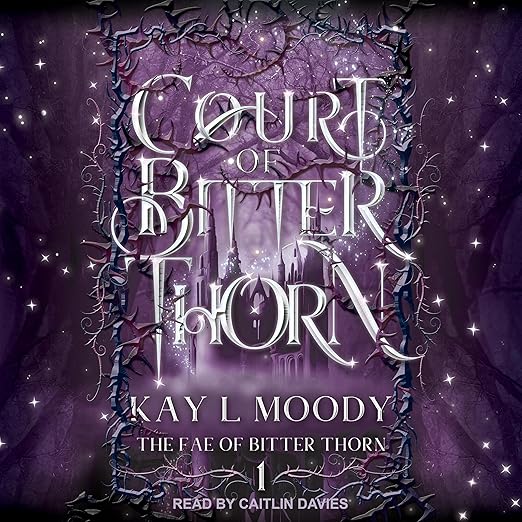
- Performance: Caitlin Davies brings warmth and edge to Elora's voice, handling the tension between the protagonist's strategic scheming and her reluctant emotional vulnerability with consistent effectiveness.
- What it covers: fae bargains and betrayal, loyalty to family versus the world, love that complicates convenience
- Feel: Atmospheric and morally slippery, with a slow-building romantic tension that earns its payoff
- Our call: A well-constructed fae fantasy debut that surpasses its familiar setup through sharp character dynamics and a second act that rewards patient listeners.
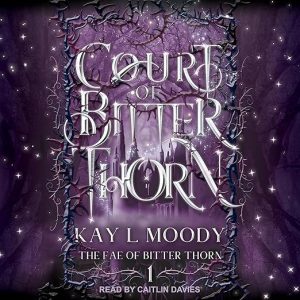
Elora did not choose to be in Faerie. She was tricked into it by a fae prince, bound by the terms of a bargain, and now she cannot return to the mortal world until Prince Brannick either wins the High King's throne or is removed from contention. For Elora, whose younger sisters are in the mortal world depending on her, the fastest option is obvious: sabotage the prince rather than help him. Sell his secrets to the highest bidder. Get home faster. Court of Bitter Thorn by Kay L. Moody, the first audiobook in the Fae of Bitter Thorn series, builds its most compelling tension in the gap between Elora's strategic ruthlessness and what she actually does when the stakes become personal.
The premise sits comfortably within the human-in-Faerie subgenre that Holly Black and later Sarah J. Maas made popular at scale. One reviewer draws an explicit comparison to The Cruel Prince, citing the strong female character, the male character designed to initially read as an antagonist but reveal depth, and the parallel fae world built with genuine attention. The comparison is fair. Moody is working within a tradition, and the question with any work inside a tradition is not whether it innovates radically but whether it executes well and adds something specific. Court of Bitter Thorn does both.
A Closer Look at Court of Bitter Thorn
Caitlin Davies narrates the audiobook across just over eight hours, and her performance is well suited to a first-person narrative built around a protagonist who is constantly calculating. Elora is never fully letting her guard down, not even when she is letting her guard down, and Davies conveys that layering without making Elora seem merely cold. The emotional undercurrent is always present. The defenses are just very good.
Reviewer alexiophiles admits that the story took time to establish its footing, and that observation is honest and useful for prospective listeners. The early sections of Court of Bitter Thorn are more workmanlike than later chapters: Elora arrives in Faerie, the rules of the bargain are established, the training arrangement with Brannick begins. The narrative mechanics of this setup are familiar enough that a reader who has consumed the genre extensively may find the opening movement paced for patience rather than pace. The payoff, when Brannick begins to function as an actual character rather than a placeholder for romantic tension, justifies the investment.
What Makes Court of Bitter Thorn Worth Hearing
The sword training dynamic, Elora using her combat skills to prepare the prince she is simultaneously betraying, is the book's best structural choice. It creates a relationship that is obligatory, adversarial, and increasingly genuine all at once, and Moody exploits the built-in tension of that arrangement effectively. Every session is a small negotiation between what Elora is willing to give away and what she is keeping. The prince's response to her, his reading of her, matters in ways that complicate her plan without invalidating it.
The world-building is economical rather than exhaustive. The politics of the fae courts are established clearly enough to generate stakes without the narrative pausing for exposition dumps. Brannick's position within the succession politics, the rival king whose plans Elora is considering facilitating, the general landscape of court relationships: all of this is legible. Moody trusts readers to assemble the world from story rather than from descriptions.
Things to Know Before Starting Court of Bitter Thorn
Reviewer Carola is honest about finding the first portion of the book slow, noting that the story accelerates substantially once the fae prince is fully present as a character. That transition point, where Brannick ceases to be a tactical obstacle and becomes a full participant in the narrative, is worth marking. The audiobook's back half is where Court of Bitter Thorn distinguishes itself from more generic examples of the genre, and arriving at that half with sufficient trust to engage fully makes the experience substantially more rewarding.
The choice Elora ultimately faces, her sisters' survival versus the fates of half the inhabitants of Faerie, is the book's moral center. It arrives late and it arrives hard. Moody has been setting up this dilemma through the entire narrative without making it feel engineered, and the moment when both options are visible and both are real choices is the audiobook's most effectively written passage. A certain prince complicating the calculation is handled with more emotional intelligence than the genre convention usually receives.
The series continues beyond this first volume, and Court of Bitter Thorn functions as it should: a complete enough story to satisfy the immediate experience while establishing a world and a set of relationships that create genuine appetite for what comes next. Reviewer Customer from Kindle who cited this alongside The Cruel Prince notes that the novel hits the major notes of that tradition: the check list of qualities that make fae romance work at its best. Court of Bitter Thorn checks them reliably.
Who Kay L. Moody Is Writing For
This audiobook is for listeners who have responded to Holly Black's The Cruel Prince, Sarah J. Maas's Court of Thorns and Roses series, or Julie Kagawa's Iron Fey books and are looking for more in that vein. The familiar structural moves of the human-in-Faerie subgenre are all present, and Moody executes them with enough character investment to make the formula feel inhabited rather than mechanical.
Listeners who are fatigued by fae romance conventions or who find the initial slow build frustrating rather than productive will likely be less patient with the book's first act. Those willing to commit through the setup will find a second half that delivers on the character promise established in the opening and leaves the series on solid ground for its continuation.
Is Court of Bitter Thorn audiobook appropriate for someone new to fae fantasy romance?
Yes, though it is worth knowing the genre conventions it works within. Human protagonist trapped in Faerie by a bargain, complex fae love interest, competing courts with political stakes: these are established genre patterns. Moody uses them competently, and the book works well as an entry point for readers new to this subgenre.
How does Caitlin Davies' narration handle the dual nature of Elora's character in the audiobook?
Davies balances Elora's strategic exterior and emotional interior effectively throughout. Elora is simultaneously scheming against Brannick and involuntarily developing feeling for him, and Davies conveys that contradiction without making either mode feel false or forced.
Is there a slow start to the Court of Bitter Thorn audiobook, and is it worth persisting through?
Several reviewers note the opening movement is more deliberate than the later sections. The worldbuilding and bargain mechanics require establishment before the character dynamics can fully activate. Listener consensus suggests the second half justifies the patience required in the first, particularly once Brannick's character becomes fully dimensional.