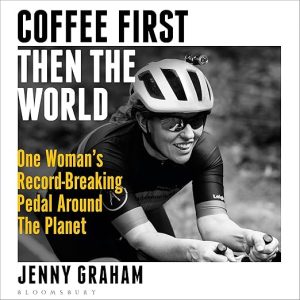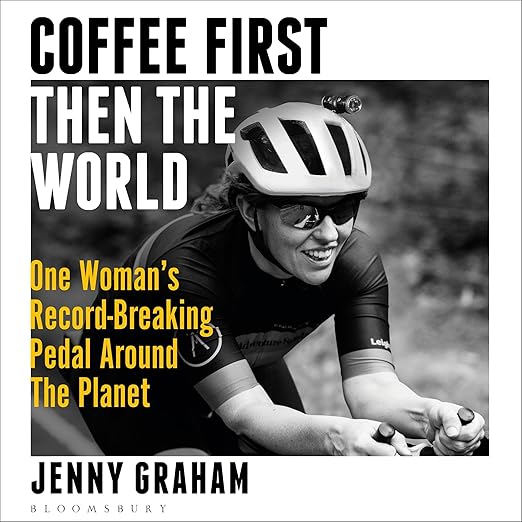
I finished Coffee First, Then the World on a Sunday afternoon, having started it the previous Thursday morning during a particularly long stretch of train travel. This is the kind of audiobook that makes long journeys feel shorter, which is an almost obscene thing to say about a book describing 18,000 miles of solo cycling across sixteen countries. Jenny Graham covered in 124 days what I was covering in three hours, and she did it alone and unsupported. I sat with a coffee and my train seat and found myself periodically embarrassed by the comparison.
Graham set the record for the fastest unsupported solo circumnavigation of the globe by bicycle in 2018, finishing at the Brandenburg Gate in Berlin and beating the previous female record by nearly three weeks. She was an amateur, not a sponsored professional athlete. She funded the trip herself, fixed mechanical failures on the road with whatever she could find, slept on roadsides, and rode through the night repeatedly to stay on schedule. The memoir describes all of this with a quality I would call disarming honesty: she does not glamorize the suffering or minimize it, and she is equally candid about the moments when she considered stopping.
How Coffee First, Then the World Holds Up
The word amateur deserves more attention than it usually gets in discussions of endurance sport. Graham is described by reviewers as authentically self-motivated, without the ecosystem of sponsorships, support crews, and media management that surrounds most record attempts of this kind. That absence of professional apparatus gives the memoir a texture that more polished adventure books typically lack. When her bike breaks down in Russia, the repair is genuinely improvised. When she runs low on money, the shortage is real. When she makes a questionable decision about routing in Australia during temperature extremes, you believe it was a questionable decision rather than a manufactured narrative tension.
Mark Beaumont, who holds the male record for the same circumnavigation, is quoted describing the book as brilliant, and that endorsement from someone who has done the same journey is worth noting. Beaumont's own circumnavigation was heavily supported and professionally managed; Graham's was not. The books they have written about their respective journeys are consequently quite different in character, even though the route is superficially similar.
Why Coffee First, Then the World Works as an Audiobook
Graham crossed four continents and sixteen countries: road collisions in Russia that she describes with unsettling casualness, weather extremes in Australia where the temperature variation pushed into physical danger, the landscapes of Mongolia that multiple reviewers cite as the book's most beautiful section, and wildlife encounters in North America that she describes with the same mixture of delight and pragmatic caution that characterizes her voice throughout. The book is not organized as a country-by-country travelogue but as a cumulative experience of what it is to be alone on a bicycle for four months, which is a better choice for the material.
The shortlisting for the Sports Book Awards 2024 Cycling Book of the Year and its selection for the BBC and Reading Agency's Big Sporting Read 2024 reflect a book that the cycling community has claimed as its own while also crossing over to readers with no particular interest in cycling. One reviewer described it as perfect for the biker, runner, or athlete in your life, and the authentic self-motivation at its core makes that broader appeal understandable. You do not need to care about cycling speeds or gear ratios to find Graham's experience of the world, specifically her openness to connection with strangers across cultures, compelling.
Weak Spots in Coffee First, Then the World
Graham wrote and reads the book herself, and the combination of those two facts produces something specific. She is not a trained narrator, and her delivery occasionally runs slightly faster than optimal for complex logistical passages. But the Scottish directness in her voice is exactly right for material that is fundamentally about someone who does difficult things without fuss. There are moments when she describes near-disasters, a night riding blind in Russia, a mechanical failure at the worst possible time, where her flat delivery makes the danger more vivid than theatrical performance would have. The understatement is the point.
At eleven hours and thirteen minutes, the audiobook is the right length for the journey it describes. The book does not pad its narrative with philosophical digression or reflective chapters that break the forward momentum. Graham is in motion for most of the book, and the pacing reflects that. The exception is the final section, where the approach to the Brandenburg Gate allows for some reflection, and where the emotional release of completion is handled with exactly the restraint you would expect from someone who has been containing everything for four months.
The Right Listener for Coffee First, Then the World
If you cycle and have ever thought seriously about a long-distance tour, this book will both inspire and usefully terrify you. Graham's account of the mechanical realities, the sleep deprivation, and the physical accumulation of 18,000 miles is not romanticized, and the result is a memoir that respects the reader enough to describe what the achievement actually cost.
If you do not cycle, the book works as a story about a specific kind of determination and a specific kind of freedom. Graham talks about the joy of the adventure opening up despite and because of the difficulty, and that progression from anxiety to presence to genuine delight is the book's emotional arc regardless of what vehicle you prefer. Lorraine Kelly is quoted calling it an amazing adventure that left her in total awe. That reaction seems about right.
At a Glance
- Voice: Jenny Graham reads her own memoir with the same direct, unguarded quality her writing has; the Scottish accent and self-deprecating humor carry across fourteen countries and 124 days.
- Big ideas: Endurance and the acceptance of discomfort, female ambition in a record-setting context, the unexpected joy of human connection across borders
- Atmosphere: Physically exhausting and quietly triumphant, with enough honesty about suffering to make the achievements feel real
- Worth it?: One of the more honest cycling memoirs you will find, written by someone who seems genuinely surprised by what she accomplished and equally surprised by how much she enjoyed parts of it.
A Few Questions About Coffee First, Then the World
Does this audiobook work for non-cyclists, or is it primarily for the cycling community?
It works well for both. The cycling-specific content, gear, mechanical failures, route strategy, is present but not dominant. The book's central concerns are human connection, physical endurance, and the experience of solo travel across cultures, all of which translate well outside the cycling world.
How does Jenny Graham's self-narration compare to a professional narrator?
Her delivery is slightly faster than optimal in complex passages, and she is not a trained narrator. But the Scottish directness and self-deprecating humor in her voice are exactly right for the material. The understatement she brings to near-disaster moments is more effective than theatrical narration would have been.
Is the book suitable for younger listeners or teenagers interested in adventure sports?
Yes. The book does not contain explicit content and its message about self-belief, improvisation under pressure, and openness to unfamiliar cultures is well suited to young listeners interested in outdoor adventure or endurance sports.