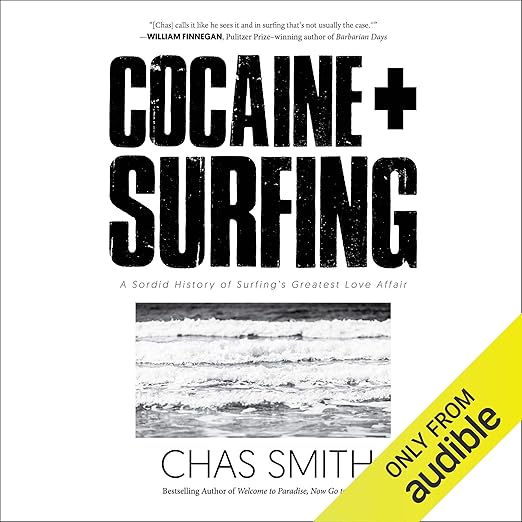
Chas Smith's Cocaine + Surfing takes its title literally and metaphorically in equal measure, and the audiobook format, with Tom Pile narrating, is where Smith's prose style finds its best delivery mechanism. Smith writes in a register that owes something to Tom Wolfe and something to New Journalism's tradition of embedding the writer's own absurdity into the material, and Pile reads it with the detached amusement of someone watching an industry eat itself. From the opening context, which traces surf culture's transformation from mild outlaw image to billion-dollar brand machinery, the book is doing real cultural analysis dressed in deliberately provocative clothing.
Our Take on Cocaine + Surfing
The core argument is more interesting than the title implies. Smith is interested in the gap between surf culture's external image, Kelly Slater and Laird Hamilton and clean living and positive affect, and its internal reality, which moved from beer and weed to cocaine with the same speed and decisiveness that the industry moved from local board shops to Midwestern mall stores. The corporate sanitization of the public image happened precisely as the private culture was accelerating in the opposite direction. That tension, between what the surf brands need outsiders to believe and what actually happens at parties, on boats, after contests, is Smith's real subject.
He draws on his position as an insider outsider, close enough to the culture to have access, iconoclastic enough to be willing to write it down. The PEN Center USA Award nomination for nonfiction that went to his earlier book Welcome to Paradise, Now Go to Hell suggests he has a track record of doing this kind of embedded cultural reporting with enough craft to get the literary community's attention. Cocaine + Surfing is the same approach applied to a more specific and more taboo subject. The book does not aim to comprehensively document the surf industry's drug history. It uses cocaine as a lens, Smith's phrase is "the vehicle," to expose what the industry's carefully maintained public persona is designed to hide.
Why Listen to Cocaine + Surfing
The audio format suits the material well. Smith's writing is anecdotal and associative rather than argued in the conventional nonfiction sense, which means it benefits from the momentum of continuous listening rather than the start-stop rhythm of reading. Pile's narration treats the more outrageous anecdotes, the overdoses, the cover-ups, the bar fights that ripple through the industry without ever reaching mainstream coverage, with the same level tone as the cultural analysis, which is the right call. Playing the scandals for dramatic effect would undermine the deadpan quality that makes the book funny and unsettling at once.
Reviewers who describe it as one of the most fun reading experiences in years and as educational about a culture they had no prior context for are describing two legitimate but different uses of the same book. It works as entertainment and as genuine cultural reporting, and it is rare to find nonfiction that does both with equal competence. One reviewer who notes they could not wait to finish it, who found the style not to their taste, represents a real population: Smith's voice is specific and will not work for everyone. Seven-plus hours is a meaningful commitment to a style that either clicks for you or does not.
What to Watch For in Cocaine + Surfing
The book is not a comprehensive history of surf culture, and it does not aim to be. Smith assumes a baseline familiarity with the major figures and brands of professional surfing, and listeners with no prior knowledge of the sport will need to let some references wash over them. The cultural argument holds without that knowledge, but some of the satirical edge depends on knowing who Kelly Slater is and why the comparison between his image and the reality Smith describes is funny rather than just strange.
The structure is more essay-collection than narrative arc. Smith circles his central thesis rather than building toward a revelation, which suits the material but can feel digressive in the middle sections. Listeners who want a tightly plotted nonfiction investigation with a clear climax should know going in that this is not that kind of book.
The comparison to Tom Wolfe that Smith's work invites is worth examining. Wolfe embedded himself in subcultures and wrote from inside the vernacular, and Smith does something similar, but with a more overtly comedic and self-aware relationship to his own position as insider-outsider. Smith is not pretending to be a surfer who happens to write. He is a writer who has spent time in surf culture, and the book's perspective reflects that positioning honestly. This means the book's limitations are also its honesty: Smith sees the industry from a vantage point that is close enough for access and far enough for irony, and that specific angle is both what makes the book interesting and what it cannot fully transcend.
Pile's narration has the additional quality of making the book's tonal variety legible. When Smith shifts from cultural analysis to an extended set piece about a particular party or event or industry figure, Pile shifts with him without losing the thread of the larger argument. The book's associative structure, which circles its thesis from different angles rather than building toward a single revelation, requires a narrator who can signal those shifts without creating whiplash. Pile does this consistently across the full seven hours.
Who Should Listen to Cocaine + Surfing
This audiobook rewards listeners who enjoy cultural journalism with a gonzo sensibility, who are interested in how industries construct and maintain their public images against internal reality, and who can appreciate dark comedy as a mode of serious analysis. Prior interest in surfing is useful but not essential. The book is not for listeners who want a conventional sports history, a cautionary tale about drug use, or a sympathetic portrait of the surf industry. Smith is not any of those things. He is a very specific kind of writer doing a very specific kind of thing, and if that thing appeals to you, seven hours goes fast.
The Short Version
- Voice: Tom Pile delivers Chas Smith's gonzo prose with the right measure of wry distance, keeping the absurdity intact without tipping into parody.
- Big ideas: Counterculture mythology versus commercial reality, addiction as industry metaphor, the gap between image and practice
- Atmosphere: Darkly funny and slightly unhinged, like a very well-informed bar conversation that gets more interesting the longer it goes on
- Worth it?: Smith's investigation of cocaine and surf culture is a sharper piece of cultural criticism than its title suggests, and it holds up in audio because the writing has genuine voice.
Before You Listen
Do you need to know anything about surfing to appreciate the Cocaine + Surfing audiobook?
Basic familiarity helps, particularly with names like Kelly Slater and Laird Hamilton, whose public images are part of what Smith is satirizing. The broader cultural argument about image management versus internal culture is legible without prior surf knowledge, but some of the sharpest observations will land harder if you know the territory.
Is Cocaine + Surfing a serious piece of cultural criticism or primarily entertainment?
Both, and that is not a contradiction. Smith uses the framework of cultural journalism to make a real argument about the gap between surf culture's manufactured public image and its private reality. The entertainment comes from how he delivers that argument, with gonzo prose and deadpan absurdism that the PEN Center USA nomination for his earlier book suggests the literary community takes seriously.
How does Tom Pile's narration handle the more outrageous anecdotes in the audiobook?
Pile narrates with a level, dry tone that suits Smith's style. He does not amplify the scandal elements for dramatic effect, which would undercut the book's deadpan quality. The more extreme material, overdoses, cover-ups, violence, lands harder because of that restraint.
Is Cocaine + Surfing audiobook suitable for someone who does not use or approve of drug use?
The book does not endorse cocaine use. It uses the drug as a cultural and industrial metaphor to analyze how the surf industry's public image diverges from its internal culture. Listeners who prefer not to engage with substance-related content extensively should note that it is the central subject for seven-plus hours, not incidental material.