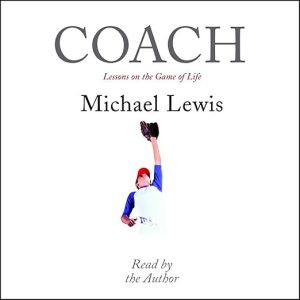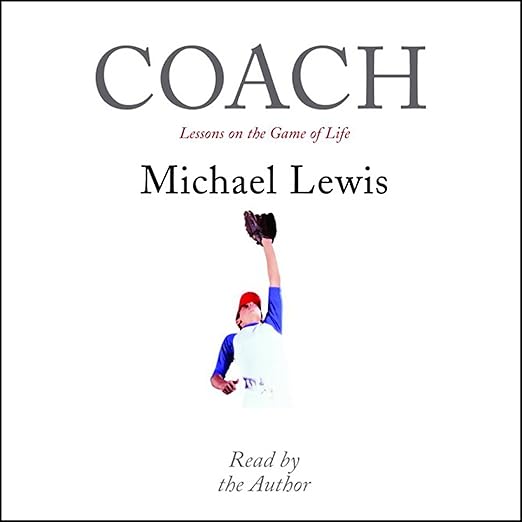
I listened to Coach twice in the same afternoon. The first time because it was under an hour and I had the time. The second time because something in it had landed in a way I wanted to revisit. Michael Lewis is not in the habit of writing short things; his books are typically long, researched, and wide-angled. Coach is the exception: a personal essay about a baseball coach who changed his life when he was fourteen years old, told with the kind of restraint that suggests Lewis understood this story did not require amplification.
Coach Fitz was the irascible, often terrifying coach at Lewis's New Orleans prep school. The turning point the book circles is a single baseball game where Fitz put the ball in a fourteen-year-old Lewis's hand with everything on the line, and managed to convey such complete trust in the boy's ability that the boy found he had no choice but to rise to it. That moment, and the philosophy behind it, is what Lewis spends an hour unpacking in the most personal terms. He is still, thirty years later, trying to measure up to what Coach Fitz expected of him.
What makes this essay more than nostalgia is Lewis's analysis of what Fitz was actually doing in that high-pressure moment. The coach's message, as Lewis reconstructs it in adulthood, was not about winning. It was about self-respect, sacrifice, courage, and endurance. These are words that can sound hollow when deployed as lessons, but Lewis locates them in the specific, physical, time-pressured reality of a fourteen-year-old standing on a pitcher's mound with his coach watching. The abstraction becomes concrete, and the concrete moment carries the abstraction without effort.
Lewis also observes something important about how the cultural context has shifted. The kind of demanding, unsentimental mentorship that Fitz practiced, that terrified children into performing beyond their own self-assessed limits, is harder to sustain in an environment shaped by over-protective parenting and the anxiety of affluent modern families. He does not argue that Fitz's approach was always benign or that it would suit every young athlete. He argues that something valuable was lost when it became unsustainable. That is a more complicated point than the essay's brevity might suggest it is going to make.
Why It Works in Audio
Lewis narrating his own memoir is the right call here. His Southern cadence carries the New Orleans setting and the social textures of the prep school environment without requiring description. His self-deprecating humor, particularly when recalling his own adolescent limitations and fears, makes him a reliable narrator precisely because he is not flattering himself. And his obvious emotion about the subject, thirty years removed from the events, is audible without tipping into sentimentality.
Reviewers consistently note that the brevity is appropriate rather than insufficient. One reader points out that the story has been told at exactly its proper length, that there is no inflation for page count, no detour that serves anything other than the central memory. That is high praise in a genre full of books that could be half as long. At under an hour, Coach can be listened to in a single sitting, and several reviewers report returning to it multiple times. That rereading impulse is the clearest sign that the book contains more than its length suggests.
Things to Know Before Starting Coach
Listeners expecting a full-length sports memoir will need to recalibrate before they start. This is a personal essay, not a narrative arc with rising and falling action and a climactic resolution. It stays close to a single relationship and a single formative moment. Readers looking for context about Lewis's subsequent career or about the broader culture of high school athletics in New Orleans will find only tangential references.
Lewis also makes observations about modern parenting and over-protection that some listeners may find more provocative than intended. His argument is nuanced, but it moves quickly in a short space, and some of the implications about what children need from demanding adults are not fully developed. That is the cost of brevity.
Who Will Get the Most From It
This is the audiobook to send to a young athlete in your life, or to anyone who has a mentor figure they are still measuring themselves against decades later. It works as a gift, as a listen for coaches and teachers who want to think about long-term influence, and as a brief but serious meditation on how the adults in a child's life shape the adults those children become. Michael Lewis fans who have read his journalism and longer nonfiction will find this an unusually intimate window into the person behind the analysis. Do not let the running time fool you into expecting less than it delivers.
In Brief
- Read by: Michael Lewis reading his own memoir delivers the intimacy and self-deprecating humor this personal essay demands - his Southern cadence adds something no studio narrator could replicate.
- At its heart: Mentorship and lasting influence, youth sports and self-belief, the adult reckoning with formative figures
- Vibe: Warm, reflective, and cleanly moving without being sentimental
- Short version: In under an hour, Lewis crystallizes something true about the adults who shape us and the standards we spend decades trying to meet - brief, but it earns its brevity.
Frequently Asked Questions
Is Coach long enough to justify an audiobook purchase?
At just under an hour, it is one of the shortest audiobooks available. Multiple reviewers report listening to it more than once, which suggests the content justifies the time commitment well. At its free Audible price point, the length is not a financial consideration.
Does Michael Lewis's self-narration work for this personal essay format?
Very well. His Southern cadence, self-deprecating delivery, and evident emotional investment in the subject add layers that a professional narrator could not reproduce. Reviewers consistently describe the self-narration as integral to the experience.
Who is Coach Fitz and what happened to him after Lewis's time at the school?
Coach Billy Fitz was the baseball coach at Lewis's New Orleans prep school. The book follows up on Fitz's later years and what became of him, using that retrospective to deepen the portrait of a man who shaped students across many years. Lewis tracks what he can about Fitz's legacy beyond their own relationship.