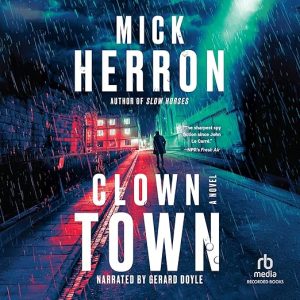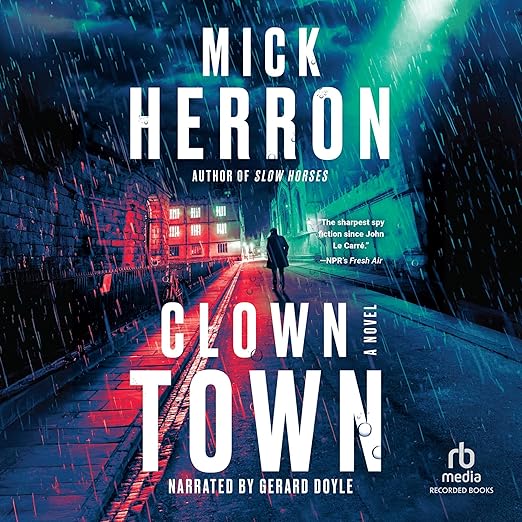
I finished Clown Town on a Sunday night and sat with it for a while before picking up anything else. That is not something I do with every series entry, even for series I love. But Mick Herron has done something with this ninth installment that I did not expect: he has made Diana Taverner pay. Not in the way thriller series usually exact payment from their morally compromised characters, not with exposure or exile, but in the specific, private way that makes a Slough House reckoning different from anyone else's reckoning. I listened to the final hour while making dinner and burned something I was not watching closely enough.
The setup sends River Cartwright, on medical leave and waiting for clearance to return to work, into his dead grandfather's library. David Cartwright, the former head of MI5 who spent years telling River that old spies become ridiculous clowns, has left the library to the Spooks' College in Oxford, and a missing book, or possibly a book that never existed, pulls River into an investigation that connects to an operation from the height of the Troubles. Meanwhile, Diana Taverner has identified a threat from that same buried operation and developed a scheme that requires a dupe. Jackson Lamb has, officially, no intention of sending his slow horses anywhere near it.
Where This One Lands
The title does the structural and thematic work of the whole novel in two words. David Cartwright's observation that old spies grow ridiculous, that they are little better than clowns, echoes through a book that is in part about whether the Slough House misfits have been that all along. But Herron complicates the metaphor in the way he complicates everything: clowns, as the book argues quietly and then loudly, can be dangerous. The people Taverner plans to sacrifice are not tragic heroes, they are clowns by most measures. What Lamb does about it is the question the novel builds toward, and the answer is not entirely comfortable.
Publishers Weekly gave this a starred review and called it "overflowing with gritty action and mordant humor" and "as good as espionage novels get." That is not blurb hyperbole. The Troubles backstory, a covert operation at the height of violence in Northern Ireland, carried out by people now threatening to go public, gives the book a historical weight that the more contemporary plots in earlier entries did not have. It also gives Taverner's scheming a particular ugliness, because what she is trying to bury is not just embarrassing. It is genuinely terrible.
Why Clown Town Works as an Audiobook
Taverner has always been the series' most morally complex figure. She is intelligent, necessary, frequently right, and consistently willing to sacrifice other people for institutional advantage. Clown Town pushes that dynamic further than any previous entry. Her plan is clever. It is also monstrous. And Herron does not let the monstrousness off the hook, which is what separates this from a standard spy thriller where the ends occasionally justify the means. The price Taverner pays in this book is real, specific, and not the kind that gets paid to a tribunal. It gets paid in the bench conversations with Lamb, which remain one of the best recurring scenes in genre fiction.
Gerard Doyle has narrated every Slough House audiobook and has built something genuinely remarkable in his performance of Jackson Lamb. The character, unwashed, odiferous, supernaturally perceptive, capable of sudden violence and occasional protection, requires a voice that is both repellent and magnetic. Doyle has that calibration exactly right. Reviewers who have been with the series since Slow Horses will feel the accumulation of that performance in scenes this book makes possible.
What Gives Us Pause
The introduction of the long-sidelined crew who ran the Troubles operation adds characters who have been living with the consequences of their work for decades. Herron uses them carefully, not as exposition, but as people for whom the past is not past. The contrast between their specificity and the institutional bureaucracy that is now trying to erase them is where the book does some of its sharpest work.
Who Should Pick Up Clown Town
Anyone already in the Slough House series should listen to this immediately and will not need further convincing. Anyone who has heard of the Apple TV+ series Slow Horses and is wondering where to start: start at book one, Slow Horses. Read through. This payoff is real but it requires the foundation. Readers who bounced off Herron's style early in the series, the dense irony, the bureaucratic detail, will not find book nine an easier entry point. Those who stayed will find exactly what they came for, in a stronger form than usual.
Before You Listen
Can Clown Town work as a first entry into the Slough House series?
Technically readable, but not recommended. As one reviewer noted, who even starts with book nine? The emotional weight of what happens in Clown Town depends entirely on nine books of accumulated character investment. Start with Slow Horses, book one.
Is Gerard Doyle still the narrator for this installment?
Yes. Doyle has narrated the entire series and his Lamb performance continues to be one of the signature recurring characterizations in audiobook fiction. Multiple reviewers specifically note the narration as part of why the series works as well in audio as it does on the page.
Reviewers call this the best in the series, does that mean earlier books are weaker?
The series has been consistently praised throughout, and "best yet" is a common reaction to new Slough House entries among dedicated fans. What makes Clown Town strong is how it uses the weight of what has come before, which means the earlier books are not lesser, they are what makes this one land.