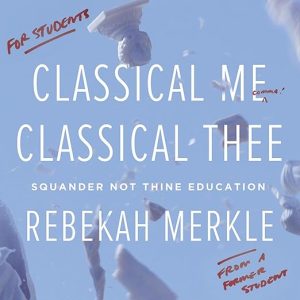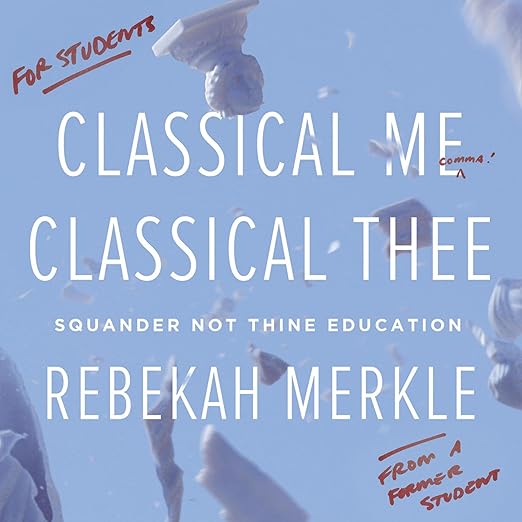
Rebekah Merkle wrote Classical Me, Classical Thee from a position of genuine credibility: she was a student in one of the first classical Christian schools in the country, a guinea pig, as she puts it, in the experiment she now defends. This audiobook is built around a single clarifying argument, and it makes that argument with the efficiency its brief runtime demands. Merkle knows which high school classes students roll their eyes at and which books they skim, because she did both. This is not a defense of classical education from a position of removed authority. It is an insider's account of what the practice is actually for, and it makes its case in under two hours precisely because Merkle respects her audience's time enough not to pad it.
The central metaphor Merkle builds around is the drill-versus-game distinction. The argument runs like this: no athlete drills for the sake of the drill. You drill so you can win the game. The tragedy of a classical education received without understanding is not that students learned useless things. It is that they drilled without knowing there was a game. This framing reorients the question entirely. Merkle is not defending the Iliad or Latin grammar as inherently valuable information to retain forever. She is arguing that these things are training in how to use your mind, and that the game they prepare you for is your actual life, not a test, not a grade, not a performance for parents and teachers.
This is a sufficiently clear and sufficiently honest argument that it works on students and on parents equally. Multiple reviewers noted that they found the book illuminating as parents, helping them understand the why behind curriculum choices they had accepted without fully grasping. One reviewer described reading it alongside their student so that ideas about education could be discussed between them, which is the best possible outcome for a book like this. Ben Zornes's narration captures Merkle's conversational warmth without over-performing the directness, and the result is an audiobook that sounds like a knowledgeable older sister explaining something important rather than an authority figure issuing directives.
Why Listen to Classical Me, Classical Thee
The brevity is a feature, not a limitation. Merkle's case is complete in under two hours because it is focused. She is not writing a comprehensive defense of classical education against all objections or a history of the classical Christian school movement. She is writing the book she wished she had been given when she was sixteen and resenting Latin, and she writes it at the length that audience can realistically absorb. That discipline of scale is itself a quiet argument for the educational philosophy she is defending: say what needs to be said, no more. The argument models its own principles.
For listeners new to the classical education conversation, this audiobook provides a clear entry point. The distinction between the grammar, logic, and rhetoric stages of the trivium is addressed without the technical vocabulary that makes some classical education literature inaccessible to outsiders. Merkle translates the framework into terms that connect with lived student experience rather than educational theory. At 4.7 stars across two hundred and nine ratings, the reception is strong and consistent across the demographic range the book addresses, from students who were required to read it to parents who came to it through a recommendation.
What to Watch For in Classical Me, Classical Thee
The book is explicitly written from within a classical Christian educational framework. The Christianity is present but not foregrounded as a doctrinal argument. Merkle is not using this book to defend Christian theology: she is using it to explain a pedagogical philosophy that happens to be embedded in Christian institutions. Listeners who come from secular classical education backgrounds will find most of the argument transferable. Those who resist any integration of faith and education frameworks should be aware that the author's own formation was specifically within the Christian classical tradition and that context shapes her assumptions throughout. The spoiler she offers in the opening pages, that grades are not the point, is not theological: it is pedagogical, and it holds regardless of the institutional context.
One listener who described themselves as having studied other works in the education space, including John Gatto's writing, found that this book connected dots they had not previously seen linked. That response suggests the book has a useful role not only for students encountering classical pedagogy for the first time but for adults who have been thinking about education broadly and want a focused, opinionated perspective on what the classical approach is actually trying to accomplish. The brevity means it can be listened to in a single session and then discussed, which is how Merkle clearly intends it to be used.
The Right Listener for Classical Me, Classical Thee
High school students in classical schools who want to understand what their curriculum is for rather than just endure it will find this audiobook the most direct answer available. Parents navigating the classical education decision, either considering it or already enrolled and seeking to understand it better, will find Merkle's account of the student experience particularly clarifying. Listeners with a background interest in educational philosophy will find the argument worth engaging regardless of their prior conclusions. Those looking for a detailed history of the classical education movement or a technical pedagogical defense will need to supplement elsewhere; this is an accessible, personal case built to be understood in a single sitting and acted on immediately.
Common Questions
Is the Classical Me, Classical Thee audiobook appropriate for high school students, or is it more suited to parents and educators?
Merkle explicitly writes for high school students, addressing them directly throughout. Multiple reviewers noted it works equally well for parents, but the primary audience is students in classical schools who want to understand why their curriculum is designed the way it is.
At under two hours, does this audiobook cover the full case for classical education or just an introduction?
The brevity is intentional. Merkle makes a focused, complete argument for why classical education is preparation for life rather than academic performance. It is not a comprehensive defense against all objections, but within its stated scope it is a fully developed case rather than a preview.