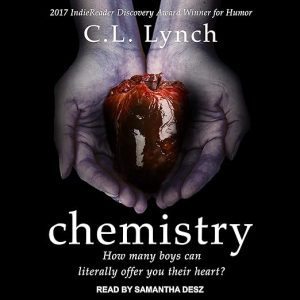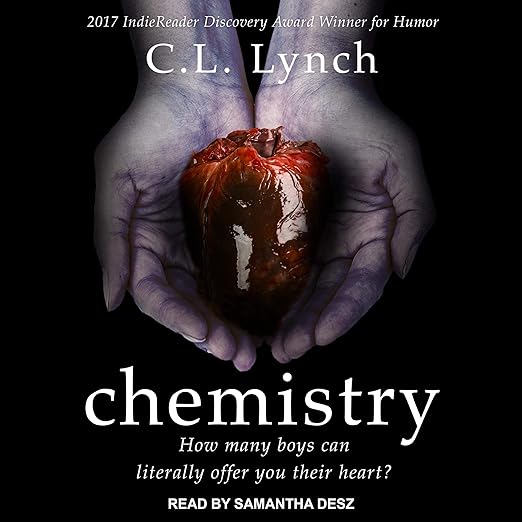
Can a teenage girl with anger management issues and a suitor who keeps trying to hand her his heart, literally, carry nine hours of audiobook without the joke wearing through? Chemistry runs nine hours and eight minutes and asks precisely that. C. L. Lynch built the first Stella Blunt novel as a comedy of manners wearing a horror costume, and the listing, credited to Samantha Desz, sells it without ever quite admitting what the costume is.
How Chemistry Holds Up
Stella Blunt does not want your sympathy and the book knows it. Her size, her snark and her trust issues appear in the copy as three big problems, which is neat misdirection, because the novel treats one of them as a problem and the other two as equipment. Ron K, at five stars, puts a finger on why the comedy works: it lives in the dialogue, in clever twists at sentence level, in what that response calls unusual sentences that would not function in any other context, and highlighting them turned out to be the only sensible reaction. Take that as a description of the material. This is not a plot-driven funny book. The plot is a straight line, and the laughs come from how a sentence gets bent on its way out of somebody's mouth.
Nothing in the metadata prepares a browser for what kind of book that is. The tag field is empty. The shelf label reads teen and young adult, and stops there. The description gets as far as calling Howie Mullins weird as hell, shy and smitten, mentions that he offers Stella his heart in the literal sense, floats a chainsaw as her possible reply, then retreats into the phrase salty-but-sweet paranormal romance without ever saying what Howie actually is. The concealment is a pleasure inside the novel. On a product page it leaves a shopper unable to tell whether this is a sweet high school romance or something with teeth in it.
Why Chemistry Works as an Audiobook
Comedy that survives a second pass is rarer than comedy that lands once. Amelia read it twice and says so in a five-star response from November 2016, reporting a hard time putting it down long enough to write anything and a spouse worn out by being asked what was so funny. That same account makes the sharpest claim available on this page: the book is more than a witty Twilight satire, and it will enchant Twilight lovers and thrill Twilight haters alike. Pulling both off at once is difficult, and it explains the shape of the thing. Parody needs you to recognize the target, and this one assembles a functioning romance out of the parts it is mocking.
Nine hours and eight minutes is a long stretch for humor that operates one line at a time. The recording has to answer for that, because prose this dependent on timing either gets its beats honored or gets flattened into recitation. Samantha Desz carries the full runtime, and the material asks for something specific: sarcasm played without italics, since Stella's asides only work when they sound like thinking rather than performing. The book also splits its attention between two equally awkward teenagers, so the reading has to keep an adoring, drooling boy on the correct side of the line where he stops being funny and starts being unpleasant.
Weak Spots in Chemistry
Two of the five responses arrive at the same complaint from opposite directions, and the book absorbs it. A. Wills gives four stars and opens by admitting to disliking Stella Blunt entirely at the start: rude to her parents, inconsiderate, judgmental about popular girls, pretty selfish. That account then reverses itself, arguing that disliking Stella is the point and the evidence that a real character got built. Whether you follow the reversal will decide your nine hours. Mr. and Mrs. Blunt, the same response adds, are a hoot from the very start, and that matches the construction: the parents are the reliable comic engine while their daughter is busy being difficult.
Every signed response on this listing was written between November 2016 and May 2017, and the recording was published in September 2019, two to three years after the last of them. They describe reading, as well: highlighting passages, laughing before the end of the first page, going back through it a second time. So the 4.2 average across 581 ratings is a verdict on a text that was already circulating well before this file existed, and nothing written beneath the star bar reaches the nine hours you would actually be buying. That gap matters more on a comedy than on almost anything else, because the distance between a joke on the page and a joke in the ear is where these books live or die.
Who Should Listen to Chemistry
Reach for Chemistry if you like young adult fiction rude, verbal and self-aware, and if the phrase Twilight satire makes you lean in rather than sigh. It suits listeners who enjoy a heroine written to be difficult on purpose, who want a romance where the awkward party is the boy, and who do not need a mythology explained to them in an opening chapter. Stella Blunt is marked as the first book of a series, so the close opens doors rather than sealing them.
Skip it if you need a likable lead. Heather Ford, at three stars, wanted to love this book, had followed the author online for a long time, read all four Twilight books, values fat representation and an atypical heroine, and still landed on the verdict that Stella is a whiny not-like-other-girls type. That is a fair reading of the same evidence everyone else praises. Give it a pass too if explicit language is a problem: a five-star response from April 2017 describes it as a young adult romantic comedy with a bit of horror and a lot of explicit language, and states outright that the book may not suit all readers, while the listing itself carries no content note whatsoever.
- Narrator: Samantha Desz is credited solo for a book that keeps two equally awkward teenagers talking at once.
- Subjects: Fat representation, paranormal romance, high school outsiderdom, Twilight parody
- Tone: Sarcastic, warm underneath, occasionally toothy
- Bottom line: Genuinely funny, provided you can live with a lead designed to irritate you first.
A Few Questions About Chemistry
How long is the Chemistry audiobook, and can it be listened to on its own?
Nine hours and eight minutes, and yes. Stella Blunt is numbered one in the series fields, so nothing precedes it. The story opens with a move to a new school and introduces every character from scratch, which is the standard first-book setup rather than a continuation.
What is the paranormal element the description keeps dodging?
The listing never names it. Howie is called weird as hell, he offers Stella his heart in the literal sense, and a chainsaw appears as her possible answer, but the copy stops there and falls back on paranormal romance. You go in unspoiled, which is the intended effect and also a real gap in the product page.
Is this audiobook a romance first or a comedy first?
A comedy first. The romantic arc is straightforward and resolves the way the genre promises, while the energy of the book sits in voice, family scenes and dialogue. If you want slow-burn tension and long romantic set pieces, the balance here will feel tilted toward the jokes.
Does the Chemistry audiobook work if you have never read Twilight?
Yes. The parody sharpens considerably if you know the target, but the satire is aimed at a book most people recognize by reputation alone, and the Blunt household and Stella's voice carry the story on their own terms. No prior reading is assumed by the text itself.