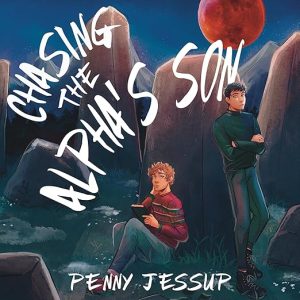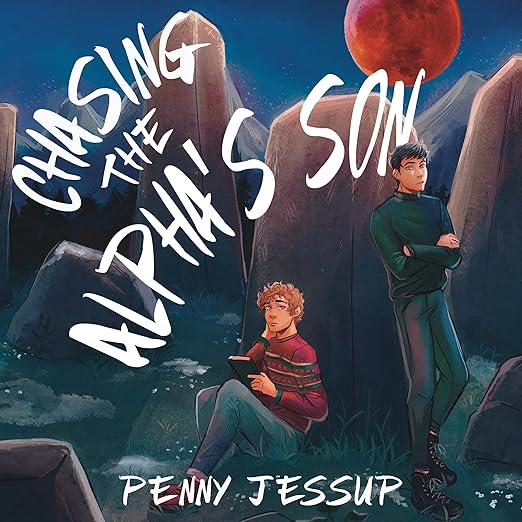
I started Chasing the Alpha's Son on a Saturday morning with a cup of tea and a plan to listen for an hour. Ten hours and seventeen minutes later I had not moved very far from the couch. Penny Jessup's second entry in The Alpha's Son series has a particular quality that a lot of YA paranormal romance tries for and misses: it makes you care about the outcome not because the stakes are cosmically large, but because you have become genuinely attached to the people involved.
The book picks up three months after the beach kiss that ended book one, with Max in a state of suspension. Jasper has gone silent. Max has made his declaration and received no answer. The Blood Moon ski lodge premise that drives the second book is charmingly specific, which is exactly what this genre needs more of. A week in the mountains, political unrest between allied wolf-packs, and a set of circumstances that force Max and Jasper into the same small world while also multiplying the obstacles between them. The mechanics are familiar. The execution is warmer and more attentive than most comparable series manage.
How Chasing the Alpha's Son Holds Up
What elevates Chasing the Alpha's Son above standard paranormal YA is Jessup's treatment of Max as a protagonist who experiences genuine doubt rather than just romantic frustration. By the midpoint of this book, surrounded by snow storms and political maneuvering he did not anticipate, Max begins to question whether the destiny he has been chasing is actually what he wants. That question is serious and the book treats it seriously. The genre convention is for the protagonist's love interest to be obviously correct as a choice, and Jessup complicates that tidiness without abandoning it.
Max's uncertainty feels like the uncertainty of someone who is young, who has never seen a relationship modeled the way he needs, and who is being asked to make an enormous commitment in an environment that is actively hostile to it. One reviewer described how the book brought them to tears because of its inclusiveness and awareness of other queer identities within the pack community. That dimension is handled with a light touch rather than a didactic one. The world Jessup builds acknowledges the complexity of queer life in a hierarchical supernatural society without making it the sole subject of the book, which keeps the story from becoming a message delivery system rather than a narrative.
In lesser paranormal YA, the supernatural event at the climax tends to function as a deus ex machina: something magical happens, the problem resolves, everyone is changed but the change feels cosmetically applied. Jessup avoids this by making the Blood Moon both a plot mechanism and a genuine test of character. The irrevocable change it brings arrives not as a rescue but as a demand: both Max and Jasper must choose who they are going to be, not just whether they love each other. That distinction matters enormously for the book's emotional credibility.
Several reviewers noted the ending was less stressful than the first book's cliffhanger but still left them wanting more. That balance is difficult to achieve in an ongoing series and Jessup manages it. The resolution is satisfying as an installment without closing the larger story, which is the ideal outcome for a middle-of-series volume. One reviewer called it a work of art. That is generous, but the craft at the ending is real and should not be undersold.
Weak Spots in Chasing the Alpha's Son
Michael Mola has to carry a large cast through this book. The ski lodge setting means Alpha Jericho, various Elite Pack members, rival suitors, and the entire political apparatus of inter-pack relations all have to be vocally distinct enough to track without becoming a vocal performance exercise. He manages this by anchoring everything to Max's perspective and letting the supporting characters exist at the distance Max actually experiences them. When Jasper speaks, the shift in register is noticeable. When the political tensions between pack leaders flare, the voices carry enough differentiation to clarify the scene without overwhelming the intimate center of the story.
The ten-hour runtime is appropriate for the amount of ground Jessup covers. Reviewers who read all three books in the series back to back describe the experience as immersive in a way that individual volumes do not fully convey. Listening to Chasing the Alpha's Son as a standalone is satisfying; listening to it as the continuation of an investment in Max and Jasper's story is considerably more rewarding.
The Right Listener for Chasing the Alpha's Son
Reading book one before this one is not optional. Chasing the Alpha's Son assumes familiarity with the established relationships, the world's specific rules around Lycan packs and Blood Moon traditions, and the emotional history between Max and Jasper. Listeners who have already spent time with The Alpha's Son will find this a rewarding continuation. Those who enjoy queer paranormal YA with genuine emotional investment rather than pure genre mechanics will find Jessup's handling of Max's interiority worth the full runtime. This free audiobook is particularly well-suited to listeners who prefer their supernatural romance to take the human stakes as seriously as the wolf-pack politics. Jessup's awareness of queer experience, and her refusal to reduce that experience to a single dimension of the story, is what makes the series feel like it is actually about something rather than using queerness as decoration for a standard paranormal romance plot.
A Few Questions About Chasing the Alpha's Son
Do I need to listen to the first book before starting Chasing the Alpha's Son?
Yes, without question. The second book assumes you know Max, Jasper, Alpha Jericho, and the emotional events of book one's ending. Starting here would mean missing essential context for why the three-month silence carries such weight and why the political dynamics at the ski lodge matter.
Is the relationship between Max and Jasper resolved by the end of this book, or does it remain open?
There is meaningful resolution to the central tension from book one, and the Blood Moon event produces real change in their relationship. However, reviewers consistently note that the ending leaves room and desire for more. It is satisfying as an installment without closing the story entirely.
How explicit is the content in Chasing the Alpha's Son, and is it appropriate for younger YA readers?
The book is categorized as YA and the romantic content is handled at a level consistent with that classification. The emotional and identity-related themes are handled maturely, but the physical content stays within standard YA parameters. It is not adult paranormal romance in terms of content level.