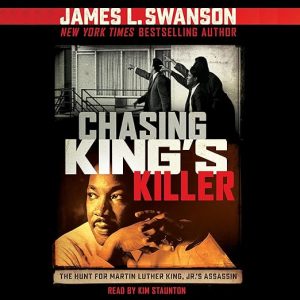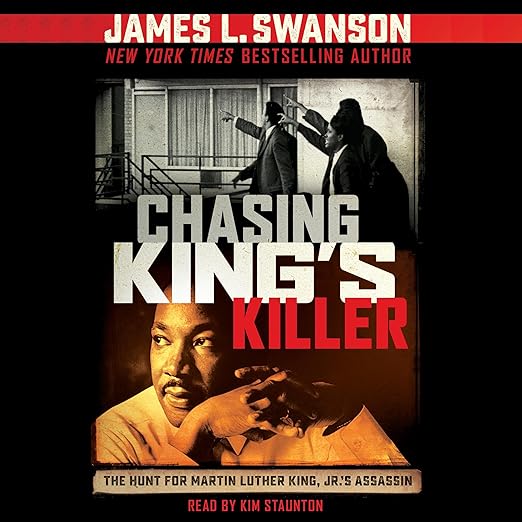
A gunshot on a Memphis motel balcony ended a thirteen-year movement almost overnight, and James L. Swanson spends this audiobook reconstructing both halves of that story at once: Dr. Martin Luther King Jr.'s meteoric rise through nonviolent protest, and the strange, racist prison escapee, James Earl Ray, who cut it short. Kim Staunton narrates all five hours and forty minutes of Swanson's account, which follows the same Chasing Lincoln's Killer formula that made his earlier Scholastic titles bestsellers with teen listeners.
First, the Big Picture
Swanson has a specific, proven format: pair a towering historical figure's final chapter with a genuine manhunt narrative, aimed squarely at a teen audience without talking down to them. He used it on Lincoln's assassination and on the Kennedy shooting in The President Has Been Shot!, and Chasing King's Killer applies the same structure to April 4, 1968, tracking Ray's escape and eventual capture alongside King's own final, threat-shadowed years of activism. The dual-track approach keeps the pacing brisk across a relatively tight five-hour-and-forty-minute runtime.
Reviewer Arul Ravichandran specifically praised how the book 'walked me through the great deeds done by' King, and noted that the print edition 'has pictures/photographs from the actual days when those chain of events occurred'. That's a real format consideration worth flagging up front: archival photography like that is print-exclusive and won't translate to the audio edition. What does carry over cleanly is Swanson's narrative pacing, built for readers used to fast-moving nonfiction rather than dense academic history.
The dual timeline is really the engine of the whole book. Swanson spends real time on King's own thirteen-year rise, the organizing, the public demonstrations, the specific eloquence that made his speeches land, before the narrative ever turns toward Ray, which means the assassination arrives with the full weight of everything King built rather than as an isolated crime scene. That structural patience, establishing the stakes of what was lost before detailing how it was taken, is what separates this from a narrower true-crime treatment of the same event.
The synopsis specifically credits King's 'relentless peaceful, non-violent protests, public demonstrations, and eloquent speeches' as the engine of his rise, and Swanson keeps that specific vocabulary, discipline, eloquence, persistence, present throughout rather than letting the assassination narrative retroactively flatten King into just a martyr figure. Staunton's narration has to hold that balance too, honoring the speeches and the organizing work with real weight before the book's tone shifts into manhunt mode.
This is deliberately not a comprehensive civil rights history; it's a tightly focused true-crime-adjacent account of one specific assassination and the thirteen-day manhunt that followed. Adrian's five-star review called it 'a thrilling and captivating story about the death of MLK Jr. and what happened afterwards', and added that it was good enough to send them looking for Swanson's other books, which is about as strong a recommendation as a YA nonfiction title can earn: it converts casual readers into repeat customers of the author's catalog.
Staunton's narration has real work to do here, holding a teen listener's attention through both the biographical build-up and the procedural chase without letting either half drag. Swanson's own track record with Chasing Lincoln's Killer gives a strong signal for what to expect tonally: fast, propulsive, unafraid of the genuinely dark material at its center, but built for a younger audience discovering this history for the first time rather than readers who already know every detail of the case.
This is Swanson's third entry in a specific format, following Chasing Lincoln's Killer and The President Has Been Shot!, and a listener who has already spent time with either of those earlier titles knows roughly what to expect tonally: fast pacing, real primary-source grounding, and a refusal to soften the violence just because the audience skews younger. That established track record is itself a form of quality assurance for a first-time Swanson listener, since the earlier books built the exact same structure around different assassinations and landed well with the same YA readership this one is aimed at.
Arul Ravichandran's review gets at the book's real educational value plainly, writing that it 'helped me understand the significance and the contribution of' King's role 'in the civil rights movement in America.' That's a meaningful outcome for a book this focused on the assassination specifically; Swanson manages to use the manhunt narrative as a vehicle for genuine appreciation of what King accomplished, rather than letting the true-crime mechanics crowd out the historical significance of the man at the center of it.
Weak Spots in Chasing King's Killer
The book's center of gravity is James Earl Ray and the mechanics of the manhunt, not a broader survey of the civil rights movement or of King's full body of work and philosophy. Listeners hoping for deep engagement with King's writing, his theology, or the wider strategic debates inside the movement should know this is narrower and more plot-driven than that, closer to a true-crime account with a historical figure at its center than a comprehensive biography.
The 4.6 average across 222 ratings is a strong, consistent signal, but the reviews attached to this listing skew short and personal rather than critical, more testimony about what the history meant to each listener than assessment of Swanson's craft or Staunton's specific narration choices. Anyone wanting a detailed sense of pacing, tone, or vocal performance before pressing play will have to lean mostly on Swanson's established track record from his earlier titles rather than on specific feedback about this audiobook's production.
At five hours and forty minutes, this moves considerably faster than an adult-oriented civil rights history would, which is a deliberate trade-off: depth on the wider movement, King's theology, his organizing philosophy, his tensions with other civil rights leaders, gets compressed in favor of narrative momentum around the specific thirteen-day manhunt for Ray. Listeners wanting Swanson's brisk, propulsive pacing should know that's exactly what they're getting; listeners wanting an exhaustive account of the movement itself should treat this as a starting point rather than a complete picture.
Is This One for You?
Middle and high school listeners already assigned or drawn to civil rights history are the direct audience, especially anyone who has already read Swanson's Lincoln title and wants the same fast-moving treatment applied to a more recent tragedy. Classrooms and family road trips both suit a runtime this size well, short enough to finish across a couple of long sittings without asking for the multi-week commitment a denser nonfiction title would.
Readers wanting the archival photographs and printed documentation that the physical and ebook editions include should note those visuals simply aren't part of the audio experience, and pair this with the print edition if that documentary material matters to how they want to engage with the history. Anyone looking for a wide-lens history of the civil rights movement rather than a focused account of one assassination and its aftermath will want a different, broader title instead.
Before You Listen
Does this audiobook cover Martin Luther King Jr.'s full life, or mainly the assassination?
Mainly the assassination and the thirteen-day manhunt for James Earl Ray, with King's thirteen-year rise covered as essential context rather than a full biography.
Is the Chasing King's Killer audiobook appropriate for middle schoolers?
It is aimed at a teen audience and follows the same format as Swanson's other Scholastic bestsellers, though the assassination content is handled with real weight, not softened.
Do I need to have listened to Chasing Lincoln's Killer before this audiobook?
No, each Swanson title stands alone, though listeners who enjoyed Chasing Lincoln's Killer will recognize the same fast-moving, manhunt-driven structure here.
How long is the Chasing King's Killer audiobook?
It runs five hours and forty minutes, a relatively tight runtime that trades broader movement history for narrative momentum around the specific manhunt.