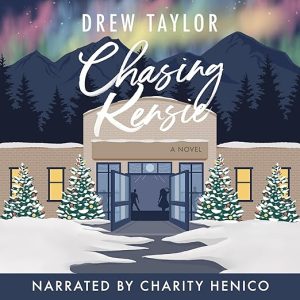
Kensington Smith arrived in Crescent Cove, Alaska, carrying what English teachers often carry: annotated novels, a thermos of coffee, and the particular brand of optimism that assumes everyone is basically good if you look hard enough. I found the audiobook version of Drew Taylor's Chasing Kensie on a gray afternoon when I needed something that balanced warmth with honest emotional weight, and Charity Henico's narration pulled me in within the first chapter. This is a Christian contemporary romance that takes its faith element seriously rather than using it as decoration, and the Alaskan winter setting gives the whole production a texture that generic small-town romances often miss.
The enemies-to-lovers setup here runs on a specific and satisfying engine: Kensie has decided that Nicolas Lancaster, her best friend's older brother and the school's P.E. teacher and football coach, is not worth her grace. He is too comfortable in his own skin, too quick with the wry comment, too obviously enjoying the way she bristles at him. Nick, for his part, has convinced himself that riling her up is a harmless hobby. Taylor is careful to establish that both of these positions are self-deceptions, and the slow unpeeling of those defenses forms the real core of the novel. When Nick is tapped to help Kensie organize the annual Winter Solstice Dance, the forced proximity works because the author has already built enough genuine friction between them that the warmth feels earned rather than sudden.
Where This One Lands
What distinguishes this from a standard enemies-to-lovers narrative is Taylor's attention to the pain underneath both characters. Kensie's practiced smile is not merely a romantic complication; it is a real defense mechanism with real history behind it. Nick's flirtatious facade similarly masks inner demons the story takes time to actually illuminate. One reviewer quoted a line that lodged in their memory: 'Love him like Jesus,' which captures the faith dimension of the book better than any summary could. That phrase is not a piety; it is a challenge, and the novel frames it as one of the hardest things either character has to learn. The faith journey here is not a side note but a structural element, and it shapes the resolution in ways that feel genuinely distinctive for the genre.
The Alaskan setting deserves more credit than romance synopses typically give it. Winter in Crescent Cove is a real atmospheric presence in this story, not a postcard backdrop. The long dark, the cold, the particular social intimacy of a small community where everyone knows everyone's older brother, these things bear on the romance in ways that feel specific rather than generic. When Kensie's guard comes down, the landscape feels like part of why, and that is better craft than most genre novels manage.
Why Chasing Kensie Works as an Audiobook
Charity Henico's narration is a strong fit for this material. Her pacing during the banter sequences captures the sharpness Taylor writes for Kensie without tipping into shrill territory, and she modulates well between the comedy of their early antagonism and the emotional exposure of the later chapters. Nick's chapters, filtered through Kensie's first-person register, retain his voice without Henico needing to shift into an unconvincing male register. The 7-hour-plus runtime feels appropriately paced; the story never rushes the pivot from loathing to genuine feeling, and Henico's performance is patient with that deliberateness.
One reviewer noted that the book 'started off slow' before building into something rewarding, and that seems like an honest calibration for prospective listeners. Taylor is not interested in accelerating the romantic timeline for the sake of plot momentum. If you come in expecting the typical genre compression, the early chapters may test your patience. If you settle into the character work, the payoff is proportionate to the investment.
What Gives Us Pause
The faith integration is the element most likely to either deepen your appreciation of the story or sit awkwardly depending on your own orientation. Taylor does not write apologetics; she writes characters who are genuinely working out questions of forgiveness, grace, and self-worth through a Christian framework. The 'one source of Hope' the synopsis references is not vague inspirational language but a specific theological claim that functions as the emotional resolution of both characters' arcs. Listeners who have no patience for that framework will likely find the third act unsatisfying. Listeners who share or are curious about that framework will find it handled with more integrity than the genre average.
The slow-burn pacing is real and intentional. Nick and Kensie's shift from antagonism to something genuine spans most of the novel's runtime, and Taylor resists the impulse to manufacture external drama to accelerate it. Some listeners will experience this as the book earning its emotional conclusions; others will want the gears to shift earlier. Reviewers who stayed with it consistently reported the investment paid off.
Who Should Pick Up Chasing Kensie
Listeners who appreciate Christian contemporary romance with genuine faith content rather than token gestures will find this among the better examples in the genre. Fans of slow-burn enemies-to-lovers arcs where both characters are genuinely hiding something will find the payoff proportionate to their patience. The Alaskan setting is a draw for anyone tired of the standard small-town south or English countryside romance backdrops.
Listeners seeking fast-moving romantic tension or a predominantly secular romance should look elsewhere. Those who found the faith elements in similar novels preachy should be aware that Taylor's Christianity is structural to the story, not cosmetic, though it reads as sincere rather than didactic based on reviewer response.
Quick Take
- Narration: Charity Henico delivers the banter with the right edge and carries the emotional shift with patience, a solid fit for the material.
- Themes: enemies-to-lovers, faith as emotional framework, buried grief beneath practiced personas
- Mood: Wry and slow-burning, warmed by an Alaskan winter light
- Verdict: A Christian contemporary romance that earns its emotional resolution through character depth rather than genre shortcuts, though slow-burn patience is required.