Key Details
- Voice: Colin Kaepernick leads a cast of more than twenty narrators including Jaden Michael, creating a full-cast audio experience produced in Dolby Atmos that goes well beyond standard audiobook narration.
- Big ideas: identity under pressure, racial authenticity in sports, the courage of an unpopular choice
- Atmosphere: Urgent and intimate, with the weight of a decision that shaped a generation
- Worth it?: A carefully produced audio adaptation that uses its full-cast format to give a pivotal crossroads moment in Kaepernick's young life real emotional texture.
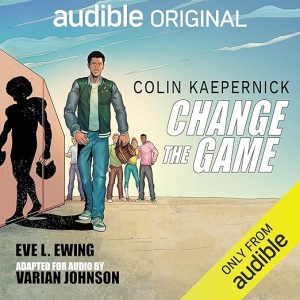
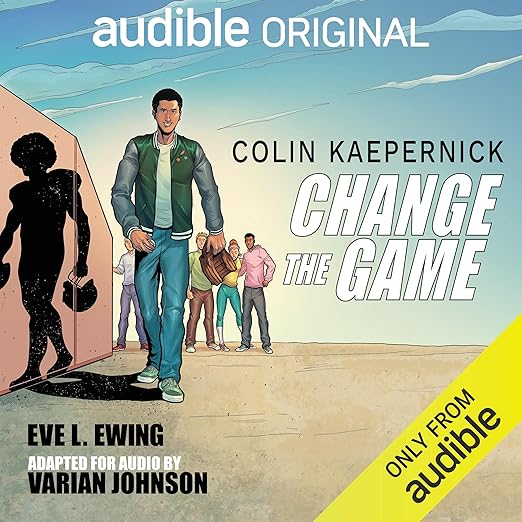
Senior year. Baseball scholarship offers stacking up. A body built for the pitcher's mound and a future that every adult in your life has already planned for you. And a feeling, quiet and persistent, that none of it is actually yours. Change the Game is the audiobook adaptation of Colin Kaepernick's YA graphic memoir, and the decision at its center, baseball versus football, scholarship certainty versus a completely unguaranteed future, is rendered here with enough emotional specificity that it lands as more than a sports story.
The audiobook format does something the graphic novel format cannot. With Kaepernick himself narrating alongside a cast of more than twenty performers, including Jaden Michael, who played Kaepernick in the Netflix series Colin in Black and White, the story becomes something close to a radio drama. It is available in Dolby Atmos on compatible platforms, and the production design reflects genuine ambition about what audio storytelling can do for material that originated as visual art.
The story's central tension is not simply baseball versus football. It is about identity. Kaepernick describes looking up to athletes like Allen Iverson, talented and unapologetically Black and dominating their sport while remaining entirely themselves. Baseball, in the framing Kaepernick cites from five-time All-Star Adam Jones, is historically a sport with a complex relationship to Black identity. Football means no scholarship offers, sleeping on minor league hotel room floors, and a leap of faith into uncertainty. But it also means something more authentic to who Kaepernick actually is.
That dimension of the story, the relationship between athletic choice and racial identity, is what lifts this well above standard sports memoir territory. Reviewer J. Bleck notes that the book generated immediate family discussion because her daughter, like Kaepernick, is a transracial adoptee. The questions Kaepernick is wrestling with in high school, about who you are versus who other people expect you to be, resonate across contexts well beyond elite athletics.
Why It Works in Audio
The full-cast production makes the audiobook significantly more immersive than a single-narrator version would be. Kaepernick's narration of his own interiority is grounded and direct. The ensemble cast brings the surrounding characters to life in ways that a graphic memoir conveys visually and an audiobook must accomplish through voice. The production makes that translation successfully, with each cast member differentiated clearly enough that the social landscape of Kaepernick's senior year reads as three-dimensional.
At just over ninety minutes, the audiobook is built for a single listening session. The brevity is appropriate to the source material's graphic novel origins, and the production density, the full cast, the Dolby Atmos audio design, means the time passes efficiently. This is not a book that overexplains its themes. It trusts the listener to understand what the choice represents without belaboring the symbolism.
Before You Commit to Change the Game
Kaepernick's self-narration is notably restrained compared to the more performative moments in the ensemble cast. He delivers his own story with a directness that reads as deliberate: this is what happened, this is what I felt, this is what it cost. That restraint in the face of material that could easily be rendered as heroic myth-making is one of the more interesting choices in the production.
The book does not cover Kaepernick's NFL career or his activism around police brutality, which became the defining story of his public life. That context exists for most listeners as background, and its absence from the narrative is appropriate: this is specifically about a high school senior at a crossroads, before any of the later history was written. The story is self-contained, and its meaning does not depend on knowing what comes next. Though knowing what comes next gives the choice of football over baseball an additional resonance that would be impossible for a listener to entirely set aside.
Reviewer Robert Miller called it simply "the best," and while that is not a nuanced critical assessment, it captures something about the book's emotional directness. It does not traffic in complexity for its own sake. It tells a specific story about a specific choice in the simplest and most direct terms available, and the simplicity is a feature rather than a limitation.
The production context matters here too. The audiobook was produced in Dolby Atmos, and the spatial audio design adds a layer of dimensionality that standard stereo narration cannot provide. For a story about a young man trying to orient himself in a world that keeps pulling him in competing directions, the immersive sound design is more than a technical flourish. It places you in the gym, on the field, in the room where the decision is forming. Audio storytelling at this level of production ambition is still relatively rare, and experiencing it in a narrative this emotionally direct is a reminder of how much the format can accomplish when the production team treats sound as a creative element rather than just a delivery mechanism.
Who Will Get the Most From It
This audiobook is an excellent fit for young adult listeners navigating questions of identity and belonging, and for anyone who has faced a decision where the expected path and the authentic one pointed in different directions. Sports fans who followed Kaepernick's NFL career will find the high school context illuminating without the book being contingent on that prior knowledge.
Listeners who want depth of characterization or a complex narrative structure will find the runtime and format limiting. This is adaptation of a graphic memoir: economical, image-forward in its original form, and translated here into audio with a full cast that compensates for the absent visuals. Its power is in the directness and the production quality, not in narrative complexity. For what it is, it is executed with care and produces the intended effect reliably.