- Narration: Gary Furlong is credited with a book that moves between English and Indian settings, a range no reviewer here puts to the test.
- Themes: Colonial occupation, obsessive first love, mechanical time, queer young adult romance
- Mood: Inventive and steadily darkening
- Verdict: A middle volume that widens its world convincingly, carrying a romance some listeners will find troubling rather than swoony.
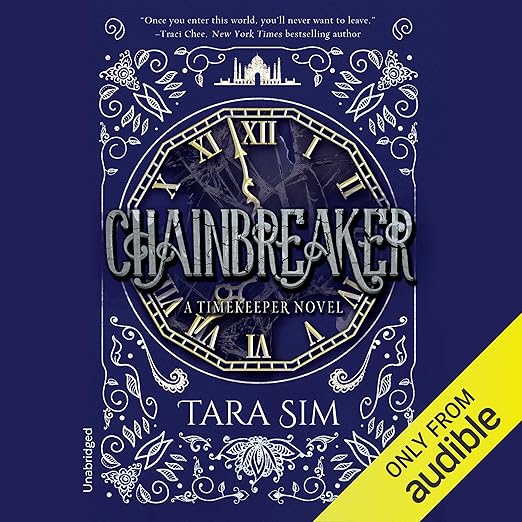
Chainbreaker does the thing middle volumes are supposed to do and almost never manage: it makes the world bigger without making the story thinner. Tara Sim moves the second Timekeeper book from England to India, where clock towers have begun falling, and in the process turns a charming steampunk premise into something with a political argument running underneath it. The audiobook lasts ten hours and twenty-nine minutes, and Gary Furlong is credited with the reading.
For anyone who needs the setup: Danny Hart is a clock mechanic in a world where time itself is kept running by physical towers, and damaging a tower Stops time in the place it governs. He knows he is being watched. He has no idea by whom or by what. When towers start collapsing in India without time Stopping, he is sent to investigate, and his relationship with Colton travels into territory neither of them planned for.
What Tara Sim Delivers
Sim's handling of the colonial setting impressed me more than anything else in the book. The publisher's summary puts it plainly: the British occupation may be sparking more than just the attacks. That sentence is doing an enormous amount of work. A lesser book would treat India as scenery for an English protagonist's adventure and the falling towers as a puzzle to be solved with cleverness. Sim folds the occupation into the mechanism, so the mystery cannot be untangled without the politics coming with it.
Karissa Eckert's review reaches the same conclusion from the reader's side, calling this "an amazing continuation of this series" and praising the invention directly: "a very creative world where time is run by clock towers". That reviewer also states the structural fact worth knowing up front, that this is the second volume of a trilogy. Sim is writing a middle book that expands rather than marks time, and you can feel the difference in how briskly the Indian chapters move.
My own hesitation concerns the romance, and I am far from alone in it, so I will hold that thought for the section below. What belongs here is the observation that the emotional center of this book is not the mystery, whatever the plot summary implies. It is two people working out whether what they have together can survive contact with a wider and much less sympathetic world, and the collapsing towers are the pressure applied to that question.
What Tara Sim Gets Right
This premise genuinely rewards being heard. A world in which time is a maintained mechanism generates its own vocabulary of cogs, chimes, fibers and Stopped towns, and hearing that vocabulary rather than scanning it makes the conceit land more physically than it does on the page. Ten and a half hours is also a comfortable length for young adult fantasy: long enough for the Indian sections to breathe, short enough to finish inside a week of ordinary commuting.
The queer romance is handled without apology and without fanfare, which in a genre that regularly does one or the other deserves naming. Danny and Colton's relationship is not the plot's reward for good behavior, granted in a final chapter. It exists from the beginning, and the book's central questions grow directly out of it. Listeners hunting young adult fantasy where a same-sex relationship is the given rather than the revelation will find exactly that here.
A 4.6 score drawn from over two hundred ratings is high for a middle book, and the enthusiasm in the reviews reads as unforced. One reader, posting as OHBears, offers no more than "A very enjoyable series !" plus a note about loving the story and the characters. Brevity of that sort usually signals somebody who finished happy and felt no need to argue about it afterward, which is a decent indicator for a second installment.
Where Tara Sim Loses Some Ground
The review to read before buying belongs to J. Sexton, at four stars, and I agree with most of it. That reviewer opens by admitting to being "honestly torn about Chainbreaker", likes most of the cast, understands the period with its steampunk twist, then names the trouble: "I don't like some of the attitudes expressed or the romantic portrayal of an obsessive love." Danny and Colton are written as consuming one another, and the book frames that intensity as romantic rather than as a warning sign.
Whether that counts as a flaw depends on the listener and, candidly, on the listener's age. A teenager absorbing an obsessive love story presented with approval is a real consideration, and a parent choosing this for a fourteen-year-old should know the intensity goes unexamined in this volume. Sim may well be building toward a reckoning in book three. Inside book two it is simply the texture of the relationship, offered without commentary.
Second, this is unambiguously a middle book, and the four-star reviewer puts that phrase in the review title. The structure bears it out. Threads open, the scope widens, alliances shift, and resolution is deferred to a volume you do not yet own. If finishing a ten-hour listen without closure irritates you, wait until the third book sits in front of you and treat the two as a single stretch of listening.
Third, on the recording. The reviews attached here run to plot, characters, worldbuilding and Sim's prose, and Gary Furlong's reading is not among their subjects, so I have nothing evidenced to report about it. The material does set a specific task worth thinking about. Danny is English, a large part of the book unfolds in India among Indian characters, and how one narrator handles that range is a reasonable thing to sample before committing ten hours.
Who Should Pick Up Chainbreaker
This is for listeners who finished Timekeeper wanting more of the world, for young adult fantasy readers who like their magic mechanical and rule-bound, and for anyone hunting queer speculative fiction in which the relationship is established rather than earned in a closing chapter. Readers who enjoyed the lighter end of Gail Carriger's steampunk, or Cassandra Clare's ensemble casts, will recognize the register, though Sim plays it considerably straighter than either.
Approach carefully if obsessive love written as romance troubles you, if you are choosing on behalf of a younger teenager and do not intend to talk it through afterward, or if unresolved endings leave you cross. Do not make this your entry point either. The emotional stakes rest entirely on a first book you would be skipping, and none of these ten hours will carry any weight without it.
Common Questions
What age group is this audiobook written for?
It sits in the older young adult range. The prose is accessible to confident middle schoolers, but the colonial politics reward some historical grounding, and one reviewer objects to how approvingly the central obsessive relationship is drawn. Fifteen and up is a sensible floor for listening without guidance.
Does the audiobook end on a cliffhanger?
It ends the way second volumes usually do, with the immediate crisis addressed and the larger situation considerably worse than it started. The publisher's own description promises a dark and dangerous path from which Danny and Colton may never return, and the book takes that promise seriously.