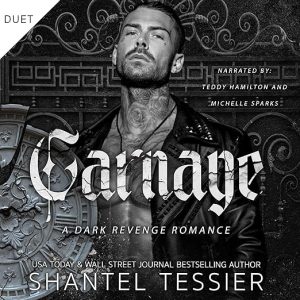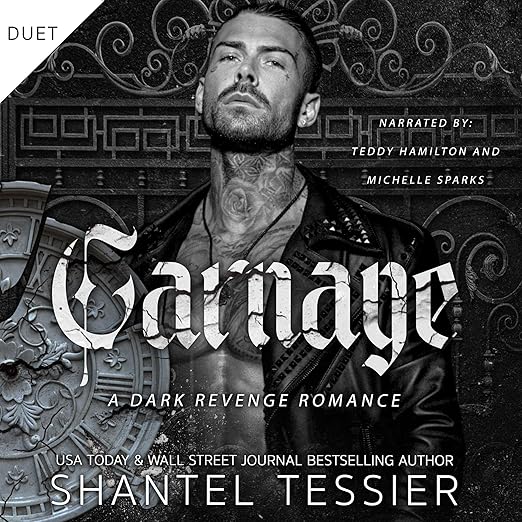
Carnage opens with a premise the Lords universe has been carefully building toward across multiple books: the Spade brothers, who operate the institution known as Carnage - a hidden prison where Lord oath-breakers live out their lives in shackles, cut off from the outside world - finally take center stage as protagonists rather than background presences. This audiobook is the fifth entry in Shantel Tessier's Lords series, and while the synopsis correctly notes it can be listened to as a standalone, the full emotional weight of what Carnage represents in the world of the Lords lands considerably harder for listeners who have been following the series since The Ritual. Teddy Hamilton narrates across nearly nineteen hours, and in dark romance audio circles his name in the credits is itself a reliable signal about the kind of intensity this listening experience will deliver.
The premise the book builds on is deliberately direct: a woman named Ashtyn ran from the man she once vowed herself to, Saint Beckham Carter. He finds her. He drags her back to Carnage, where the world outside cannot reach her and where she will serve him until he decides otherwise. What Tessier does with this framework across nineteen hours is more layered and more emotionally demanding than the setup alone suggests, and the dual POV structure is the mechanism that makes the complexity function. Ashtyn has reasons for running that Saint does not know, and that asymmetry of information shapes every scene between them throughout the audiobook. The listener knows things Saint does not, which creates a specific kind of suspense that is different from conventional thriller mechanics - not who will survive, but when the truth will surface and what will happen to the relationship between these two people when it does. One reviewer describes the book as an emotional roller coaster worth sacrificing sleep over, which is precisely the right register for what this audiobook offers. The Lords series as a whole - The Ritual, The Sinner, The Sacrifice, Sabotage, Carnage, and Madness - is described by one reviewer as a relentless descent into the shadows of power, privilege, and psychological torment at Barrington University. Carnage is the point in that descent where the Spade brothers' particular brand of darkness takes the foreground. The dual POV structure is also doing something specific that series readers will recognize as a signature Tessier move: Ashtyn's chapters carry a knowledge that Saint's do not, and that asymmetry is not resolved quickly. The reader sits with that imbalance for a significant portion of the runtime, which creates a distinct and uncomfortable kind of narrative tension that readers of lighter romance fiction may find unusual but that dark romance readers will find familiar and satisfying.
What Shantel Tessier Gets Right
Teddy Hamilton's narration is the most consistently praised element of this audiobook across the available reviews, and that praise is earned. He does not soften the Lords' universe's darkness - Saint Carter is described as over-the-top in the book's own framing notes, and Hamilton does not pull that characterization back toward sympathy or moderation. But he keeps the possessiveness and intensity within the emotional logic of desire rather than allowing it to function as pure threat, which is the precise calibration dark romance requires in order to work emotionally rather than simply thematically. At 18 hours and 29 minutes, Hamilton carries both POV voices across the full runtime: Ashtyn's contained, strategic interiority as she navigates a situation she cannot escape, and Saint's obsessive certainty that Ashtyn belongs to him in terms that admit no negotiation. The Spade brothers have been visible across the earlier Lords books as background presences whose full story was being deliberately withheld, and the anticipation the series built for their full arc is part of what makes this audiobook feel as momentous as the reviews suggest to series readers.
Where Shantel Tessier Loses Some Ground
The content warnings listed inside the book are explicit and apply in full throughout. The Lords universe is constructed around dark power dynamics, captivity situations, and possessive hero behavior that are presented without the redemptive framing of conventional romance fiction. Listeners who want dark romance with eventual softening, character rehabilitation, or a clear moral critique of the power dynamics being depicted will find Carnage resistant to those expectations. Saint Carter is not designed to be sympathetic in the traditional sense but to be magnetic in the specific way the dark romance genre requires its most extreme heroes to be, and Hamilton's narration serves that design consistently. The standalone claim in the synopsis is accurate in the sense that the central relationship has a complete arc and the core narrative resolves, but listeners without series context will miss the accumulated emotional weight the Spade brothers carry from their prior appearances. Starting with The Ritual and reading forward provides the full experience the series was built to deliver across its sequence.
Who Should Pick Up Carnage
This audiobook is for readers already committed to dark romance who want a long, intense, and structurally careful entry in the Lords universe - and specifically for series readers who have been waiting for the Spade brothers' story since they first appeared at the edges of earlier volumes. If you have listened to the preceding books in the series, this is an essential continuation of everything those books were building. New listeners who want to start here will follow the plot, but the emotional stakes will be shallower without series context behind them. Skip Carnage if morally complicated power dynamics, captivity scenarios, and possessive over-the-top heroes are outside your established reading comfort zone. The book earns its audience within that specific and devoted genre space and does not attempt to be something more broadly palatable.
Before You Listen
Can I listen to this audiobook without having read previous Lords series books by Shantel Tessier?
The synopsis confirms Carnage can be listened to as a standalone, and the central romance between Ashtyn and Saint has a complete arc within this volume. However, the Spade brothers appear in earlier Lords books, and series context significantly deepens the emotional stakes. Listeners starting fresh will follow the plot but will miss layers of meaning that series readers bring to this volume.
Is Teddy Hamilton's audiobook narration appropriate for the dark content of the Lords universe?
Hamilton is specifically known for his work in dark romance and brings the calibration this genre requires - keeping possessiveness and intensity within the emotional logic of desire rather than allowing it to become flat or gratuitous. Reviewers praise his performance consistently in this audiobook, and for listeners familiar with his work in similar material, this is among his strongest recordings in the genre.
How long is this audiobook, and does the nearly nineteen-hour runtime feel proportionate to the story?
At 18 hours and 29 minutes, Carnage is a substantial commitment. Reviewers who engaged fully with it describe the pacing as addictive enough to sacrifice sleep over, suggesting the runtime sustains engagement rather than exhausting it. The dual POV structure and the information asymmetry between Ashtyn and Saint create enough narrative tension across the full runtime to justify the length for readers invested in both characters.
What content should listeners be aware of before starting this audiobook?
Tessier lists content warnings inside the book rather than in the synopsis, which is consistent with the Lords series format. Based on series conventions and reviewer descriptions, listeners should be prepared for dark power dynamics, captivity situations, possessive hero behavior, and morally complex consent framing throughout. The book's own framing notes describe the hero as over-the-top and confirm this relationship is not presented as a healthy or conventional model.