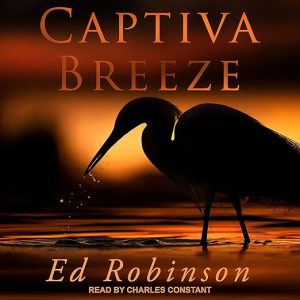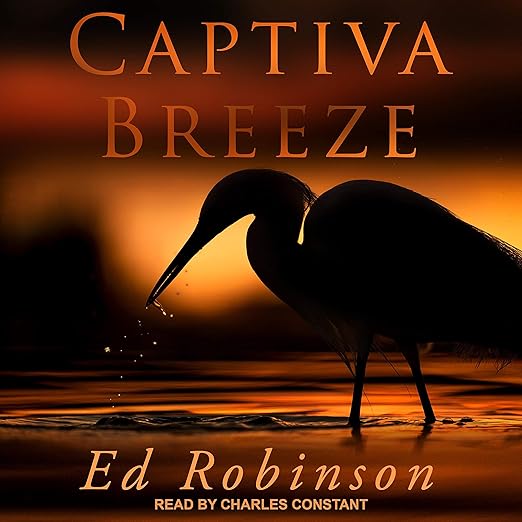
Captiva Island is under threat in Captiva Breeze, the nineteenth entry in Ed Robinson's Meade Breeze Adventure Series, and the protagonist who bears the island's name is not going to let a government bridge project destroy the barrier island ecology he has spent his life inhabiting. Florida's coastline has been a battleground between development pressure and ecological preservation for decades, and Robinson plants his fictional conflict squarely in that real tension. Breeze's personal stakes are clear from the first pages: this is his home, his water, the geography that gave his life its particular shape. This audiobook, narrated by Charles Constant across five hours and thirty-three minutes, places Breeze in the unusual position of working alongside the governor of Florida rather than operating around official authority. That alliance, which one reviewer describes as Breeze becoming something like a barnacle on the political process, is the novel's central structural invention and the source of most of its complications.
Robinson has refined his formula across nineteen books in a way that either reads as mastery or predictability depending on your relationship to the series, but what distinguishes this particular volume is the specificity of its setting detail. The geography of North Captiva Island, Cayo Costa, South Seas Plantation, Cabbage Key, and Pine Island Sound is rendered with the kind of precision that makes a reviewer say they have visited the area and found the descriptions accurate. That sense of place is doing real work in the story. The conflict over the bridge is not abstract political drama; it is about specific islands and waters that Robinson treats as characters in their own right. The Florida ecology is not backdrop here. It is the thing being defended, and the reader feels the stakes of its loss.
The assignment Breeze receives toward the novel's second half, described in the synopsis as appearing out of his league, generates the primary suspense of the second half. Robinson has always written Breeze as a man whose competence has been established through accumulated experience rather than exceptional natural gifts, and the second assignment tests that framework effectively. The question of whether Breeze will be his own downfall is handled with more genuine suspense than the series typically allows, which gives the volume a higher emotional stakes than some of the more comfort-read entries in the long sequence.
The Strengths
Charles Constant's narration has the quality Robinson's prose requires: unhurried, grounded, comfortable in the Florida coastal atmosphere. The series has always been written at a pace that matches its setting, and Constant does not push against that rhythm. The five-hour-and-thirty-three-minute audiobook runtime reflects the novel's focused scope. Robinson does not overwrite, and the listening experience benefits from that compression. A reviewer who has read all nineteen books in the sequence noted that this one lands among the series highlights, which is a useful data point for fans who have been tracking quality across the run.
The combination of environmental stakes and political intrigue is handled with enough specificity to satisfy genre readers who want their outdoor adventure fiction grounded in real policy debates. The bridge-to-North-Captiva storyline draws on actual debates about development pressure on Florida's barrier islands, and Robinson's engagement with the real geography and ecology of the region gives the conflict weight that pure adventure plotting would not generate on its own. For the series' established audience, this is Robinson doing what he does best, with added political texture that opens new story possibilities.
Weak Spots in Captiva Breeze
A reviewer cautions that new listeners who have not read the previous volume may miss some backstory, which is the standard caveat for any entry late in a long-running series. Volume nineteen is accessible enough in its self-contained plot mechanics, but the texture of Breeze's relationships and his established reputation among the people he works with depend on prior investment. The emotional resonance of the governor alliance is substantially richer if you know Breeze's typical relationship to official authority and his history with the Florida waterways. New listeners would do better starting near the beginning of the series to build that context organically.
The novel's shorter runtime means Robinson moves efficiently between the two main plot threads, and occasionally the transitions feel more abrupt than readers of longer adventure novels might prefer. The governor's character, who is central to the political-alliance thread, receives less development time than the storyline requires for full resonance. As it stands, the alliance is functional and interesting but not as fully rendered as the Breeze side of the partnership. The environmental stakes compensate by being vivid and specific throughout.
Recommended For
This audiobook is most rewarding for established series readers who want to spend five-plus hours with a character and setting they already trust. The Florida coastal atmosphere, the balance of environmental stakes and adventure plotting, and Breeze's particular blend of competence and unpredictability are all well maintained through the series' nineteenth entry. New listeners to adventure series with strong geographic specificity and a protagonist defined by experience rather than youth will find the series worth exploring from the beginning, but Captiva Breeze specifically is not the right entry point. Readers who want rapid-fire action at every page turn will find Robinson's measured approach a mismatch for their tastes regardless of entry point. What Robinson offers instead is density of place and the kind of character confidence that nineteen novels of consistent writing produces. That is a specific and real pleasure, but it requires knowing what you are coming for.
Good to Know
Does the audiobook work as a standalone, or is reading the earlier Meade Breeze books necessary first?
The plot of Captiva Breeze is self-contained enough to follow without prior volumes, but the emotional texture, particularly around Breeze's relationships and his standing with the people he works with, depends on history built across eighteen earlier books. New listeners will get the story but miss some of the resonance.
How does Charles Constant's narration handle the Florida setting and outdoor adventure sequences in the audiobook?
Constant's unhurried style suits both the setting and Robinson's prose rhythm well. The coastal atmosphere comes through without the narration feeling like a nature documentary, and the action sequences are handled with enough pace to generate tension without losing the series' characteristic ease.
Is this audiobook appropriate for listeners who want environmental themes in their adventure fiction?
Yes. The bridge development conflict and the specific geography of the barrier islands around Captiva are central to the plot rather than decorative backdrop. Robinson writes about Florida's coastal ecology with evident knowledge, and the environmental stakes are real rather than symbolic.
At five and a half hours, does the audiobook feel rushed or is the shorter runtime well-suited to the story?
The runtime fits Robinson's style. He writes focused, efficient novels rather than sprawling ones, and the audiobook pacing reflects that. The two main plot threads both receive adequate development within the available time, though a few secondary characters benefit from the compression less than the primary conflict does.