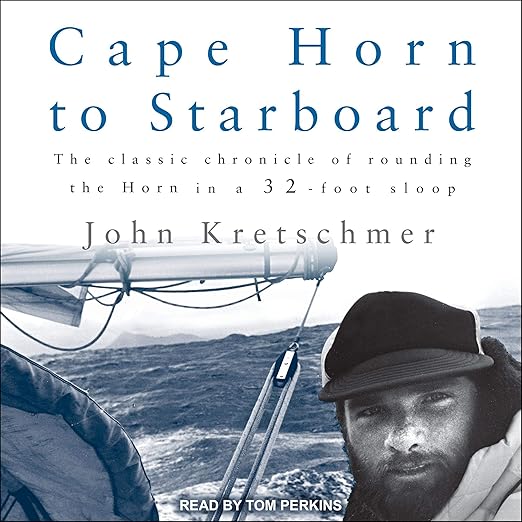
Cape Horn to Starboard begins with a navigational choice that establishes the terms of the entire account. John Kretschmer, sailing east to west in a 32-foot boat, placed the Horn deliberately to starboard, on the right side, which means he was going the hard way: against the prevailing westerly winds, against the west-to-east current that circles the globe at 56 degrees south latitude. This audiobook, narrated by Tom Perkins and running six hours and fifty-two minutes, is the account of that choice and its consequences. Kretschmer would go on to become one of the most respected sailing authors and offshore instructors working today. This is the book that established why that reputation is warranted, written when he was still young enough not to have edited the fear out.
The legend of Cape Horn is built on its statistics: winds that have built across thousands of miles of open ocean, seas that can overwhelm even well-found boats, a latitude where storms form and reform without interruption. Kretschmer's vessel was not a state-of-the-art offshore machine. It was a 32-footer going east to west, the direction the great clipper ships avoided by going the other way. That choice is what makes this account worth reading rather than just admiring from a distance.
One reviewer noted that this is written by a young Kretschmer, and you have to put up with his youthful style. That's an honest assessment, and it's also part of what makes the book interesting. The voice is unguarded in ways that a more seasoned author might have edited away. There's a directness to the fear, to the uncertainty, and yes, to the romantic attachment he describes, that feels like a genuine journal of a young man doing something extraordinary rather than a polished retrospective. Kretschmer didn't write this knowing he'd become the authority he later became. He wrote it as someone who had just done something he wasn't sure he'd survive, and that uncertainty is audible in the prose throughout.
The technical content is embedded in the narrative rather than segregated into separate chapters, which means listeners get the seamanship delivered as action rather than explanation. When Kretschmer describes sail changes in deteriorating conditions south of the Horn, the technical detail is specific enough to be informative but never stops the story to become a lecture. For listeners who want to understand what actually happens physically when a small boat is rounding the most dangerous headland in the world, this book provides a ground-level account that is rare in its specificity and honest in its difficulty.
Why Listen to Cape Horn to Starboard
Tom Perkins narrates with a measured, slightly formal delivery that suits the gravity of the subject. He doesn't heighten the drama artificially, which is the correct instinct for material that is inherently dramatic. The Horn passage sections have enough inherent tension that an overwrought narration would have been counterproductive. Perkins keeps the pace deliberate and the tone restrained. Some listeners may find his pacing slightly slow in the action sequences, but the approach serves the audiobook's overall credibility.
At six hours and fifty-two minutes, this is a compact listen for a passage account of this scale, and Perkins's measured delivery keeps it from feeling rushed despite the brevity. The format suits this material well. Sailing books are often consumed on the water, in transit, or in the kind of focused solitude that the subject demands. The reviewer who described it as a lasting read that kept them totally drawn in by the events on each page was responding to the propulsive quality of an account that never quite lets you settle into comfort. That quality translates fully to the listening format.
What to Watch For in Cape Horn to Starboard
The east-to-west routing is the technical crux of the book and the reason the Horn is to starboard rather than port. Sailing east to west means sailing against the prevailing westerly winds and the west-to-east current, which is why the great age of sail clipper ships went the other direction. Kretschmer's choice to go the hard way is not explained primarily as romantic bravado but as a navigational decision with real consequences, and the book earns its premise by delivering on the difficulty of that choice.
The passages describing the approach to the Horn and the rounding itself are the heart of the book, but the sections before and after them establish enough context about the boat, the crew, and Kretschmer's own state of mind that the climax lands with proper weight. The book doesn't rush to the Horn and then wrap up. The journey south and the journey north after the rounding are given their due, which means the listener understands the full scope of what was undertaken rather than just the headline moment. For a book of this length, that pacing discipline is what gives it durability.
Who Should Listen to Cape Horn to Starboard
Sailors with offshore ambitions who want a firsthand account of what a Horn rounding actually involves will find this essential. Maritime history readers who know Cape Horn from the clipper ship era will find Kretschmer's modern account a useful counterpoint. Armchair adventurers who want the experience of extreme sailing without the technical density of a how-to manual will find this accessible while still being specific. The book also functions as a portrait of what the early stages of becoming a serious offshore sailor look like from the inside, and the contrast between Kretschmer's voice here and the authoritative sailing educator he became is its own kind of interest. Listeners who want a more polished literary memoir or extensive psychological interiority should know this is primarily a sailing account with honest personal detail rather than a deep interior narrative.
Frequently Asked Questions
Do I need to know sailing terminology to enjoy this audiobook?
No, but familiarity with basic sailing concepts will deepen your appreciation of the technical sections. Kretschmer explains what he's doing and why, so complete novices can follow the narrative, but the seamanship detail will mean more to listeners who know the difference between running and beating to windward.
Is Cape Horn to Starboard the kind of audiobook that holds up for non-sailors interested in extreme adventure?
Yes. The account of the Horn passage itself is accessible regardless of sailing background, and the personal dimension, including Kretschmer's fear, his decisions under pressure, and the relationships aboard, gives the book emotional purchase beyond the technical achievement.