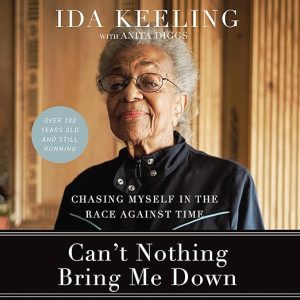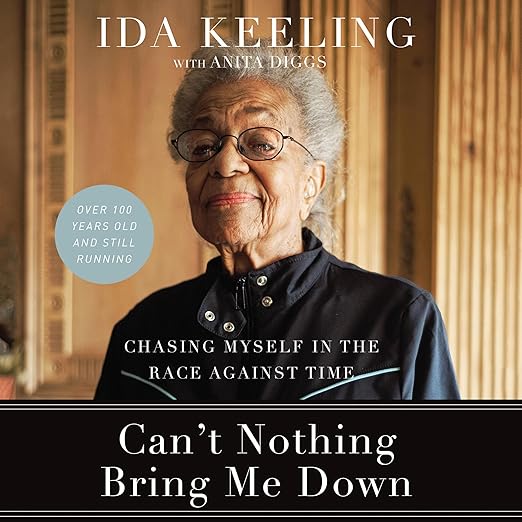
Ida Keeling's audiobook, Can't Nothing Bring Me Down, earns its title before the first chapter ends. Keeling, who set a world record in the 60-meter dash for the 95-99 age group and was still competing well past her 100th birthday, is not a figure who invites gentle handling, and this memoir does not offer any. At the time of writing she was 104 years old, a fact the book presents not as biological anomaly but as the logical outcome of a life lived with fierce intentionality in the face of losses that would have ended many people's engagement with the world entirely. The narration by Lisa Renne Pitts makes the Bronx setting feel specific and inhabited from the first chapter, grounding the memoir in the actual community from which Keeling's strength comes.
The Verdict, Briefly
The book moves through Keeling's origins as the child of immigrants in the Bronx during the Great Depression, working from age 12 to help provide for her family, raising four children alone after her husband's death, and serving as an active participant in the civil rights movement. But the book's emotional gravitational center is the 1978 and 1980 murders of her two sons, for which justice was never achieved. Keeling describes the paralysis that followed in plain, unhurried language, the sense that she simply did not have the strength to carry on. Her daughter's encouragement to put on running shoes at 67 years old and begin chasing the paralyzing sorrow from her heart is not rendered as a neat therapeutic turning point. It is described as a physical intervention, as literal as taking medicine, and the specificity of that framing is what makes it land differently than the inspirational memoir formula usually allows. Running gave light and new energy to Ida, as the synopsis states, and since her first race nearly 35 years before the book was written, she has never looked back.
Reviewers who knew Keeling personally describe the book as revealing depths they had not fully seen even in years of friendship and admiration. One neighbor writes that she could say she truly knew Keeling only after reading the memoir, despite a decade of friendship. Another reviewer notes the book packs a great deal into a relatively short space, covering Depression-era childhood, civil rights involvement, the murders, the late athletic discovery, and the world record performance without any section feeling rushed or under-examined. A third describes the book as very enlightening about the early life of many Black Americans in the early 1900s, noting the grit and determination to keep going that permeates every chapter. What the book does with the civil rights section is worth noting: Keeling's activism is not framed as extraordinary or heroic in the way memoir sometimes renders the past. She participated because her community participated, because the cause was immediate and personal, and because doing nothing was not a position she recognized as available to her. That matter-of-fact framing of community participation as a natural extension of personal values rather than exceptional courage is one of the memoir's consistent and distinctive qualities.
Why Listen to Can't Nothing Bring Me Down
Lisa Renne Pitts narrates across six hours and 43 minutes, and the performance is exactly what this material needs. Keeling's voice as rendered by Pitts has the cadences of the Bronx community the author inhabits, and the warmth that comes through in every passage about faith, family, and neighbors is not the generic inspirational warmth of the wellness genre but something specific and located in a particular place and set of relationships. Pitts handles the harder passages, the murders, the years without justice, the depression that followed, with a steadiness that matches Keeling's own refusal to collapse under them. The audio format is particularly well-suited to a memoir with this kind of direct, conversational address: when Keeling quotes God telling her she should just keep on because he is not done with her yet, hearing that exchange in audio carries a conviction that the same words on a page might not fully transmit.
Points to Consider
The faith dimension is central and explicit throughout. Keeling's relationship with Jesus is not background context or decorative spirituality; it is active, conversational, and woven into how she describes surviving grief, finding the strength to run, and her outlook at 104. One reviewer notes the book has some grammatical irregularities that reflect Keeling's speaking voice rather than formal prose conventions, which divided print readers between those who found it authentic and those who found it uneven. In audio, narrated by Pitts, this texture comes across almost entirely as character and authenticity rather than inconsistency. The memoir also carries something the synopsis's bullet-point framing does not quite capture: genuine humor. Keeling is funny, specifically and situationally funny, in the way of someone who has lived long enough to find absurdity in things that once seemed only terrible.
Who Should Pick Up Can't Nothing Bring Me Down
This audiobook is well-suited to anyone interested in running as more than sport, in late-life athletic discovery after catastrophic loss, or in memoir that measures resilience against genuinely devastating circumstances rather than ordinary adversity reframed as transformational. Listeners who appreciate faith-centered memoir will find the spiritual content woven throughout rather than confined to a chapter or two. The six-hour runtime makes it a natural companion for a long run or a weekend drive, which feels appropriate given the subject and the person. Skip it if you need athletic memoir focused on training methodology or performance science; Keeling's relationship to running is entirely about meaning and survival. But for a clear account of what a human being can do when they decide, at 67, that sorrow will not be their final answer, Can't Nothing Bring Me Down is the real thing.