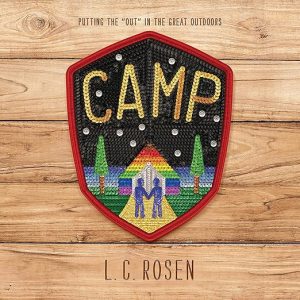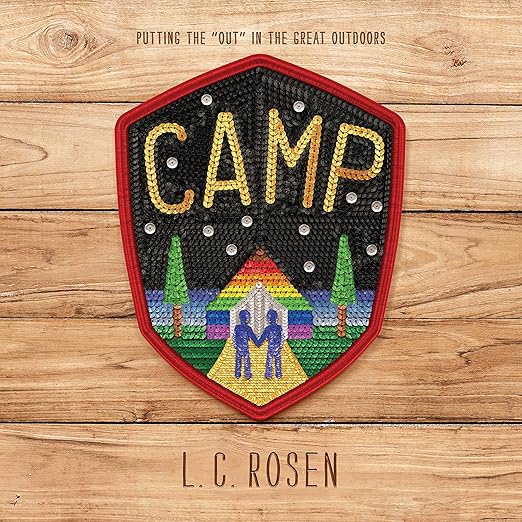
Randy Kapplehoff spends a year rebuilding himself into somebody else, and the audiobook has to let you hear both people at once. L. C. Rosen sets Camp at Camp Outland, two weeks a summer where queer teenagers get to exist without managing anyone, and gives its sixteen-year-old lead a plan: drop the show tunes, the nail polish and the unicorn bedsheets, get buff, arrive as Del, and finally register with Hudson Aaronson-Lim, who only wants straight-acting guys. Drew Caiden reads it in ten hours and twenty-two minutes.
Is Camp Worth Your Time?
Rosen builds this as a screwball comedy and then loads it with something screwball comedies rarely carry. The disguise plot is genuinely funny, complete with a summer musical and a supporting cast who can see exactly what Randy is doing, and underneath it sits a question the book will not let anyone dodge: how much of yourself can you shed for someone who does not know you are shedding it. The romance works because Hudson is written as a person rather than a prize, with reasons for the preference that turn out to be their own kind of damage.
Mechanics first: the December 22, 2020 five-star describes a theater kid trading nail polish and musicals for a masculine stereotype, going by Del, arriving straight-passing and catching the crush's eye immediately. That response also calls the love interest Hunter throughout rather than Hudson, which is a small thing and worth knowing if you are trying to match reviews to characters before you buy.
The publisher's copy is a mess in its own small way. Its opening sentence announces the summer camp setting and then announces it again inside the same clause, so the very first line a buyer reads says the book is set in a summer camp twice. Nobody proofread the pitch on a book about how carefully we present ourselves.
Why Camp Works as an Audiobook
Drew Caiden has an assignment most narration jobs never hand out: playing a sixteen-year-old who is himself playing a part, badly, for ten hours. Randy as Del is a performance inside a performance, and the whole comedy depends on the listener catching the seams that Hudson keeps missing. Push it too hard and Randy becomes a liar rather than a boy in love; play it too smooth and the reader loses the ache underneath. The camp musical adds a second demand, since stage material has to land through speech alone.
Nothing in the visible responses grades that performance, so the format decision comes down to what the material asks for rather than to any listener's verdict. What the material asks for is intimacy. Randy tells his own bad plan in first person, and a voice in your ear is the natural home for a character whose real self has been driven entirely inward.
Camp fiction works as substitute weather, and the October 13, 2020 five-star shows why. That reader had spent seven summers at camp as camper and counselor, has a child going now, and turned to a camp story precisely because the season had been cancelled. This book delivers the pine trees, the cabin politics and the two-week compression with real fondness.
Weak Spots in Camp
Content rather than craft drives the strongest reservation on the page. The July 12, 2021 three-star loved the story and still marked it down because the setting failed a plausibility test: no camp for teenagers, that response argues, would overlook the sexual activity here, let alone encourage it. It also wanted more of the other campers, acknowledging that Randy's viewpoint keeps the focus locked on Hudson. That is a fair heads-up for anyone buying this for a younger teenager, since nothing on the listing carries a content note of any kind.
Narrow field of vision is the price of the first-person choice. The book buys its intimacy by giving side characters their moments in glimpses, which works while Randy is the subject and pinches whenever the ensemble takes over a scene. Ten hours is long enough for that constraint to register.
Chronology and arithmetic both deserve a look. The June 2, 2020 five-star landed three weeks ahead of the recording, timed to the start of Pride Month, which makes it a Pride verdict on a book nobody had yet heard. And the column of five, at five, four, five, three and five, totals twenty-two and averages precisely 4.4, which is the figure posted above six hundred and eighteen ratings. It is unusual for a visible sample this small to land exactly on the population number, and it does suggest the spread here is honest rather than clustered.
Should You Listen to Camp?
Queer teenagers and the adults who buy for them are the intended readership, and the book earns the placement by being funny first and instructive never. The August 1, 2023 four-star describes it as cute and predictable in the best sense, praises character growth that happens independently of the love interest, and singles out the contrast the book draws between the dream version of a person and the real one. That is the argument for handing it to a fifteen-year-old.
Adults who went to camp, queer or otherwise, are a second real audience. Rosen writes the institution well: the cabin hierarchy, the summer musical, the way two weeks generates a year's worth of feeling. Listeners who enjoy romantic comedy structure done properly, with a disguise that has to collapse and a reckoning that has to follow, will get a satisfying shape.
Subtlety about masculinity is not what this offers, since the book states its theme in the first line of its own description and keeps stating it. Buying for a younger reader without checking is the other mistake to avoid, given the sexual content the three-star flags and the absence of any warning on the record. Anyone hoping for the musical numbers themselves should adjust expectations: the show is a plot engine, not a soundtrack.
The Short Version
- Narrator: Drew Caiden plays a teenager playing a role, a double register the whole comedy depends on and the hardest thing this book asks of a voice.
- Subjects: Toxic masculinity and straight-passing, self-acceptance, queer summer camp as refuge, love built on a false front.
- Tone: Sunny screwball with a real bruise underneath.
- Bottom line: Funny, warm and sharper than its premise promises, with sexual content the listing never flags.
Frequently Asked Questions
Is the Camp audiobook appropriate for younger teenagers?
Parents should look before buying. The listing carries no content note of any kind, and sexual activity among the campers is treated as ordinary camp life rather than as an event. The tone stays comic and warm throughout, but the book plainly assumes an older teen readership than the shelving suggests.
Are the songs from the camp musical performed in the audiobook?
The musical drives the plot rather than the soundtrack. Rehearsals, casting politics and performance nerves all matter to the story, and the reading conveys the stage material through speech. Listeners expecting a scored production or performed numbers should set that expectation aside before starting.
How does the narration handle Randy pretending to be Del?
That double register is the central demand on Drew Caiden across ten hours. Randy is performing masculinity for one person while the listener is meant to hear the strain, which means the performance must leak effort without tipping into parody, chapter after chapter.
Is this a romance or a coming-of-age story?
Both, with the coming-of-age doing the heavier lifting. The pairing with Hudson supplies the plot and the happy ending, but what the book actually cares about is what Randy gives up to be wanted, and whether affection built on a false version counts at all.