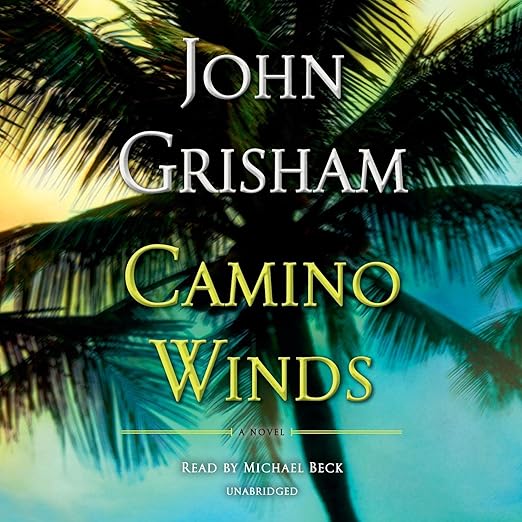
John Grisham is one of those authors I return to when I want competent storytelling from someone who genuinely understands narrative craft. I picked up Camino Winds on a long weekend, having read Camino Island a couple of years earlier and remembered its bookshop-community warmth fondly. The second volume in the trilogy is a different animal in terms of its central machinery - less about the literary world's glamour and more about what happens when a hurricane strips away civility and provides cover for murder - but Grisham's structural confidence is fully present throughout.
Hurricane Leo does the work that storms do in southern fiction: it reveals. The mandatory evacuation clears the island of most of Camino Island's residents, but Bay Books owner Bruce Cable stays behind, as does author Nelson Kerr - whose subsequent death, initially attributable to the storm, turns out to involve suspicious blows to the head inconsistent with wind damage. The local police are overwhelmed with real hurricane casualties and not equipped for the investigation. Bruce starts asking questions, and the questions lead to Nelson's unpublished manuscript.
First, the Big Picture
The premise is clever in the way Grisham's best setups are clever: it uses the specific reality of a hurricane's aftermath - the chaos, the overwhelmed institutions, the physical destruction of normal life - as the genuine condition under which a murder can go uninvestigated. This is not a convenient plot device; Grisham researched hurricane aftermath with the same care he typically brings to legal procedure. One reviewer described the hurricane sequences as real scenes from hurricane planning and aftermath, which is accurate. Leo feels like a credible storm, not a backdrop.
The novel's suggestion that Nelson's thrillers might have been closer to fact than fiction - that the shady characters populating his manuscripts may have been drawn from real criminal networks - is a device Grisham handles with enough restraint that it does not become preposterous. The manuscript becomes a clue rather than a deus ex machina, and the resolution earns its shock through careful setup rather than narrative convenience.
Michael Beck's narration serves the material's procedural rhythms well. The Camino Island books have a particular texture - the casual intimacy of a small island community, the literary world's slightly precious self-regard, the Florida light in every scene - and Beck conveys the setting without over-romanticizing it. At eight hours and forty-two minutes, this is a Grisham of efficient length: long enough to develop the mystery properly, short enough to hold tension across the runtime.
Delia Owens described it as the type of wild but smart caper that Grisham's readers love, which is a reasonable account of what Grisham is doing here. The book rewards listeners who enjoyed Camino Island's ensemble - Bruce, Mercer, and the wider circle of literary figures - and who are curious to see what Grisham does with the same setting under catastrophic weather conditions.
Weak Spots in Camino Winds
Multiple reviewers note that the first section is slower than the second. One described it bluntly: the first part drags before finally getting interesting. That experience tracks with Grisham's structure here - he is spending time establishing the hurricane's impact, the community's dispersal, and the initial confusion about Nelson's death before the investigative momentum builds. Listeners who trust Grisham to eventually tighten the narrative will be rewarded; those who need immediate thriller energy may find the opening chapters testing their patience.
The book also works less well as a standalone than as a continuation. The emotional attachment to Bruce Cable and the Camino Island world is built in the first novel, and some of the satisfaction here comes from seeing familiar characters under pressure. New listeners can follow the mystery without prior context, but they will miss the texture that series readers bring to the experience.
Is This One for You?
Readers who enjoyed Camino Island are the primary audience and will find this a worthy continuation. Grisham fans drawn more to his legal thrillers than his lighter fiction may find the bookshop-community setting less engaging, but the criminal conspiracy elements are developed seriously enough to satisfy genre readers across that divide. At under nine hours, it is a good choice for a weekend listen or a long travel day. Those who want a slow-burn hurricane novel with literary texture and a credible central mystery will get exactly that from Camino Winds.