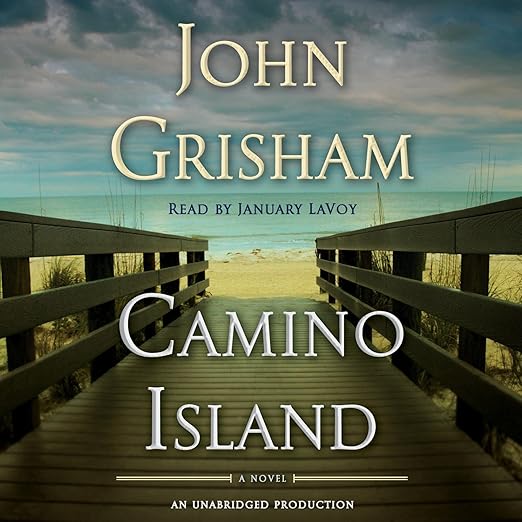
I started Camino Island on a Saturday morning when I had a few hours and no particular agenda. It is not the kind of audiobook that demands your full attention from minute one, and it rewards a relaxed approach. John Grisham has made his reputation on propulsive legal thrillers, and this book is not that, which is either its strength or its weakness depending on what you bring to it.
The setup is genuinely clever. A gang of thieves pulls off a meticulously planned heist from the vaults beneath Princeton's Firestone Library, making off with rare Fitzgerald manuscripts insured for twenty-five million dollars. The mechanics of the theft are precise and compelling, and Grisham opens with enough forward momentum that the subsequent deceleration feels like a choice rather than a failure. What follows is something closer to a literary novel about the world of rare books than to the genre machinery that made him famous.
First, the Big Picture
The character around whom the book's second act orbits is Bruce Cable, a Florida bookseller who is considerably more than his charming bookshop facade suggests. Cable is the kind of antagonist-adjacent character that Grisham rarely builds: morally ambiguous, genuinely cultured, difficult to dislike even once you understand what he is doing. One reviewer described ending up rooting for the antagonist, which requires real craft. Grisham gives Cable a full inner life and a social world populated by eccentric authors and literary figures who gather on Camino Island seasonally. That world is rendered with obvious affection for the book industry, and readers who are themselves deeply invested in literary culture will find more to enjoy here than those who picked this up primarily for the heist.
Mercer Mann, the protagonist assigned to infiltrate Cable's circle, is where the book generates the most friction among reviewers. She is a novelist struggling with writer's block and financial pressure, which gives her motivations for going undercover a complicated moral texture. One reviewer found her frustratingly passive and prone to complaint; others found her relatable precisely because her situation is not heroic. Mercer is written as a literary protagonist inside a genre thriller, and that hybrid does not always resolve cleanly. She is interesting more often than she is likable, which is a legitimate artistic choice but an uncomfortable one in a book that also wants to entertain.
Grisham himself described this book as a departure, and January LaVoy's narration reflects that. She does not attempt to manufacture tension where Grisham has not written it. The middle sections, which follow Mercer's gradual integration into the island's literary social scene, move at a pace that one reviewer aptly called a leisurely jaunt periodically jolted into high gear. LaVoy handles those jolts well: when the book decides to accelerate, she accelerates with it without making the quieter sections feel like they were waiting to be over. Her performance across the ensemble of characters, from Cable's sophisticated coolness to the rotating cast of visiting authors, is varied and distinct throughout the nearly nine-hour runtime.
At eight hours and forty-five minutes, the book is long enough that the pacing issue becomes a real consideration for some listeners. If you measure audiobook quality in events-per-hour, this is not the Grisham for you. If you are willing to spend time in a vividly rendered Florida setting with characters who have interior lives worth exploring, the length feels appropriate rather than excessive.
Things to Know Before Starting Camino Island
This is the first of three Camino novels, and it functions well as an introduction to Cable and the island world Grisham clearly found worth returning to. The resolution of the manuscript plot is satisfying without being tidy, and the ending leaves Cable's character in an interesting position for the next book. One reviewer who went in without strong expectations found it an excellent book with deep characters and a plot that resisted prediction. That openness to the material seems like the right disposition to bring.
For audiobook listeners specifically, the Florida setting and the literary social world translate well to audio. There is a lot of conversation in this book, and LaVoy handles dialogue with naturalness. The Fitzgerald manuscripts that set the plot in motion are treated with genuine reverence by both the author and the narrator, which will resonate with anyone who cares about rare books and literary history. Readers who finish this will find the second and third Camino novels a natural continuation, with Cable's arc developing in directions this opening entry carefully prepares.
Is This One for You?
Readers expecting the tightly wound legal procedural of Grisham's peak courtroom work will need to recalibrate their expectations. This is a beach book in the best sense: atmospheric, character-driven, comfortable with ambiguity, and occasionally surprising. Fans of literary fiction who have stayed away from Grisham because they assumed the genre was not for them might find Camino Island the entry point worth trying.
- Narrator: January LaVoy handles Grisham's leisurely pacing with warmth and control, maintaining tension through the literary-world sections without forcing urgency the prose does not support.
- Subjects: Rare book theft and the black market, literary espionage, the ambiguous morality of collectors
- Tone: Sunlit and languid, with periodic lurches into genuine suspense
- Bottom line: Readers expecting a Grisham courtroom thriller will find something deliberately different here; readers who love books about books will find a lot to enjoy.
Is Camino Island different from Grisham's typical legal thrillers?
Significantly. There are no courtrooms and very little legal content. The book is closer to a literary crime novel about the rare book trade, with a leisurely pace and character-driven middle sections that some Grisham readers find refreshing and others find slow.
Do I need to read the Camino series in order?
Camino Island is the first in the series and is the correct starting point. The characters and world that continue into Camino Winds and Camino Ghosts are introduced here, and reading out of sequence would reduce the payoff of Cable's arc.
Is Mercer Mann a protagonist readers will find easy to root for?
Not straightforwardly. She is morally compromised by her undercover arrangement and frequently conflicted about it. Reviewers are divided on whether she is frustrating or sympathetic, and the answer probably depends on your tolerance for protagonists who make choices you would not make yourself.