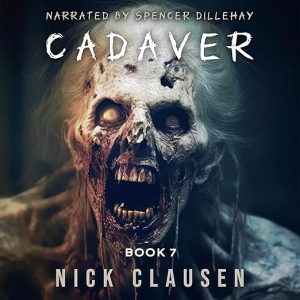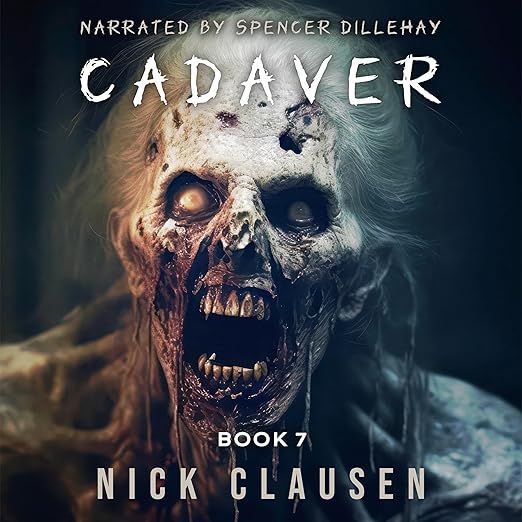
Seven books in, the zombie series that started with two teenagers and a frozen corpse reaches its last five hours, and the audiobook selling that ending does not describe it. The description on this record is the series pitch: a new, fast-paced, unpredictable and brutal take on the genre, followed by the inciting incident from volume one, the corpse hauled out of the woods and the morgue below the hospital where the dead start sitting up. Nick Clausen's actual seventh installment is nowhere in the copy. Spencer Dillehay reads it.
Start with what the page does tell you. Cadaver runs on containment rather than on the open road: the infection breaks out inside a hospital, the building fills with the newly dead, and the authorities seal it rather than clear it, which turns the series into a siege story with the survivors trapped in the same corridors as the thing hunting them. Seven volumes of that is a structural gamble, since a confined space burns through its own geography, and the fact that Clausen got a conclusion out of it says the escalation kept finding new floors to fall through.
Five stars posted on April 30, 2024 report the finale tying up a lot of loose ends and praise how the series ends, read in a single sitting. That verdict arrived two months before this recording was published, so it grades the text edition rather than this reading, and it is the earliest of the five responses on the page by a wide margin.
Worth flagging above all is the description itself, because a buyer at volume seven is being sold the premise of volume one. The copy calls the series new, announces the thrilling conclusion in the same breath, and then summarizes the opening chapters of a book published years earlier. Anyone arriving here after book six gets no indication of where the story now stands, and anyone arriving cold will start in the wrong place.
Why Cadaver 7 Works as an Audiobook
Five hours and seven minutes is a single long evening, and the material is built for exactly that. Clausen writes short scenes with hard cuts, the kind that pull a reader forward by refusing to pause, and a continuous recording removes the natural stopping points a printed page provides. A finale that has to resolve seven books of accumulated survivors benefits from being taken whole, since the resolutions land only if you remember who is still alive.
Crowd management is the demand on the reading. A siege narrative keeps a dozen people in the same building, most of them frightened, several of them shouting, and the performance has to keep them separable without a name tag on every line. Spencer Dillehay is working in a confined acoustic space where the difference between two panicking survivors is the only thing telling a listener whose death is being described.
Holly Borah posted five stars in April 2025 with the series comparison that matters most: this is another zombie series, but the cause is what makes it different, and the response places it alongside Clausen's Dead Meat while waiting for the next installment of Invaders. That is a returning reader's endorsement rather than a first encounter, which is the audience this volume is actually built for.
Weak Spots in Cadaver 7
One complaint on the page cannot reach a listener at all, and it happens to be the most useful thing there. A four-star posted in August 2024 credits the author with an original twist and a smooth ending, then deducts a star specifically for a lot of grammar mistakes and hopes the next series is cleaner. Typography and copy-editing are invisible in audio, so the single stated reason for that deduction evaporates the moment you press play. It is a fair warning for anyone weighing the ebook against the recording, and an argument for the recording.
Other reservations do carry over. A five-star posted in January 2025 records that some things felt rushed while still calling the book engaging, and objects to the fate of the only two Black characters in the story, which is a content criticism rather than a craft one and will matter to some listeners. That reader also praises the restraint in the visual writing, saying the imagery lands without being oversaturated in detail.
Then the fields. The publisher of record on this listing is Spencer Dillehay, which is also the narrator credit, so the person reading the book is the person releasing it. That is not a defect in itself, and self-produced horror audio is a healthy corner of the market, but it means no third party sat between the performance and the master. The teen and young adult filing deserves a second look as well, on a book whose own copy uses the word slaughterhouse.
The Right Listener for Cadaver 7
Listeners who have followed Cadaver from the corpse in the woods are the only audience the finale serves properly, and they will get what they came for: resolution, casualties, and a pace that does not slacken. The comp titles in the copy point at the right neighborhood, naming Mark Tufo, Bobby Adair, Mike Evans and Camille Picott, so anyone at home in that catalog knows the register on offer.
The five-star posted on April 19, 2025 adds the single most interesting thing anyone says about this series, praising the combination of apocalyptic zombie horror and Norse mythology. Nothing in the description mentions Norse mythology anywhere. If that blend is what distinguishes Cadaver from the rest of the shelf, and one reader clearly thinks it is, the listing is hiding its own best selling point.
As a starting point it is actively misleading, since the copy will put you in the wrong book. Slow, atmospheric or psychological horror is not the register either, because the appeal here is momentum and body count rather than dread. Younger listeners drawn in by the teen shelving should be warned that the violence is explicit and the survival rate is low, and parents making that call will find nothing on the record to help them.
The Short Version
- Read by: Spencer Dillehay is both reader and publisher of record here, working a confined siege with a large cast crammed into one building.
- At its heart: Containment horror, an outbreak with an unexplained cause, survivor attrition, a series ending its own escalation.
- Vibe: Fast, claustrophobic, gory.
- Short version: A brisk finale for existing readers, sold under a description that summarizes the wrong book.
A Few Questions About Cadaver 7
Does the audiobook description actually describe book seven?
No, and that is the listing's biggest failure. What you get is the series pitch plus the opening of volume one, corpse in the woods and hospital morgue included. Nothing tells a returning listener where the story stands after six books, so buy on series loyalty rather than on the summary.
Can you start the Cadaver series with this audiobook?
You can, but you should not. It resolves seven volumes of survivors and consequences in five hours, and the satisfaction depends on knowing who is still alive going in. Start at book one, where the two teenagers and the corpse in the woods actually belong, and work forward.
Does the audiobook sidestep the copy-editing problems the text edition has?
Entirely. Punctuation slips and grammar errors live on the page, and a narrator speaks past them without a listener ever noticing. If rough copy-editing is what has kept you away from the written version, the recording removes the objection, which is an unusual reason to prefer audio over text.
How graphic does the violence get for a book shelved with teen fiction?
Graphic enough that the shelving deserves a second look. The publisher's own words for the series are brutal and slaughterhouse, the death toll is high, and characters readers have followed for six books do not survive. The prose avoids wallowing in gore, but nothing is softened either.