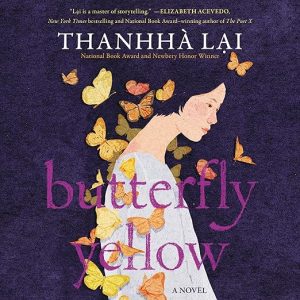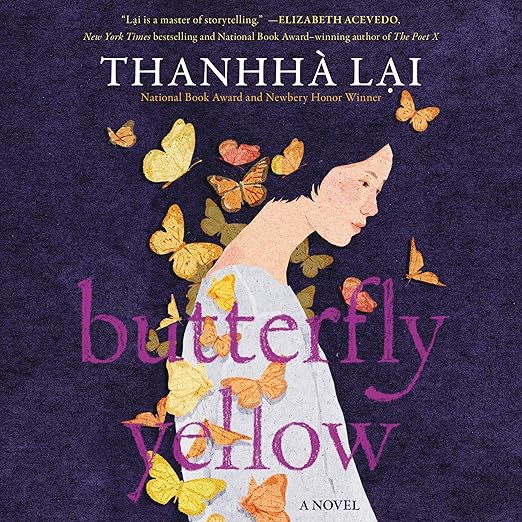
Thanhhà Lai builds Butterfly Yellow around a silence that grows more painful the longer it lasts. Hang has spent six years surviving the aftermath of the Viet Nam War, making her way across impossible terrain and distance to reach the little brother she was separated from at a Saigon airport in the war's final days. When she finally finds Linh in Amarillo, Texas in the summer of 1981, he does not remember her. This audiobook, narrated by LuLu Lam with a precision that the emotional weight of the material demands, takes that devastating premise and handles it with a disciplined compassion that is considerably harder to achieve than it looks. Lai, whose verse novel Inside Out and Back Again drew on her own refugee experience, writes Hang as someone whose strength is not the absence of grief but the persistence through it.
What distinguishes this novel from other stories about refugee experience and sibling separation is the specificity of its central wound. Linh is not simply living a different life in America. He has become a different person, American enough in his habits, memory, and identity that the Vietnamese sister who crosses the country to find him is, to him, essentially a stranger. The distance between them is not hostility but something quieter and more devastating: amnesia of origin. Hang has to decide whether to claim the relationship she has sacrificed everything to restore or to let Linh live the American childhood he has built without her.
LeeRoy, the Texas boy with rodeo ambitions who befriends Hang and helps her navigate a landscape that is baffling to her in every register, is written with warmth rather than condescension. The friendship between them is the novel's heartbeat, and Lai uses it to show the ways in which kindness and genuine connection can cross the enormous cultural distance between a Vietnamese refugee and a rodeo kid from Amarillo without flattening either character's particularity. Reviewer Miss Print captured this well, noting that Hang arrives in Texas knowing the address but not knowing how to move through the world around it, and that quality of disorientation inside competence is what Lai renders with the most precision.
The Strengths
LuLu Lam's narration is central to why this audiobook works as an audio experience. Hang's English in the novel is deliberate and sometimes grammatically unconventional, reflecting her status as a learner, and Lam handles this without condescension or parody. The effect is of someone thinking carefully in a second language, which mirrors the reader's understanding of what it costs Hang to communicate in a country where everything is unfamiliar. The emotional weight of the reunion scene and the more complicated scenes that follow it are given space by a narrator who trusts the silence in the prose rather than rushing to fill it with sentiment.
At six hours and thirty-three minutes, Butterfly Yellow is a focused listen that rewards sustained attention. The novel is short for its emotional ambition, which reflects Lai's economy as a prose writer. She was trained in poetry, and the rhythms of the sentences in this audiobook carry that compression. Some passages hit harder for what they leave out than for what they say, and Lam is sensitive to that compression in her delivery, holding back where a less careful narrator would push.
Weak Spots in Butterfly Yellow
Readers expecting a straightforward story of reunion and healing should know that this novel refuses easy resolution. The relationship between Hang and Linh at the book's end is not repaired in the sense of being restored to what it was before the separation, because what it was before does not exist anymore. The emotional resolution is real but hard-earned and open in a way that some younger readers may find unsatisfying. A reviewer noted that the novel broke their heart, and that is a fair warning: the sadness here is not the kind that gets neatly folded up by the final chapter.
The Texas setting is used skillfully but remains somewhat lightly sketched in terms of period social detail. Listeners interested in the historical specifics of Vietnamese refugee resettlement in the American Southwest during the early 1980s will find the novel more emotionally precise than historically comprehensive. That is a genre choice rather than a flaw, but it is worth naming. The Scott O'Dell Award for Historical Fiction recognizes the novel's accuracy in emotional and cultural terms rather than its density of period documentation.
Recommended For
This audiobook is most directly aimed at young adult listeners and older readers who find the YA category hospitable to stories about displacement, cultural identity, and survival. Fans of Elizabeth Acevedo and Ibi Zoboi, both named in the publisher's own framing, will recognize the combination of lyrical prose, immigrant experience, and emotional ambition. Adult listeners who do not typically read YA will find this one worth crossing the category boundary for: Lai's economy and the weight of her themes do not condescend to younger readers, and the novel handles its material at a level of complexity that adults often underestimate in the category. LuLu Lam's narration makes this an audiobook worth choosing over the print version for the subtleties of voice alone. Lai's compressed, poetry-informed sentences gain an additional dimension when spoken aloud, and the emotional textures of the reunion scenes in particular are served better by a skilled narrator than they would be by silent reading.
Before You Press Play
- Read by: LuLu Lam brings a precise emotional intelligence to Hang's voice, navigating the disorientation of the Texas setting and the grief of the reunion with real subtlety.
- At its heart: Refugee experience and belonging, the gap between memory and identity, the cost of survival
- Vibe: Quietly devastating and ultimately open-hearted, the sorrow moves through rather than accumulates
- Short version: Thanhhà Lai's YA debut earns every emotional note it strikes, and LuLu Lam's narration gives it the careful attention it deserves.
Before You Listen
Is Butterfly Yellow suitable for younger teen listeners, or does the subject matter require some maturity?
The novel is recommended for readers twelve and up, and the audiobook suits that range. The themes of war, refugee survival, and the emotional complexity of a sibling separation and reunion are handled with care rather than graphic detail. There is no content that would be inappropriate for middle-school listeners, though younger readers may need to sit with the ambiguity of the ending.
Does this audiobook work if you haven't read Lai's earlier novel Inside Out and Back Again?
Yes, completely. Butterfly Yellow is a standalone novel with its own distinct characters and story. Inside Out and Back Again is written in verse and draws on Lai's own refugee experience, but there is no narrative connection between the two books. Reading or listening to the earlier work may deepen your appreciation of Lai's thematic concerns, but it is not a prerequisite.
How does LuLu Lam handle the representation of Hang's limited English in the audiobook?
Lam navigates this aspect of the character with real precision. Hang's deliberate, sometimes grammatically unconventional speech is given a thoughtful cadence that conveys the effort of communicating in a second language without making the character seem lesser. It is a difficult balance and Lam maintains it consistently throughout the six-hour listen.
Does the audiobook end with a satisfying resolution to Hang and Linh's relationship?
The ending is emotionally resonant but deliberately open rather than conventionally resolved. Hang and Linh do not simply return to the relationship they had before the six-year separation, because that relationship no longer exists in the form Hang remembered. Lai gives the story a sense of forward possibility rather than a tidy restoration, which is the more honest and more challenging ending.