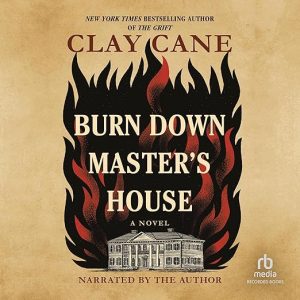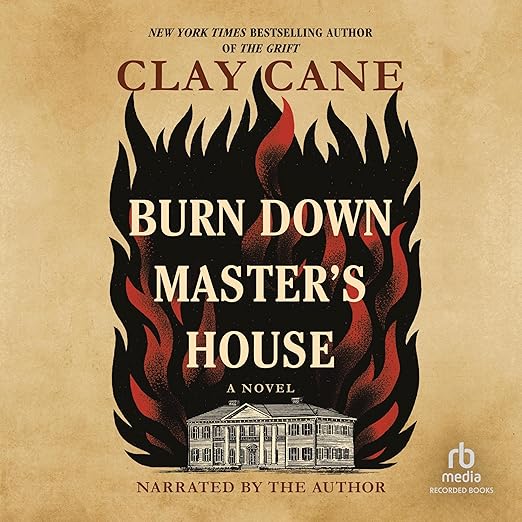
I started Burn Down Master's House on a Saturday morning with the intention of listening for an hour, maybe two. I did not stop until late afternoon. Clay Cane's novel does that thing that the best historical fiction does: it makes the past feel breathing and specific and unbearably close. By the time I got to the final sequences I was sitting on my kitchen floor, back against the cabinet, not willing to be anywhere comfortable while these characters were suffering and fighting and burning.
Cane, an award-winning journalist and New York Times bestselling author, has drawn on true stories of enslaved people who resisted their enslavement, men and women whose names history mostly did not preserve. The novel follows five interlocking perspectives across time and geography, all connected by the Virginia plantation called Magnolia Row and by the spreading fire of resistance that moves through their lives. Luke, literate and sharp, and Henri, fierce and defined by an unbreakable spirit, form the beating heart of the book. Around them: Josephine, who learns to make silence into a weapon. Charity Butler, who fights for her freedom through the courts. Nathaniel, a man who has become a perpetrator of the very system that first victimized him.
Historical fiction with multiple viewpoints lives or dies by whether the separate storylines justify their independence or whether the reader simply waits to get back to the characters they prefer. Cane sidesteps this problem almost entirely because each of his five protagonists is fully realized and because the connections between them are structural rather than coincidental. The reader understands that these individual acts of resistance are, together, something larger than any single person's story. That is the book's central argument, articulated through form rather than thesis statement: resistance is not heroic individuals but fire passed between people who never met each other, burning across time.
One reviewer described the reading experience in terms that evoked specific scenes from contemporary cinema, and another called for Ryan Coogler to direct the adaptation. Both responses signal the book's cinematic density. Cane's prose is richly visual, building scenes that are physically immediate in a way that rewards audio presentation. You see these characters. You feel the heat and the fear and the specific quality of determination in each of them.
Cane's Own Voice Knows Where the Weight Falls
Clay Cane narrating his own novel is a different calculation than a nonfiction author reading their own work. Fiction narration demands more in terms of voice differentiation and pacing. What Cane offers is something a professional narrator hired cold could not replicate: an intimate knowledge of what each sentence is meant to do. He knows where the weight falls in every line because he put it there. His performance for Luke and Henri in particular is strong, each man physically distinct in sound, the intelligence of one and the physicality of the other coming through without caricature.
At 11 hours and 28 minutes, the book is substantial enough to develop its multiple timelines with real care, and Cane sustains focus across the full length. There are passages where the novel's density, the historical detail, the interwoven storylines, might challenge listeners who prefer a faster-moving narrative. But the book earns its complexity, and listeners who commit to it will find that the structural choices pay off in the final act in ways that simpler storytelling could not have achieved.
Nearly a Thousand Listeners Gave This 4.7 Stars
Multiple reviewers, including one with a graduate degree in history, have praised the novel's historical accuracy alongside its emotional force. Cane is working with the documented record of American slavery while building fictional lives that illuminate what the record cannot preserve: the interior experience, the private language of resistance, the specific calculations that went into each act of defiance.
The book arrived in January 2026 as an instant New York Times and USA Today bestseller, and the 4.7 rating across nearly 1,000 listeners reflects genuine enthusiasm rather than hype. Readers who love Colson Whitehead's The Underground Railroad, Jesmyn Ward's Sing, Unburied, Sing, or Percival Everett's recent work will find Cane operating in that same charged territory: fiction as historical witness, narrative as an act of recovery for stories that were deliberately destroyed.
Violence That Refuses to Look Away From History
This is not comfortable reading, and it should not be. The graphic depictions of violence, which reviewers consistently note are never gratuitous, serve the book's insistence that slavery cannot be made palatable. Cane will not let you look away from what was done. But he also will not let you forget that people fought back, and that dual obligation, to witness and to restore, is what this kind of fiction is for. A history teacher who reviewed the audiobook noted being deeply impressed by both its accuracy and its gut-wrenching message, which gets at what Cane has achieved: not a novel that substitutes feeling for rigor, but one that insists the two are inseparable.
Listeners who are drawn to this material should also know that Cane has indicated in interviews his intention to continue writing historical fiction rooted in Black American experience. This novel establishes him as a voice of genuine consequence in that tradition, working from the same moral urgency and narrative ambition that distinguishes the best of the genre. The book deserves the widest possible audience, and the audiobook format serves it well.
A Few Questions About Burn Down Master's House
Is Burn Down Master's House based on real historical events and people?
Yes, with important distinctions. Cane was inspired by true stories of enslaved people who resisted their enslavement, but the specific characters are fictional constructions built around that historical record. The novel is rigorous in its historical detail while taking the imaginative liberties that fiction requires.
How graphic is the violence in the audiobook?
Multiple reviewers describe the depictions of violence as intense and deeply unsettling but never gratuitous. The violence serves the book's commitment to historical honesty about what slavery was. Listeners sensitive to detailed depictions of physical brutality should know this going in.
Does Clay Cane effectively differentiate between five separate narrators in his performance?
Yes. Each of the five viewpoint characters has a distinct vocal presence, with Luke and Henri particularly well differentiated. Cane's intimate knowledge of the material gives his narration an authority that carries across the full 11-hour-plus runtime.
Which authors does Burn Down Master's House most closely compare to?
Cane's publisher and readers consistently cite Colson Whitehead, Jesmyn Ward, and Percival Everett as useful comparisons. Like those writers, Cane uses the specific facts of American racial history as the foundation for fiction that operates at a philosophical and emotional level beyond historical documentation.