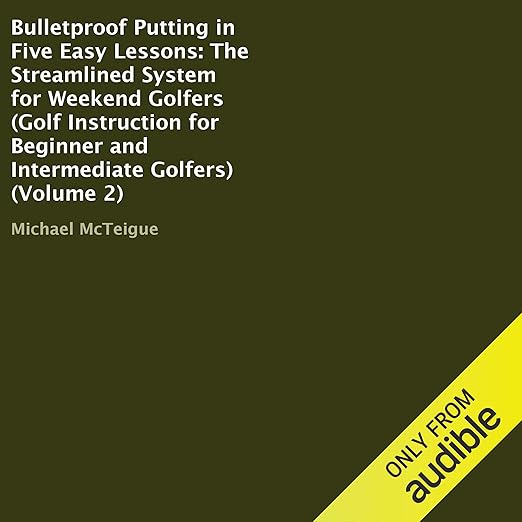
I do not play golf. I want to be upfront about that, because it shapes what I can and cannot assess here. What I can assess, after nearly three hours with Bulletproof Putting in Five Easy Lessons, is whether Michael McTeigue's instructional design is clear, whether the audio format serves it, and whether the book delivers on its specific promise to recreational golfers who want to lower their scores without becoming slaves to the practice green.
McTeigue is a former Northern California PGA Teacher of the Year, and more usefully for this book, the author of The Keys to the Effortless Golf Swing, which appears to have built him a loyal audience among recreational players. He knows his target listener well: busy adults with limited practice time, realistic expectations about their handicap trajectory, and a specific frustration with three-putting that is costing them strokes on holes where they should be scoring well.
Our Take on Bulletproof Putting in Five Easy Lessons
The system is elegant in its simplicity. McTeigue organizes putting into four categories, slam dunks, drillable putts, drainable putts, and lag putts, each requiring a different approach and a different level of ambition. This taxonomy is immediately useful because it replaces the vague instruction to make every putt with a realistic framework for what success actually looks like from different distances. A three-footer and a thirty-footer are not the same task, and treating them the same way is part of why recreational golfers struggle with consistency.
The green reading chapter and the preshot routine material are where the book does its most genuinely practical work. Reading greens consistently is a skill that many recreational players underestimate, and McTeigue provides a structured approach that is simple enough to apply under the distraction of actual play. The routine material is similarly grounded, focusing on building repeatability rather than perfecting mechanics.
Why Listen to Bulletproof Putting in Five Easy Lessons
Dave Wright's narration is a natural fit for instructional material. He reads with the calm encouragement of a good teaching pro, which is exactly the register this content requires. He does not dramatize the technical passages or rush the conceptual sections, giving each lesson time to settle before moving on.
At just under three hours, this is a lean and efficient audiobook that respects the listener's time. That brevity is appropriate. Golf instruction does not benefit from padding, and McTeigue does not pad. The five lessons move with purpose, and the specific practice recommendations, including a fourteen-putt carpet routine that multiple reviewers credit with genuine improvement, are concrete enough to implement immediately after listening.
What to Watch For in Bulletproof Putting in Five Easy Lessons
The book is strongest when it provides specific, actionable practice routines rather than general principles. The carpet-putting recommendation in particular, which multiple reviewers describe in detail and credit with tangible results, is the kind of interval practice that actually transfers to on-course performance for busy recreational players. One reviewer who describes playing to a thirteen handicap credits the Bulletproof system with taking them to an eight at their best.
The limitation of audio for this content is worth noting. Putting instruction involves physical mechanics that are easier to demonstrate visually than to describe verbally, and there are moments in the stroke-mechanics sections where a video supplement would serve the listener better than words alone. McTeigue writes clearly enough that this is manageable, but listeners who find they need to hear a physical description multiple times to internalize it will benefit from pausing and replaying.
Who Should Listen to Bulletproof Putting in Five Easy Lessons
Recreational golfers who have tried and abandoned previous putting systems will find McTeigue's approach refreshingly pragmatic. He does not promise transformation through practice volume. He promises improvement through focused, intelligent practice that accounts for the reality that most of his readers are going to get to the course on weekends and maybe squeeze in a few sessions on the living room carpet during the week.
Serious players pursuing scratch golf or single-digit handicaps will likely find this too elementary for where they are. And non-golfers will get very little from it, as the instruction is specific enough to require at least some baseline familiarity with the game. But for its intended audience, this is an honest, useful, and efficiently delivered audiobook that delivers on every one of its stated goals.
Frequently Asked Questions
Can this audiobook substitute for in-person putting instruction, or is it best used as a supplement?
It works as a standalone system for recreational golfers, but it complements in-person instruction well. McTeigue's routines are specific enough to practice independently, though some of the stroke-mechanics guidance benefits from having a mirror or video to self-check your form.
How does Dave Wright's narration handle the physical mechanics of putting technique?
He describes the mechanics clearly and without rushing, which is the right approach for instructional content that needs to be internalized rather than just heard. The audio format works for the conceptual material but listeners may need to replay certain physical technique passages.
Is this book worth listening to if you have already read The Keys to the Effortless Golf Swing?
Yes. The books are part of the same instructional series but cover different aspects of the game. Putting and the full swing require different approaches, and readers who benefited from the swing book will find Bulletproof Putting applies the same clear-thinking framework to a distinct skill set.