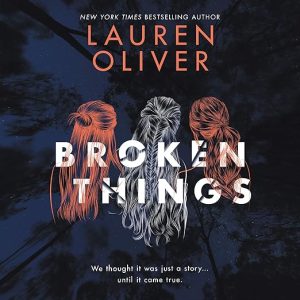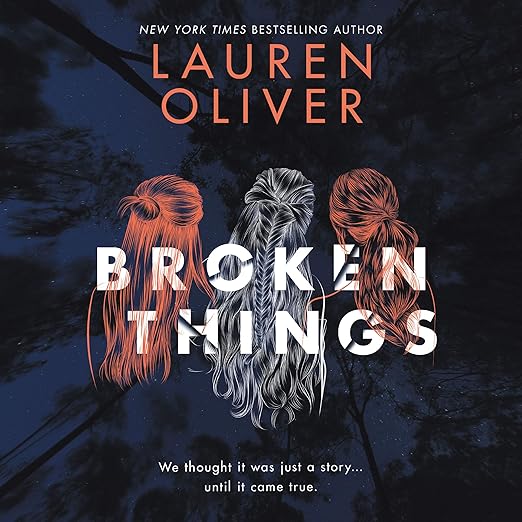
I started Broken Things on a Sunday evening when the light outside was already grey, which turned out to be exactly the right weather for it. Lauren Oliver writes a particular kind of darkness that is rooted in adolescent interiority, in the way teenage girls form relationships that are simultaneously sustaining and consuming, and this book is among her most precise expressions of that territory. The premise, two girls accused of murdering their best friend five years ago, now trying to solve her death on the anniversary of the crime, sounds like genre scaffolding. In practice it is a structure Oliver uses to examine something more specific: what happens to identity when you are defined publicly by the worst thing anyone believes you have done.
The five-year time gap is important. Mia and Brynn are not the thirteen-year-olds who lost Summer. They are eighteen-year-olds who have grown up inside a specific kind of social verdict and have been shaped by it differently. Mia has developed a surface competence, an ability to function under surveillance. Brynn has been more damaged, is carrying the weight more visibly. Their reunion is not comfortable, and Oliver doesn't make it comfortable. The friendship at the center of this book is not a warm thing; it is a thing that both sustains and implicates these characters.
How Broken Things Holds Up
One of Broken Things' genuine pleasures is the invented novel that sits at the center of the plot. Lovelorn is a children's book that the three girls became obsessed with, and Oliver renders it with enough specificity that it functions as a real thing inside the narrative rather than a convenient symbol. The girls' fan fiction, the darker text they wrote together in the shed in the woods, is the document everyone believes proves their guilt. Oliver uses the device to explore something true about creative adolescent friendships: the way the imaginative world a group of young people builds together can be more real to them than their actual circumstances, and the way that investment can be misread from outside as evidence of pathology.
One reviewer here noted that the Lovelorn sections reminded them of their own Harry Potter obsession, and that recognition, the way intense reading and world-building in groups is a normal part of adolescent experience that can look, from a prosecutorial distance, like something sinister, is exactly the book's point.
Why Broken Things Works as an Audiobook
Oliver structures the novel across multiple perspectives, including Mia's first-person present, Brynn's first-person present, and interspersed passages from the Lovelorn fan fiction. This is a technically demanding structure for audio, and Sarah Drew manages it with enough vocal distinctiveness that listeners can generally track where they are without the chapter headers. The reviewers who noted occasional confusion are not wrong; there are moments, particularly in the earlier chapters where the characters are still being established, where the switches require active attention. But Drew's Brynn is notably more frayed than her Mia, which is both a character distinction and a narration choice that pays off as the book's emotional stakes clarify.
The reviewer who described this as an atmospheric thriller that adds nothing new to the genre is raising a fair but not decisive point. The investigation structure, the unreliable narrator, the twist ending: these are genre conventions. What Oliver brings to them is writing that is substantially better than the conventions require, and a central friendship that is more psychologically complex than YA thriller conventions typically demand.
Weak Spots in Broken Things
The resolution of who killed Summer is genuinely surprising, and it arrives from a direction the book's earlier passages have prepared in ways you only recognize in retrospect. That is good structural writing. The reviewer who called it a nail-biter is using thriller vocabulary for something that earns the description through accumulation of detail rather than jump scares. Oliver's actual technique is closer to tightening a noose very slowly than to sudden shocks, and for that approach to work over nine-plus hours, the character investment has to hold. Here it does, in large part because Mia and Brynn feel like people whose history is real rather than assembled for plot purposes.
The Right Listener for Broken Things
Adult readers of literary-adjacent YA thrillers, the Delirium and Panic audience Oliver has built, will be in the right territory here. Listeners who come primarily for action-paced thriller conventions will find the middle section's introspective passages slow. Those who are interested in how YA fiction handles the psychology of false accusation, social exile, and the aftermath of violence on adolescent identity will find this more satisfying than a plot summary suggests. It's not the book Oliver's Delirium fans were expecting, but it is a more mature and formally interesting book than most genre comparisons acknowledge.
Questions Listeners Ask
How does Sarah Drew handle the different narrative voices, particularly the Lovelorn sections?
Drew gives Mia and Brynn meaningfully different vocal textures that help listeners track the POV switches. The Lovelorn fantasy sections are delivered with a slightly removed, almost ritualistic quality that distinguishes them from the present-day investigation sections. The multi-narrator challenge is well managed, though the earliest chapters require active attention before the character voices are fully established.
Is there a free audiobook version of Broken Things available on Audible?
Yes, Broken Things is available at no cost on Audible for eligible members. Check current availability through the link on this page, as pricing and membership terms are subject to change.