At a Glance
- Read by: Adrian Vargas brings an authenticity to Francisco Jimenez's voice that feels biographical rather than performed, the restraint in the narration matches the restraint in the prose.
- At its heart: Immigration and identity, the cost of poverty on ambition, family solidarity under sustained pressure
- Vibe: Quiet and unflinching, with a dignity that never tips into sentimentality or self-pity
- Short version: A slim, precisely observed memoir that asks very little of your time while giving considerably more in return, more honest than most adult nonfiction about the same subjects.
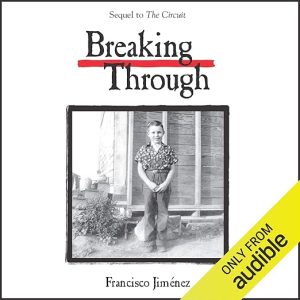
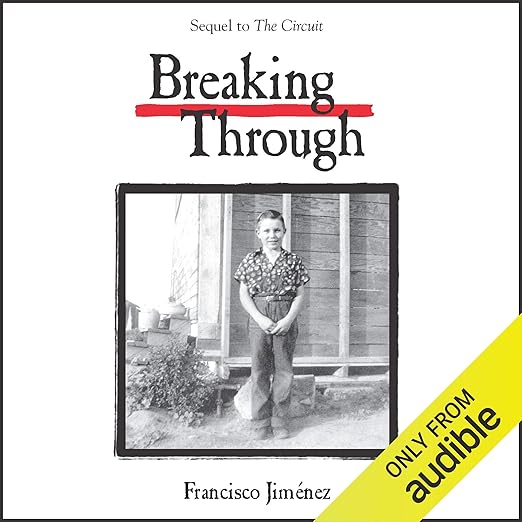
Breaking Through is the book I find myself recommending to people who tell me they do not read YA. It is technically a young adult memoir, Francisco Jimenez wrote it as a sequel to The Circuit, both published initially for school-age readers, but the qualifier feels beside the point. What Jimenez has written, in both books, is simply an honest account of his family's experience as migrant farmworkers in California, told without the bitterness the experience would have justified and without the inspirational uplift that would have made it easier to market but far less true. The audiobook, narrated by Adrian Vargas, runs just under five hours, and I finished it in two sessions feeling like I had spent time with something considerably more substantial than the runtime suggested.
The story picks up where The Circuit ended. Francisco is fourteen when the family is caught by immigration enforcement, la migra, in Jimenez's consistent, uneuphemistic language, and he and his mother are sent across the border while his brother Roberto and his father are deported separately. What follows is the family's reconstitution in the United States and the years of labor, poverty, and deliberate hope that carry Francisco through high school and, eventually, to Santa Clara University on a scholarship. It covers a lot of biographical ground in just over four hours. That compression is intentional. Jimenez does not dwell; he observes, records, and moves forward with the economy of a writer who trusts the facts to carry their own weight.
One reviewer noted that the book "did not push an agenda, but provided a story based on an unbiased view", and whatever one makes of that framing, there is something accurate in it about the prose's quality. Jimenez has the quality of a person who survived difficult things and decided, very deliberately, to tell them plainly. There is no editorial resentment of the systems that oppressed his family. There is no performed gratitude for America's eventual embrace of his achievements. There is just the record: the labor, the school, the prejudice, the love between family members who are trying to hold something together across enormous structural pressures, the decision to keep going when keeping going requires more than most people are ever asked to give.
What Francisco Jiménez Gets Right
Adrian Vargas's narration brings something specific to this material that a silent reading cannot replicate. The Spanish phrases that appear throughout, and they appear frequently, naturally, as part of the bilingual reality of Jimenez's upbringing, are handled with the ease of someone for whom this code-switching is not exotic but ordinary. One reviewer noted using the audiobook to improve their English comprehension of the material; another recommended it specifically to someone with a similar background to Francisco's. Those responses speak to something real about how Vargas's reading positions the listener: inside the experience rather than observing it from outside, which is exactly where Jimenez's prose always intends you to be.
Where Francisco Jiménez Loses Some Ground
The young adult designation matters logistically, this is used widely in middle school and high school curricula, and the audiobook has clearly reached students that way, as several reviews attest. But for adult listeners it operates differently: as a reminder of how much is compressed into adolescence when the conditions are hard, and how much dignity is possible when someone refuses to organize their story around their own suffering. One reviewer who purchased it for a college-age child noted they found it worth reading themselves, which is the appropriate response. The book is not asking for sympathy. It is offering testimony, and the distinction between those two things is what makes Breaking Through worth returning to long after its school-assignment context has passed.
Who Should Pick Up Breaking Through
The memoir has a 4.7 rating across more than 750 reviews, which for a fifteen-year-old audiobook represents sustained engagement across multiple generations of listeners rather than a spike driven by novelty. That durability reflects what the book actually is: not a timely intervention in a current debate but a record of a specific American experience told with the clarity that only comes from proximity. Jimenez lived this, wrote it without embellishment, and Adrian Vargas reads it without performing more emotion than the material itself generates. The restraint at every level is the achievement.
Who should listen: Educators, parents, and readers interested in firsthand accounts of immigration and migrant labor without the mediation of journalistic distance; anyone who read The Circuit and has been meaning to continue; adult listeners who are skeptical of YA as a category but willing to have that skepticism tested. Who should skip: Listeners who need narrative complexity or plot tension, this is a measured, episodic memoir rather than a propulsive story, and it moves at its own considered pace.
Do I need to have read The Circuit before listening to Breaking Through?
Not strictly, but it helps. The Circuit covers Francisco's earlier childhood as a migrant farmworker, and Breaking Through functions as its direct sequel. Listening to The Circuit first provides context for the family relationships and circumstances that this book builds on throughout.
Is this appropriate for the age range it is marketed to, or is the content difficult for younger readers?
Jimenez wrote it for young adult readers, and the prose level and structure reflect that. The content, poverty, deportation, prejudice, family separation, is not softened, but it is handled with care. Most educators who assign it find it one of the more honest and accessible treatments of immigration history available to that age group.
Is this book primarily about the immigration experience or about academic achievement?
Both, and they are inseparable in the text. Francisco's pursuit of education happens entirely within and because of his family's immigration circumstances. The book does not present achievement as an escape from identity, it presents it as something Francisco carried alongside everything else he was carrying.