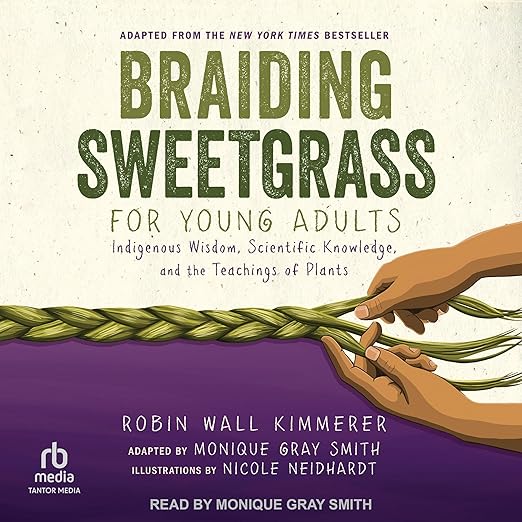
I picked up the original Braiding Sweetgrass several years ago when it was being passed around literary circles as something different from the usual nature writing. It was different. Robin Wall Kimmerer's ability to move between Indigenous wisdom and rigorous botanical science without either losing its specificity felt genuinely rare. When I came across this adaptation for young adults, narrated by the adapter herself, I was curious whether the translation would hold. I listened on a quiet afternoon with the windows open, and I came away thinking that Monique Gray Smith had found something that the original does not quite offer: a version of these ideas calibrated for someone who is encountering them for the first time, without the accumulated habits that make adult readers skim over foundational concepts.
Gray Smith reading her own adaptation is the obvious right choice. She is an Indigenous author and storyteller, and her voice carries a relationship to this material that no professional narrator could approximate from the outside. The pacing is deliberate without being slow, and the natural pauses she gives certain passages suggest someone who understands that this kind of knowledge is meant to sit with you rather than be processed and moved past.
What Robin Wall Kimmerer Delivers
Kimmerer's original argument, that plants are not resources to be extracted but beings with agency and gifts to offer, is philosophically straightforward but counter to almost everything that Western scientific education reinforces. The adaptation preserves this core thesis and brings it to younger listeners through the specific lens of strawberries, witch hazel, water lilies, and lichen, plants that appear across Kimmerer's writing as teachers rather than as specimens. Gray Smith's adaptation does not simplify these ideas so much as it surrounds them with more accessible framing and a tone that invites the reader in rather than assuming prior botanical or ecological knowledge.
What Robin Wall Kimmerer Gets Right
The audiobook has an advantage here that the print version also has but that is perhaps easier to feel on audio: it rewards slow consumption. Reviewers consistently note that this is not a book to rush through. One writes about listening with feet up and a warm drink, which is exactly the kind of attentiveness the material earns. Another describes incorporating lessons from the book into actual community garden work, which tells you something about the practical dimension of what Kimmerer and Gray Smith are offering. This is not merely inspirational nature writing; it contains real information about plants, reciprocity, and ecological practice. The adaptation is also notable for what it communicates about the losses North American ecology has sustained over the past few centuries, without tipping into despair. The balance between grief and hope is maintained carefully.
Where Robin Wall Kimmerer Loses Some Ground
Listeners coming to this from the original Braiding Sweetgrass will find some passages condensed and some of the more complex scientific discussions made more accessible. That is the nature of an adaptation rather than a flaw. Younger listeners, or adults who have not encountered Indigenous botanical knowledge before, will likely find this version more immediately usable. The book is not exclusively for young adults, as several reviewers emphasize, and its ideas translate across age groups. The running time of just under eight hours makes it a manageable listen that can be spread across several sessions without losing coherence.
Who Should Pick Up Braiding Sweetgrass for Young Adults
Young adults interested in ecology, Indigenous knowledge, or environmental activism will find this an ideal audiobook. Educators looking for a substantive, accessible text on reciprocity with the natural world will find the format particularly useful. Adults who have been meaning to read the original but found its length or depth intimidating may find this adaptation a valuable entry point. This is less suited to listeners looking for fast-paced narrative or those who prefer strictly scientific ecology without the philosophical and cultural dimensions that make Kimmerer's work distinctive.
Frequently Asked Questions
Do I need to have read the original Braiding Sweetgrass before listening to this adaptation?
No. The adaptation works as a standalone introduction to Kimmerer's ideas and is specifically designed for listeners who may not have encountered them before. Readers of the original will find it condensed but complementary rather than redundant.
How does Monique Gray Smith's narration differ from a standard professional narrator?
Gray Smith brings an insider relationship to the material as both the adapter and an Indigenous author. Her pacing reflects an understanding of how Indigenous oral traditions approach knowledge-sharing, with deliberate pauses and a warmth that professional narrators working from the outside would struggle to replicate.
Is this audiobook genuinely accessible to young adults, or does it talk down to them?
The adaptation is written to be accessible without being condescending. Several adult reviewers note that it works just as well for older listeners, and the material's depth is preserved even as the framing is made more approachable.
What specific plants or ecological topics does the adaptation focus on?
The book draws on Kimmerer's botanical work with plants including strawberries, witch hazel, water lilies, and lichen, using them as case studies for broader lessons about reciprocity and ecological listening. The coverage is thematic rather than encyclopedic.