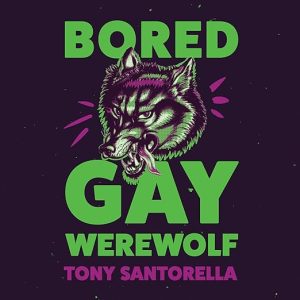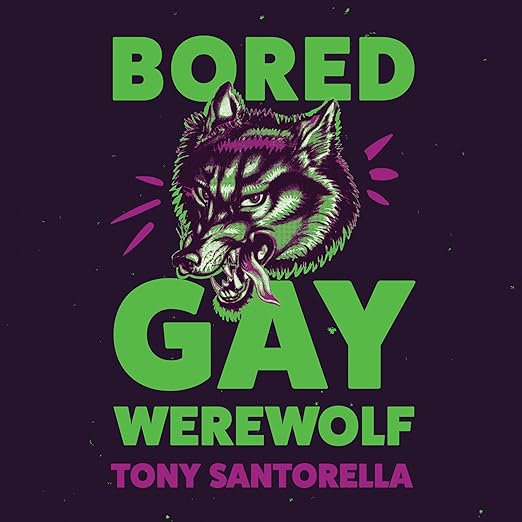
I picked up Bored Gay Werewolf on the recommendation of a reader who described it as Zombieland energy with a queer coming-of-age core, and that is a reasonable shorthand. What I did not expect was how much the comedy would depend on understatement, Brian's narration is flat in the way of someone who has stopped being surprised by his own catastrophes, and Tony Santorella uses that flatness with real precision. When Brian mentions, almost in passing, that he may have accidentally marked out guys who ghosted him on Grindr as potential monthly victims, the line lands because it arrives without fanfare.
Brian is twenty-something, works doubles at a shift job, cannot quite manage to clean his room, and has been a werewolf long enough that the monthly transformation is more logistical inconvenience than existential crisis. His closest relationships are with Nik and Darby, the latter using they/them pronouns, and one reviewer specifically called out how Darby's dialogue lifted the whole thing, and the novel's emotional center is really about that found family being tested by Tyler's arrival.
Our Take on Bored Gay Werewolf
Tyler is the book's smartest invention: a Millennial were-mentor who speaks entirely in self-help language and runs what amounts to a lupine wellness cult. The satire here is sharp without being cruel. Santorella is interested in why someone like Brian, aimless and lacking structure, would be susceptible to someone like Tyler's brand of confident purpose. The most stressful element of the novel, as one reader noted, is not the supernatural violence but watching a confused queer guy get slowly absorbed into a toxic bro culture. That dynamic is recognizable and real regardless of the werewolf scaffolding around it.
The novel is uneven in places. A few reviewers felt the characters needed more development, particularly Brian, whose personality shifts somewhat depending on which scene he is in. The gritty moments sit awkwardly against the more comedic register. But the book's best quality is that it never tries to be more important than it is, it is a brisk, funny, LGBTQ+ paranormal comedy that wants to entertain you and occasionally surprise you, and it does both.
Anthony Nyro's narration is the right call for this material. He keeps Brian in a register that is world-weary without being dour, and he handles the tonal shifts between comedy and creeping unease without making them feel jarring. The audiobook clocks in at six hours and thirty-four minutes, which is about right for this kind of novel, long enough to develop the friendship dynamics that carry the emotional weight, short enough that you are not waiting for things to happen.
The paranormal elements are present but light on the page, the werewolf logistics are treated with the same casual acceptance Brian brings to everything, which prevents the novel from becoming bogged down in mythology. If you are looking for detailed world-building around the supernatural ecosystem, this is not that book. If you are looking for a funny, occasionally dark story about finding your people and recognizing the ones who are not your people, it delivers.
What to Watch For in Bored Gay Werewolf
The pacing in the middle section slows as Brian gets drawn further into Tyler's orbit. Santorella is building toward the revelation that Tyler's plans extend well beyond self-improvement seminars, but the process of getting there requires spending time with Brian in a passive, somewhat frustrating state. Readers who need their protagonists to make decisions will feel this stretch. Readers who find Brian's passivity funny in the way that recognizable human paralysis can be funny will move through it more easily.
The novel ends in a way that sets up further adventures in Brian's world, and while the central conflict resolves, some character threads are left open. At a 3.9 average rating it is clearly a book that divides readers, and the division tends to fall along lines of tolerance for shaggy, character-driven comedy versus tightly plotted genre fiction.
Who Should Listen to Bored Gay Werewolf
This one is specifically for LGBTQ+ listeners who enjoy paranormal fiction with a comedic edge and are comfortable with protagonists who take a long time to get their act together. Fans of Casey McQuiston's more grounded work, or of T. Kingfisher's comedic horror, will likely find something here. Listeners who need well-defined supernatural rules and tight plotting should probably look elsewhere. And anyone who has ever been in a friend group slowly colonized by someone with too much charisma and a suspiciously coherent worldview will recognize something uncomfortable and true in Tyler's storyline.
- Read by: Anthony Nyro captures Brian's slacker deadpan without turning it into a one-note joke, he is consistently readable even when the character is at his most passive.
- At its heart: Queer identity and found family, toxic self-improvement culture, the difficulty of growing up without a map
- Vibe: Campy and conversational, with an undercurrent of genuine anxiety
- Short version: A genuinely funny queer paranormal comedy that works best when it trusts its weirder instincts and leans into Brian's believably messy humanity.
How much does the werewolf mythology matter to the plot?
The mythology is light and treated casually, Brian is a werewolf the way someone might be a night-shift worker, as an inconvenient fact of life. The supernatural elements escalate in the final act, but the novel is not primarily concerned with building out its paranormal world.
Is Bored Gay Werewolf the first book in a series?
Yes, the ending suggests Brian and his found family will face further complications, and at least one reviewer mentioned looking forward to Book 2. The central conflict of this installment does resolve, but it is clearly an opening chapter for something larger.
How does Anthony Nyro handle the ensemble of characters since Brian narrates in first person?
Nyro differentiates the secondary characters through vocal shifts rather than distinct character voices, which keeps the narration consistent with Brian's perspective. Darby in particular comes through clearly, which matters given how much of the emotional work they carry.