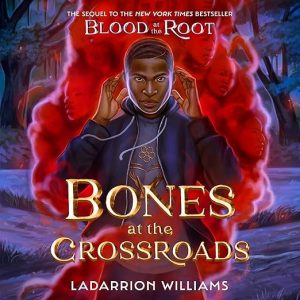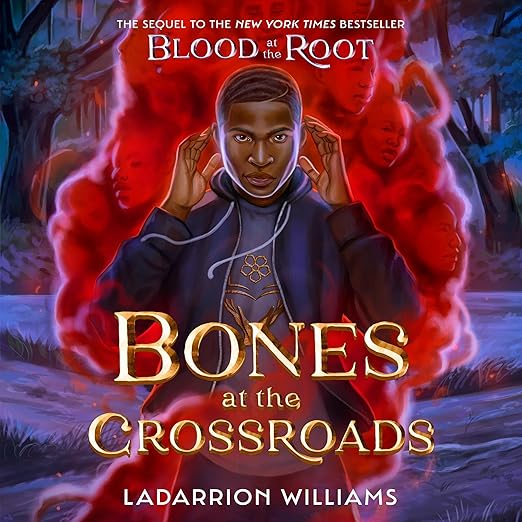
Caiman University is in Homecoming season, and Malik Baron's stated goal is deceptively, heartbreakingly modest: be a regular seventeen-year-old college student. Go to parties. Pick a major. Figure out whatever is developing between him and a classmate. The problem is that Caiman is a magical HBCU for young Black Conjurers, and Malik spent the summer before this semester reeling from revelations about his family, his heritage, and his powers. Bones at the Crossroads, the audiobook sequel to the New York Times bestselling Blood at the Root, is the installment that earns what the debut promised. Where the first book discovered the world, this one inhabits it. Jalyn Hall returns to narrate, and his performance is one of the primary reasons the second installment works as well as it does in audio form.
LaDarrion Williams is doing something structurally interesting in the Blood at the Root series that becomes clearer in this second book. He uses the recognizable scaffolding of the magical school narrative - the secret society, the new mentor figure, the romantic complication, the threat from within an institution that is supposed to be safe - but grounds every element in specifically Black American history, magical tradition, and community. The ancient magic that the secret society Malik joins traces back through is not generic fantasy world-building borrowed from European tradition. It connects to real heritage, to the history that Caiman University was created to protect and transmit across generations. That specificity is what separates this series from comparable YA fantasy and gives its conflicts their particular emotional weight.
Reviewer Anya Nicole described the second book as shifting "from discovery to transformation, as Malik begins to understand not only who he is, but where he comes from and what he was born to do." That framing is right. Blood at the Root was the origin story. Bones at the Crossroads is the story of what the protagonist does with what he now knows, even when that knowledge is frightening, contested, and actively used against him by people who should be on his side.
Why Bones at the Crossroads Works as an Audiobook
The nearly nineteen-hour runtime reflects Williams's ambition for this installment. The plot threads are genuinely numerous: the family he has only just found and that is already "fractured beyond repair," the new relative who arrives with more questions than answers, the mother whose reappearance may represent "the biggest threat to the life he's trying to build," the ancient obligations of the secret society he joins, the classmate whose friendship might mean something more significant if Malik can let himself be present enough to find out. Jalyn Hall manages this multiplicity without losing the listener in the transitions between storylines. His character differentiation is sharp - the mother, whose role in this volume is deliberately unsettling, has a distinctly different energy from the new relative, who represents a mystery of another kind entirely - and his voice for Malik himself anchors the story emotionally through all its movement.
What Hall does particularly well is track the specific emotional register of a teenager who wants ordinariness and keeps being denied it. Malik is not a chosen-one archetype who secretly wants to be special. He genuinely wants to go to parties and worry about normal things. The gap between that desire and his actual circumstances - the powers he cannot yet control, the community threats, the family entanglements - is where the audiobook's emotional core lives, and Hall conveys that gap with the kind of specificity that makes character feel real rather than functional.
Weak Spots in Bones at the Crossroads
This is a sequel that assumes you have read Blood at the Root, and the assumption is real. The family dynamics, the specific nature and history of Malik's powers, the events of the summer that have left him "reeling from revelations, heartbreak and betrayal" - none of this is reconstructed for new listeners. Williams trusts his returning audience to bring that context, which is the right choice for a series installment but represents a genuine barrier for anyone entering with this book. The emotional stakes of the mother's return depend entirely on the listener knowing what Malik knows about her from the first book. New readers should start with Blood at the Root before listening to Bones at the Crossroads - there is no shortcut through the necessary context.
The nearly nineteen-hour runtime is substantial and reflects genuine narrative depth. Williams is managing multiple threads - the secret society, the family threats, the romantic development, the ancient history of Conjurer magic - and the audiobook earns most of that length. The story does not rush toward resolution, which is consistent with this being the middle installment of what is clearly a continuing series. Several threads are deliberately left open for future books, and listeners who prefer complete narrative closure per installment should set those expectations accordingly.
The Right Listener for Bones at the Crossroads
Listeners who finished Blood at the Root and wanted more time inside Caiman University - more of the HBCU culture, the Conjurer traditions, the specific social dynamics of a community built around magical practice and Black American history - will find Bones at the Crossroads the most complete exploration of that world Williams has produced to date. Jalyn Hall's narration is a strong argument for the audiobook format specifically: the character work he does across nearly nineteen hours is an asset that the print version cannot replicate. YA fantasy readers who are drawn to series that take their protagonists' interior lives as seriously as their external adventures will find this second installment more complex and more demanding than the debut, which is a sign of a series with genuine ambition beyond its origin story. New series listeners: start with Blood at the Root, then come back to this one.
Key Details
- Voice: Jalyn Hall narrates with energy and emotional intelligence - he captures Malik's specific register as a teenager trying to claim ordinary life while carrying extraordinary inherited weight.
- Big ideas: Legacy and chosen identity, magical HBCU culture, the cost of power you cannot yet control
- Atmosphere: Kinetic and emotionally grounded, with real stakes beneath the supernatural scaffolding
- Worth it?: LaDarrion Williams deepens and complicates his world in Bones at the Crossroads, moving the series from origin story into territory with more staying power and more genuine ambition.