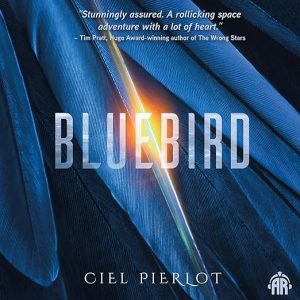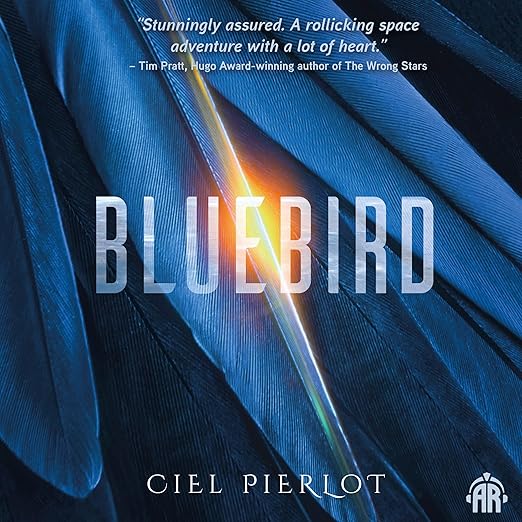
I started Bluebird on a weeknight when I had been reading dense nonfiction for two weeks straight and needed something that moved at a completely different speed. Ciel Pierlot's debut arrived with a premise I could not resist: a lesbian gunslinger fights spies in space, with a taser-wielding librarian girlfriend and a mysterious bounty hunter in tow. I was done with the first four chapters before I noticed I had missed dinner.
The setup is deliberately kinetic. Three factions vie for galactic control. Rig, who walked away from all of them three years ago, is pulled back in when her former faction threatens her twin sister's life. What follows is a galaxy-spanning heist-rescue-revolution that Pierlot keeps moving at a pace that rarely lets you settle into comfort for long.
What Ciel Pierlot Delivers
The book's genre coding is playful and aware of itself. The four-tag publisher classification, Independent Women, Robbing Hood, Keep Your Enemies Close, Guns Don't Kill People, gives you a sense of the authorial posture. Pierlot knows what she is writing and leans into it without letting the self-awareness become a substitute for substance.
What reviewers consistently return to is not the action but the character work. One reviewer noted the moments of lovely poignancy as the element that distinguished the book from its surface-level adventure packaging. Another praised the specific ways Rig and her bounty hunter companion Ginka's backstories are revealed as reflections of their personalities rather than exposition delivered in chunks. That kind of structural care is what separates good genre fiction from the merely entertaining.
The Firefly and Mass Effect comparison that surfaces in the reviews is useful: this is a book that understands found family dynamics as the emotional architecture of space opera, and it builds accordingly.
What Ciel Pierlot Gets Right
Stephanie Cannon's narration is one of the audiobook's genuine strengths. Rig is not an easy character to voice: she operates with a layer of bluster that needs to read as genuine without obscuring the vulnerability underneath. Cannon manages that balance, and listeners who have heard the audiobook specifically praise the character voice as distinct and consistent.
The queer representation is integrated rather than announced. Rig's identity and relationships are simply part of who she is and how the story unfolds, which is the approach that works. One reviewer explicitly noted that complaints about LGBTQIA content in the book missed the point: the representation is woven into the narrative rather than appended to it.
Where Ciel Pierlot Loses Some Ground
One reviewer gave four rather than five stars for a combination of plot points, writing quirks, and character inconsistencies they did not find fully resolved. Another, who approached it more analytically, noted that the technology is not particularly developed and the science fiction elements are more gestural than rigorously constructed. This is essentially a Western in space with queer protagonists, and its worldbuilding reflects that priority. Listeners who want hard science fiction with internally consistent tech will find the setting undercooked.
Some proofreading issues in the physical edition were flagged, though these are generally less perceptible in audio format.
Who Should Pick Up Bluebird
This works for listeners who want queer-centered space opera that prioritizes character and found family over technical worldbuilding. Readers who have enjoyed Ann Leckie's Ancillary Justice for its political intrigue or Charlie Jane Anders's The City in the Middle of the Night for its outsider protagonists will find Pierlot operating in a related register, though with a lighter touch and more genre fun. Those who require rigorously constructed science fiction universes will find the setting too loose. Listeners who need narratively tidy plots should know the pacing prioritizes momentum over resolution.
At fourteen hours, the audiobook is a substantial listen that uses its runtime to develop the ensemble rather than rushing toward resolution. Cannon's narration sustains the energy across the full length, which matters for a book this propulsive. If you have been looking for a queer space adventure that takes its characters seriously while also being genuinely entertaining, Bluebird delivers on both counts.