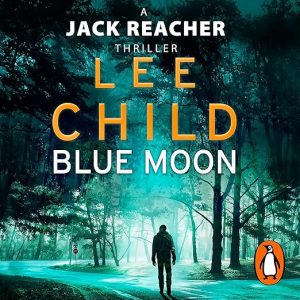
Blue Moon, the twenty-fourth Jack Reacher novel, opens on a Greyhound bus with Reacher noticing an elderly man sleeping with a fat envelope of cash clearly visible from his pocket. Another passenger has noticed too. This audiobook, narrated by Jeff Harding and running eleven hours and thirteen minutes, is the latest in Lee Child's long-running series, now carrying the additional cultural weight of the Prime TV series starring Alan Ritchson. The setup is classic Reacher: a stranger in need, a decision that will take the rest of the book to fully unpack, and a nameless city that becomes the stage for Reacher's particular brand of institutional violence against those who prey on the vulnerable. Harding's reading of the Reacher novels has earned the kind of dedicated following that makes his name part of the product itself.
The city Reacher finds himself in is nameless, which is not an accident. Child uses the generic urban setting to keep Reacher in a kind of permanent stranger status that the character's narrative identity requires. Two rival foreign gangs are competing for control of the city's criminal economy. The elderly man's vulnerability turns out to be connected to that competition in ways Reacher unpacks methodically, and the action escalates from a single act of bus-ride intervention into a full confrontation with both organizations simultaneously.
What Lee Child Delivers
Blue Moon sits comfortably in the established Reacher range: fast, violent, and constructed around the character's specific mode of threat assessment and tactical engagement. One reviewer noted that the story has a lot of killing, which at times was difficult to believe, but that Reacher's fast thinking and logic could almost make it believable. That near-credulity is the precise tone Child has been calibrating since Killing Floor. Blue Moon is not trying to do anything new with the formula, and that's both its limitation and its appeal. The Times called it one of his best, which is generous for a novel this close to its own template, but it means the template is being executed at a genuinely high level.
The elderly couple at the center of the plot, whose debt to the gangs sets everything in motion, are handled with more care than Reacher thriller peripherals often receive. Their vulnerability is specific rather than generic, and the gang competition over their situation creates a dynamic where Reacher's usual approach has to be adapted to circumstances where the sides are not cleanly separable from the people he's trying to protect. That complication is the novel's most interesting structural element and prevents it from being a purely mechanical exercise in the formula.
What Lee Child Gets Right
Jeff Harding has been narrating the UK editions of the Jack Reacher series for years, and his reading is as definitive in audio as Ritchson's performance is becoming on screen. The Sunday Times noted that Harding's narration captures Reacher's character perfectly and that you have to savour every minute. Harding delivers Reacher's flat, tactical interiority without making it monotonous, and the action sequences have a metronomic quality that suits the character's way of thinking. Reacher doesn't panic. Harding doesn't rush. The alignment between narrator voice and character psychology is precise.
The eleven-hour length is standard for the series and appropriate for the plot's scope. Child structures his novels with enough scene-level incident to keep the middle sections from sagging, and Blue Moon's gang competition dynamic generates a sufficient number of confrontational nodes to sustain momentum across the running time. The audio format suits this material particularly well because Harding's pacing makes the violence feel consequence-weighted rather than disposable, which is the trick the series has always had to perform to stay out of pure pulp territory and into something with actual craft behind it.
Where Lee Child Loses Some Ground
The nameless city setting is a deliberate feature rather than an oversight. Child uses anonymized geography to keep Reacher in a kind of permanent stranger status that the character's narrative identity requires. This novel doesn't try to embed Reacher in a specific place with specific history. It puts him in a problem and lets him solve it at the pace and with the methods the formula demands. Listeners who prefer the series entries where Child invests in a particular setting will find Blue Moon more schematic, but within its chosen scope it's clean and effective.
The rival gang structure involves organizations with Eastern European and Asian criminal backgrounds respectively, and Child maps their competition with enough specificity to make the strategic dynamics legible without deep geo-political texture. The violence is calibrated to Reacher's capabilities in a way that requires you to accept a certain level of physical impossibility as the genre convention it is. Reviewers consistently note this and consistently forgive it, which is the correct response to a series that has been making the same bargain with its audience for over two decades.
Who Should Pick Up Blue Moon
Established Jack Reacher listeners who want their next installment with Harding's narration will find exactly what they came for. Listeners who have encountered the character through the TV series and want to hear how the books sound will find Blue Moon a reliable entry point, though the canonical starting novel remains Killing Floor for those who want the full arc. Anyone looking for standalone crime thrillers with high body counts and a satisfying moral resolution will find Child's formula well-executed here. The nameless city premise also makes this an unusually portable entry in the series: because nothing about it depends on specific geography or prior relationship history with other characters, it works as a pure demonstration of what the Reacher novels are and why they have sustained a readership across twenty-four volumes. Readers seeking psychological interiority or moral ambiguity in their crime fiction should understand that Reacher is a different kind of hero, one who has resolved those questions definitively and operates cleanly from the conclusions.
In Brief
- Performance: Jeff Harding is one of the canonical Reacher narrators, and his reading of Blue Moon captures the character's flat affect and tactical precision without tipping into self-parody.
- What it covers: Street-level justice, territorial crime, the lone operator ethic
- Feel: Propulsive and violent, with the rhythm of a pulp classic executed at high competence
- Our call: Blue Moon is mid-series Reacher in its purest form, built for the established fan who wants the formula delivered with confidence, and Harding's narration has been praised even by The Sunday Times as making you want to savor every minute.
Is Jeff Harding the narrator on all Jack Reacher audiobooks?
Harding narrates the UK editions of the series, which are the editions most commonly available internationally. The US editions have used different narrators at different points in the series. Harding has become closely associated with the character and is widely regarded as the definitive audio Reacher.
How does Blue Moon compare to other audiobooks in the Jack Reacher series in terms of quality and violence level?
Blue Moon is considered by most series readers to be a solid mid-series entry, executing the formula reliably rather than innovating on it. The violence level is consistent with the series norm, which is to say substantial. It is not the series at its most experimental, but it's among the more polished mechanical executions of the Reacher premise.