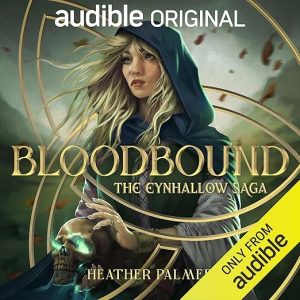
- Narration: Freya Mavor holds the narrator credit, but the description names a four-strong cast around her, Jessie Mei Li, Iain Glen and Tunji Kasim, placing this closer to audio drama than to a single-reader recording.
- Themes: Oath against revolution, undead armies, dynastic power, loyalty between women
- Mood: Hunted, cold, politically tense
- Verdict: A cast-driven fantasy sequel with genuine emotional architecture, though it demands the first book and carries no written account from any listener.
Where does loyalty end and complicity begin? Bloodbound puts that question to a squire rather than to a queen, and the choice of who has to answer it is what makes the book interesting. This audiobook runs thirteen hours and twelve minutes as the sequel to Deathbound, continuing Heather Palmer's tale of magic, oath and revolution in the kingdom of Eynhallow, and it arrives as something rarer than the credit line admits: a fully cast production, with four performers named in the description against a single name in the narrator field.
Stroma's Oath Against a Revolution's Promise
The setup is clean and the stakes are legible from the first page of description. Princess Ythsie is a fugitive with her squire Stroma beside her, both pursued by the Deathless and severed from everything familiar. Ythsie's aim is not to destroy the undead army that has held her kingdom in its grip for centuries but to release it, a nicely inverted quest: liberation of the enemy rather than its defeat. King Gillivrey meanwhile consolidates his throne, raising a fresh army and chasing a royal marriage to lock in his claim, so the clock runs against the fugitives in the ordinary way of dynastic fantasy.
The real center of gravity is Stroma. The description hands her the book's actual dilemma, a choice between the oath sworn to her princess and a rising revolution that would remake Eynhallow from the ground up, and that is a sharper conflict than most fantasy sequels bother constructing. An oath to a person, set against a cause that would abolish the position that person occupies, cannot be resolved by courage. Somebody has to be betrayed. The description's closing line says so without flinching, warning that "even the strongest oaths may not be enough to prevent everything from falling apart."
Mavor Returns With Three Uncredited Co-Stars
The production deserves specific attention, because the credit line understates what is on offer. The description names Freya Mavor, returning from Deathbound and known for Industry, alongside Jessie Mei Li of Shadow and Bone, with Iain Glen of Game of Thrones and Tunji Kasim of Nancy Drew joining for this installment. Only Mavor appears in the narrator field. That gap matters to a buyer, because a four-hander with distinct performers on distinct roles is a materially different experience from one reader voicing an entire kingdom, and those screen credits point toward actors rather than career narrators.
For this particular story the multi-voice approach earns its keep on paper. A book whose central tension sits between two women, a princess and her sworn servant, stands a good chance of benefiting from two separate voices holding those positions, since the imbalance of power between them becomes something a listener hears rather than infers from dialogue tags. Add a king consolidating a throne and a revolution recruiting in the margins and the casting starts doing structural work, giving each faction its own sound. Thirteen hours is a comfortable length for epic fantasy too, long enough to build a kingdom and short enough to finish inside a fortnight. I should declare a mild bias: full-cast productions tend to improve fantasy and tend to hurt literary fiction, because fantasy runs on faction while literary fiction runs on a single consciousness. This book sits squarely on the fantasy side of that line.
262 Ratings, Zero Written Reviews at All
Now the unusual thing about this listing, and it needs stating plainly. A 4.5 average sits here built from 262 ratings, alongside not one written review. Not a thin pool, not a stale pool, an empty one. A great many people have scored the book and nobody has said a word about it in public, which inverts the usual problem. In practice that leaves every question another listener might have answered, whether the cast overlap causes confusion, whether the middle sags, whether the ending satisfies, stays unanswered. The score establishes that people were broadly pleased. Nothing whatsoever establishes why. I am used to thin review pools and I am used to listings with nothing attached to them at all. This is neither of those, and it is stranger than both.
Start With Deathbound, or Inherit a War
Then the sequel problem, which is not negotiable. This is book two and the description makes no attempt to disguise it, opening by naming Deathbound and describing this as a continuation. Ythsie and Stroma are already separated from everything they knew when we meet them, the Deathless are already hunting, Gillivrey's grip is already tightening. Beginning here means inheriting a war in progress with no recap offered. Anyone who has not heard the first book should treat it as a prerequisite rather than a suggestion, and budget for both installments before starting either.
One expectation worth setting, since nobody else is going to set it for you. The description establishes two separate threads, Ythsie's search for a way to release the undead army and Stroma's choice between oath and revolution, and dual-strand fantasy generally alternates between such threads rather than braiding them tightly. Search plots and decision plots move at different speeds, the first through travel and setback, the second through pressure and recruitment. If the balance between the two women matters to you, that is precisely the sort of thing an empty review pool cannot warn you about in advance.
Iain Glen's King Is Reason Enough
Anyone who came through Deathbound and wants the next chapter needs no persuading, and this is straightforwardly for them. Beyond that, the natural audience is people who actively enjoy full-cast audio drama, since a production with four named actors sits closer to a radio play than to a conventional reading, and that preference runs strongly in both directions. Listeners drawn to stories about women bound to one another by duty rather than by romance alone, where the bond itself becomes the political problem, will find the central relationship built precisely on that fault line. My own reason for wanting to hear it is the prospect of Iain Glen as a consolidating king, casting that suggests somebody thought about the part rather than about the name.
Do not begin here if you have not heard the first book, which is the one firm rule on this page. Proceed carefully if you dislike multi-voice productions, if you want a self-contained story rather than a middle volume, or if committing without a single written account of anybody's experience makes you uneasy, because 262 ratings and zero reviews is a genuinely odd position to ask a buyer to trust. The cast list is the strongest evidence available on this page, and in this instance it happens to be good evidence.
Do I need to hear Deathbound before this audiobook?
Treat it as required. The description opens by naming the first book and calls this a continuation, and the story begins with both leads already fugitives, already separated from everything familiar. No recap is provided. Starting here means picking up a war in progress with the alliances and betrayals already established.
Which performers appear besides Freya Mavor?
The description credits four in total. Mavor returns from the first book alongside Jessie Mei Li, and they are joined for this installment by Iain Glen and Tunji Kasim. Only Mavor appears on the structured credit line, so the full cast is easy to miss when browsing the listing.
Why does this audiobook show 262 ratings but no written reviews at all?
An unusual combination, and one worth noticing. Ratings require a single tap while written responses take effort, so scores accumulate faster on any title. The practical consequence for a buyer is that the 4.5 average carries no explanation behind it, leaving the cast list as the most informative detail available.
How does the story handle the bond between Ythsie and Stroma?
The description frames it as an oath under intolerable strain rather than as a romance, with Stroma forced to choose between her princess and a revolution. The title sits among LGBTQ+ fiction, so listeners looking for that dimension have reason to expect it, but the copy itself commits only to loyalty.