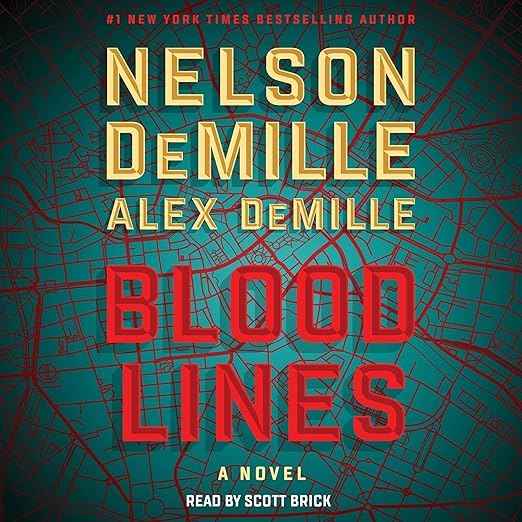
- Narration: Scott Brick is credited on nineteen and a half hours of dual-protagonist procedural work, and the reviews attached here discuss the writing rather than the recording.
- Themes: Military criminal investigation, the fault lines of modern Berlin, institutional cover-up, a partnership working under surveillance.
- Mood: Deliberate and paranoid, heavy on context.
- Verdict: A strong second case for series readers and a poor place for anyone else to start.
Nineteen hours and thirty-two minutes is a serious commitment for a single murder investigation, and this audiobook spends most of it walking two Army agents around Berlin asking questions nobody wants answered. Nelson DeMille and his son Alex wrote it as the second case for CID Special Agents Scott Brodie and Maggie Taylor, with Scott Brick credited as narrator. The body belongs to one of their own. Harry Vance was a CID special agent with the 5th MP Battalion, posted in western Germany, and the copy places his corpse "in a city park in the heart of Berlin's Arab refugee community."
The DeMilles picked their city for a reason, and the book is honest about why. William de Rham, who gave this four stars, calls Berlin "a flash point for many of the global crises and conflicts occurring since the end of World War II", which is precisely what the plot needs from a location. The description lists what Brodie and Taylor walk into: the refugee crisis, the residue of the Cold War and its secret police apparatus, and a neo-Nazi movement on the rise. One murder in one park lets the authors touch all three without writing a treatise about any of them.
The investigation follows a shape thriller readers will recognize, and one reviewer describes it better than the marketing does. Herredvard writes that the mystery is "so like peeling an onion," which is the right image for a book in which the first answer is never the real one. The official line on Vance's death is Islamic terrorism. Brodie and Taylor do not buy it. What the dead man was actually doing in Berlin during the weeks before he died becomes the question the novel is built around, and the copy is upfront that the killing is "merely the prelude to a much more sinister future event".
Running underneath that is a second threat with nothing to do with Germany. The pair spent their previous assignment in Venezuela hunting an Army deserter, and the description says American intelligence agents now fear the two "might have learned too much about US clandestine operations" while they were down there. That gives the novel a paranoid undertow, because the people best placed to help them are also the people with a reason to want them quiet. It also means they arrive in Berlin already carrying something heavier than a case file.
Highlights
Berlin does the structural lifting, and that is the argument for taking this in audio rather than print. James C Veltman's review puts it plainly: the characters "come alive", the plot is "complicated", and "the backgrounds in Berlin add a special twist to the story." Setting-heavy procedurals reward a format that will not let you skim. Your eye slides past a paragraph describing a refugee neighborhood after dark on the page. A reading does not give you that option.
Scott Brick is credited with the reading, and the demand this book makes on a narrator is a specific one: comprehension load. A full working week's worth of investigation, two protagonists whose interior thought the reviews single out for praise, German and American institutional players talking past each other, and a case that reopens every time it looks settled. Herredvard credits "the compelling personal thoughts of the protagonists" as part of what makes the novel work, and interior thought is the hardest thing to keep audibly separate from spoken dialogue across that distance. The reviews on this listing are about the writing, not the recording, so how the reading manages that separation is not something this page can tell you.
The other reason to commit is series shape. The description states outright that the sequence "concludes with The Tin Men," so the arc has a known end and a fixed length. That is worth something. Long-running thriller series tend to sag into indefinite sequel production, and a short runway to a stated finale means the DeMilles were writing toward a destination rather than around one. Book two of a finite trilogy behaves differently from book two of an open franchise, and this one carries the weight of setup that has somewhere to arrive.
What to Watch For in Blood Lines
Start at the beginning, not here. De Rham frames this novel as a worthy successor to The Deserter, the first Brodie and Taylor book, and the Venezuela business from that case is not background color. It is the reason two American agencies are circling this investigation with their own motives. The pair also open the novel having been apart for five months, a separation that only registers if you know what they were to each other beforehand.
That same review is the most useful document on the page, and it is also cut off. It stops mid-word as the reviewer begins a sentence about the earlier novel, so whatever comparison the four stars were about to explain never arrives. What survives is the verdict and the Berlin framing. What does not survive is the qualification, and a four-star review always has one.
The ratings pool is thin. Fourteen ratings at a 4.5 average is barely a sample at all, and a thin pool is a fact about circulation rather than about the book. The three attached reviews are strong, but three is three. Then the length. A runtime this size, spent on procedural detective work against a heavy political backdrop, is a great deal of Germany. If momentum is what you want from a DeMille novel, be aware that a large share of the runtime goes to context, much of it historical and jurisdictional groundwork rather than pursuit. That ambition is the book's real subject and also its drag.
Who It's For
Anyone who finished The Deserter and wants the next movement of that story should go straight in. The readers here came for DeMille and got what they came for. One titles the review "extremely absorbing" and could not put the book down. This is sturdy, well-researched thriller writing from two authors who clearly did the reading on modern Germany.
It also suits people who want a thriller with a real place attached to it. Berlin is not wallpaper in this novel: the city's unresolved history is the case itself rather than the scenery arranged behind it. If you enjoy a procedural that doubles as reportage about a city under pressure, that is the particular pleasure on offer, and it is the reason the runtime runs as long as it does.
Two groups should think twice. Newcomers to Brodie and Taylor will spend their first hours reconstructing a relationship and a mission the novel assumes they remember, and reconstruction is a poor use of a thriller's opening. And if you want something lean, check the runtime before committing. This is a long, deliberate, context-saturated investigation whose payoff is structural rather than fast, and a reader who wants the next body every forty minutes will be checking the progress bar by hour six.
Common Questions
Is this audiobook a reasonable place to start the series?
Not really. A four-star reviewer treats it as the successor to an earlier Brodie and Taylor novel, and events from that first case drive an entire subplot involving American intelligence agents with motives of their own. The two leads also open this book after a five-month separation whose weight depends on prior reading.
How much of the runtime is investigation rather than action?
Most of it. Expect interviews, jurisdictional argument and archival digging rather than pursuit. The German backdrop absorbs a large share of the book: refugee politics, the afterlife of a surveillance state, and a resurgent far right. One reviewer calls the plot complicated and clearly intends it as a compliment.
Why does the audiobook show so few ratings?
Fourteen ratings tells you about circulation rather than about quality. Pools that small move on a handful of opinions and average into nothing meaningful. The three visible reviews are detailed and favorable, though the most analytical of them is truncated mid-sentence before it reaches whatever reservation cost it a star.