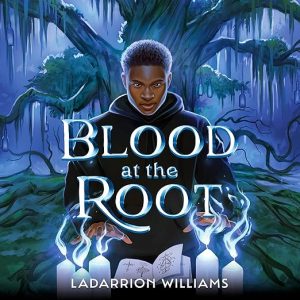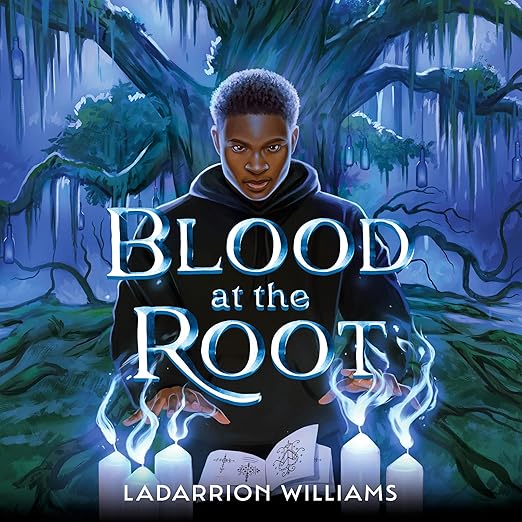
I started Blood at the Root on a flight and had to actively resist reading ahead in the synopsis because I wanted the story to unfold at its own pace. LaDarrion Williams has built something here that the fantasy genre genuinely needs: a world rooted in specific Black American cultural and spiritual tradition, set in an institution, Caiman University, that exists not as a fantastical exception to the world but as a fulfillment of something the Black community built for itself. That distinction matters more than it might seem at first pass.
Malik is seventeen when the book opens, ten years into keeping himself and his younger foster brother Taye alive and his own uncontrollable powers hidden. A daring act to protect Taye leads him to his long-lost grandmother, a legendary conjurer, and from there to Caiman University, where his mother once studied and where the reappearance of his first love Alexis collides with feuding covens, magical politics, and a reawakened evil that traces back to the Haitian Revolution. Williams is juggling a great deal, and for the most part handles it with the confidence of someone who knows their world as well as they know the characters moving through it.
Where This One Lands
I want to spend time on the HBCU element because it is the book's most distinctive and resonant achievement. Caiman is not a stand-in for Hogwarts with different demographics. It is an institution with its own history, its own internal politics, its own relationship to the broader Black community and to the specific traditions of conjuring and Haitian Revolution history that the book draws on. One reviewer described it with a comparison to Harry Potter for Southern Creole people, which captures the genre lineage while underselling how specifically Williams grounds the world in traditions that are not generically magical but historically specific.
The way Caiman functions as a place of belonging for Black magical practitioners who have had to hide themselves in the broader world, the emotional weight of Malik seeing people able to be fully themselves out of the view of white folk, as one reviewer put it, is handled with a delicacy and force that elevates the book above the premise summary. This is not diversity packaging in fantasy form. It is a writer using the genre to explore what it means to find a community that was built specifically for you, when you have spent years believing no such community existed.
The Best Parts of Blood at the Root
Jalyn Hall's narration is one of the book's genuine assets. Malik's first-person voice is urgent and specific, carrying grief and wariness and the particular exhaustion of someone who has been responsible for another person since childhood. Hall handles that complexity without making Malik either pathetic or superheroic. The voice sounds like a seventeen-year-old who has been forced to grow up, which is exactly what the character requires.
The community scenes at Caiman, where Malik is encountering his grandmother's world for the first time, are particularly well-handled. Hall gives the ensemble cast enough distinction to track without resorting to caricature, and the emotional texture of Malik's gradual sense of belonging is conveyed through voice alone with impressive precision. These are the scenes that make the book more than a magical thriller and give it the warmth that pushes it toward something lasting.
What Gives Us Pause
One reviewer offered a thoughtful criticism: the book's language and cultural specificity, the Black vernacular woven through Malik's narration and the dialogue, can feel forced in the early chapters before settling into the text more naturally. That observation is worth passing along to potential listeners, particularly those for whom English is not a first language, who may find the early chapter dialect density an obstacle before the story's momentum takes over. By most accounts, including that reviewer's, the book rewards patience with those opening sections.
The queer Black representation, which appears through secondary characters, was highlighted by multiple reviewers as meaningful in a genre where that intersection is rarely visible. Williams does not make that representation a subplot or a lesson. It is simply present in the world as one of many ways the Caiman community reflects the full complexity of Black life, which is exactly how it should be handled.
Who Should Listen to Blood at the Root
Blood at the Root is strongly recommended for young adult and adult listeners who want fantasy fiction rooted in Black American and Haitian tradition rather than generic secondary-world magic. The HBCU setting is one of the most distinctive in recent genre fiction, and the debut series energy, the first-book excitement of a writer introducing a world they clearly love, is palpable throughout.
Listeners who prefer fantasy with lighter emotional stakes or less culturally specific world-building may find the book demands more engagement than they are looking for. This is not background listening. It is a book that asks you to pay attention to the history and community it is drawing on, and that investment pays off significantly by the end. Williams is writing a series that feels unlike anything else currently in the YA fantasy space, and at nearly fifteen hours with Jalyn Hall's narration, the first entry makes a strong case for following Malik wherever the sequel takes him. People Magazine described it as bringing magical living to an HBCU in an unforgettable adventure, and that description, while compressed, captures what the book is actually doing at its best moments.