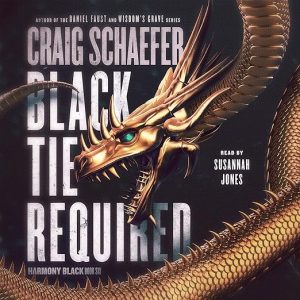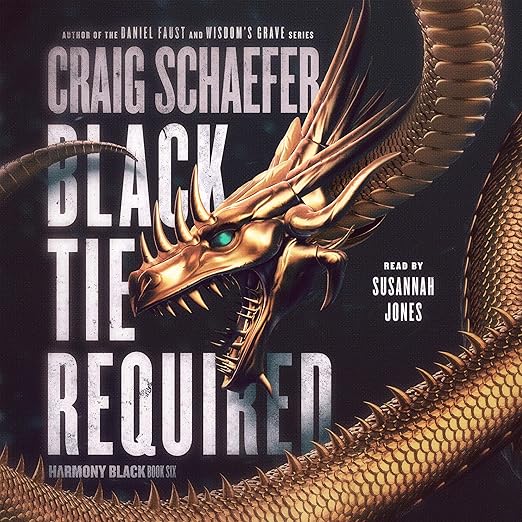
Six books deep into Craig Schaefer's Harmony Black series, this audiobook lands at a specific pressure point: the second entry in what reviewers are calling a closing trilogy within the larger run, following directly on the events of Right to the Kill. Harmony and her team return to Las Vegas, a city the synopsis calls 'a graveyard of bad memories' for her personally, to protect a source from a German-trained freelance assassin known as the Basilisk during the TechTopia tech conference. Susannah Jones narrates the full ten hours and six minutes, and this is a series where narrator continuity across multiple entries usually matters enormously to returning listeners, which makes her performance worth evaluating on its own terms here rather than against a prior narrator's take.
What starts as a single extraction mission widens fast. The assassin's target has ties to Talon Worldwide, a corporation the series has established as operating across two parallel Earths, and by the midpoint the danger has escalated from one person's life to consequences the synopsis itself describes as interdimensional. Reviewer M. Wanchoo, who reviews the book as a clear series veteran, calls it 'the best book of the series & a near-perfect thriller,' a strong claim six entries deep in a genre notorious for sequels running out of new ground to cover.
Harmony herself remains the emotional center even as the plot widens: her personal history with Las Vegas, the graveyard-of-bad-memories framing the synopsis references directly, keeps the interdimensional conspiracy grounded in a specific character's specific pain rather than becoming pure spectacle.
Why Black Tie Required Works as an Audiobook
The occult-crime premise gives Schaefer room to escalate without repeating himself: this is a world where an FBI-adjacent task force fights demons, freelance sorcerer-assassins, and interdimensional corporate conspiracies, and six books in, the mythology has clearly deepened rather than flattened out. Reviewer Harlequin's blunt assessment, that the series has 'went from flat to interesting,' is a useful, honest data point for anyone who bounced off the earlier entries: multiple reviewers independently describe real growth across the run rather than diminishing returns, which is not a guarantee genre series usually earn by book six.
Paul Cassel's review adds a detail worth sitting with: he mentions having read the entire Faust and Harmony series plus what he calls 'the oddball lesbian trilogy that adds some important elements to the canon,' pointing to a wider Craig Schaefer universe (the Daniel Faust books share continuity with Harmony Black) that includes a side series with explicit queer representation. That detail likely explains why this listing carries an LGBTQ-plus genre tag even though Black Tie Required's own plot centers on occult crime-fighting rather than identity-driven storytelling directly; the representation Cassel describes lives elsewhere in Schaefer's connected universe, and this book's tag may be inherited from that wider catalog rather than describing this specific entry.
The Vegas setting does real work here beyond backdrop. Harmony has personal history with the city, described as a place of bad memories, and Schaefer uses the neon-and-glitz surface to contrast against the criminal underworld gathering beneath it, elite conference attendees rubbing shoulders with an assassin's mistress, a sadistic demoness named Nadine who has recurred across the trilogy. Listeners who enjoy urban fantasy that treats its city setting as more than scenery will find this a well-used one.
The TechTopia conference backdrop gives Schaefer room for sharp, specific satire alongside the supernatural plot: Silicon Valley entrepreneurs, startup investors, and self-styled big thinkers provide a very of-the-moment human veneer over the occult danger gathering underneath, and that contrast, mundane tech-industry ambition sitting a few feet from literal demons and interdimensional assassins, is exactly the kind of tonal juggling act urban fantasy does best when it's working well.
Craig Schaefer has built a genuinely substantial body of work across the Daniel Faust and Harmony Black books, and that prolific output matters for evaluating a book this deep into a run: an author sustaining reader enthusiasm and plot invention six-plus books into one series, while simultaneously maintaining a separate connected series, is a real structural achievement regardless of whether any single entry is a reader's personal favorite.
A second plot thread simmers alongside the main assassin hunt: rumors of a secret auction drawing the city's criminal elite like, in the synopsis's own vivid phrase, flies to a rotting corpse. That auction subplot gives Schaefer another reason to keep expanding the cast of morally compromised players circling the TechTopia conference, and it's a reminder that Black Tie Required is working multiple simultaneous mysteries rather than a single linear chase.
Weak Spots in Black Tie Required
This is emphatically not a jumping-on point. Every review that engages with the plot assumes deep familiarity with the prior five books, and the synopsis itself references Right to the Kill's events as a direct throughline rather than recapping them. New listeners attracted by this specific premise should expect to start at book one of Harmony Black, and likely benefit from at least sampling the Daniel Faust series first given how tightly Schaefer weaves the two together.
Susannah Jones has no prior credits in this specific catalog to compare against, so her performance here is worth judging fresh rather than against series expectations. The genuine open question for returning listeners is how she handles the large recurring cast, Harmony's team, the Basilisk, Nadine, assorted Talon Worldwide operatives, across ten-plus hours; series audiobooks live or die on exactly this kind of differentiation, and it's worth sampling a chapter before committing if narrator consistency across a long series matters to a given listener.
The genre tag mismatch flagged above is worth taking seriously as a purchasing consideration rather than dismissing as a minor labeling quirk: listeners specifically seeking LGBTQ-plus representation as this book's central content, rather than as a feature of the wider connected universe, should know that Black Tie Required's own synopsis describes an occult heist-and-protection thriller first and foremost.
Fans of Jim Butcher's Dresden Files or Kevin Hearne's Iron Druid Chronicles will recognize the basic shape here, an occult investigator with a found-family team facing escalating supernatural threats, though Schaefer's version leans harder into globe-spanning conspiracy and interdimensional danger than either of those more grounded, single-city series typically does.
Who Should Listen to Black Tie Required
This is for series-committed Harmony Black readers who have already invested five books deep and want to know whether the payoff holds, and for Daniel Faust fans following Schaefer's wider shared universe who track how the two series intersect. Reviewer Paul Cassel's framing, urging followers of the series to 'be glad,' captures the intended audience precisely.
Skip this one entirely if you haven't read the first five Harmony Black books; the plot assumes total familiarity with prior events, relationships, and danger, and starting here will mean missing most of what makes this specific entry land as a strong installment rather than a confusing fragment.
Good to Know
Do I need to listen to the earlier Harmony Black audiobooks before starting Black Tie Required?
Yes. This is book six, following directly on Right to the Kill's events, and reviews confirm the plot assumes full familiarity with the prior five entries.
Why is this audiobook tagged LGBTQ-plus when the main plot doesn't focus on identity themes?
One reviewer references a separate 'lesbian trilogy' elsewhere in Craig Schaefer's connected Daniel Faust and Harmony Black universe, which likely explains the tag; Black Tie Required's own plot centers on occult crime-fighting rather than identity-driven storytelling.
How does Susannah Jones's narration handle the series' large recurring cast?
She has no prior credits in this series to compare against, so it's an open question worth sampling directly; the book's large cast, Harmony's team, the Basilisk, Nadine, and Talon Worldwide operatives, is a real test of range across ten hours.