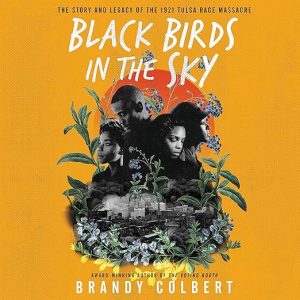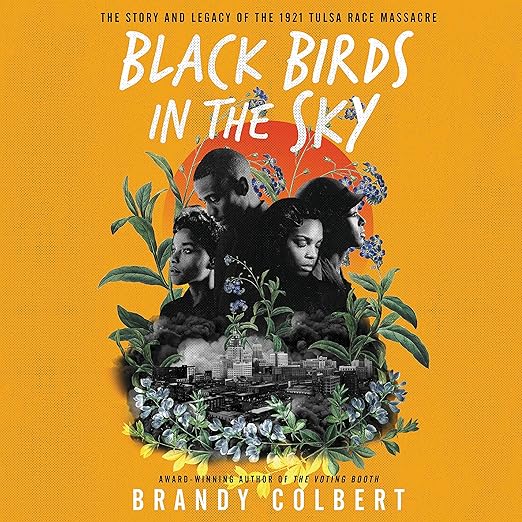
Brandy Colbert's audiobook account of the 1921 Tulsa Race Massacre begins with a specific historical scene: the early morning of June 1, 1921, a white mob crossing the train tracks into the Greenwood District of Tulsa, Oklahoma, a neighborhood known as America's Black Wall Street. In a few hours, thirty-five square blocks would be razed, hundreds killed, and a thriving community destroyed. The facts are stark, but what Black Birds in the Sky attempts, and largely achieves, is the harder task of explaining how something this deliberate and this devastating was systematically unknown to most Americans for decades afterward. That question is the book's organizing center, and Colbert pursues it with the clarity of someone who has spent significant time with the evidence and the anger both, then found a form of address that carries the weight without becoming inaccessible.
Our Take on Black Birds in the Sky
Colbert is primarily a YA novelist, and she brings to this nonfiction work the storytelling instincts of someone who knows how to hold a young reader's attention. But this is not a simplified or softened account. The book is rigorous in its historical research, unflinching in its description of the violence, and insistent on connecting the Tulsa massacre to a broader pattern of racial violence traceable from Reconstruction through the Civil Rights movement and into the contemporary moment. White resentment of Black economic and political advancement, the resurgence of white supremacist groups, the role of media framing, and the subsequent suppression of the historical record all receive careful attention. Reviewers have noted both the book's power and a genuine structural tension: one reader appreciated the contextual history of American racial violence but wanted more specific detail on Tulsa itself. Colbert's choice to situate Greenwood within a larger narrative of white violence against Black economic advancement is deliberate and defensible, and whether you experience that as essential context or as dilution of the immediate story depends on what you come to the book seeking. The Boston Globe-Horn Book Award and YALSA Honor Award for Excellence in Nonfiction suggest that the jury found the approach valid. Most listeners do too, by the final chapters, when the full pattern becomes visible.
Why Listen to Black Birds in the Sky
The self-narration is the primary audio argument. Colbert's voice carries a quality of personal investment that a hired narrator, however skilled, would struggle to replicate. Narrating your own prize-winning historical nonfiction is a specific act of commitment, and the listening experience reflects that commitment at every passage. One reviewer described their reaction as visceral: visualizing the destruction of Greenwood made the tragedy real in a way that reading it on the page might not have. Audio's capacity to make historical events immediate is deployed effectively throughout, particularly when Colbert's delivery shifts into the testimonial passages from survivors and their descendants. At five and a half hours, the audiobook is also brief enough to complete in a single extended sitting if the subject demands that kind of sustained attention, and for many listeners, it will demand exactly that. The self-narration also carries a quality of accountability that hired reading does not: Colbert is not delivering someone else's research, and that distinction is audible throughout.
What to Watch For in Black Birds in the Sky
The pacing of contextual versus specific history. Colbert invests significant time, some readers would say too much, in the broader history of racial violence in America before arriving at Tulsa specifically. The argument for this structure is that Tulsa cannot be fully understood in isolation; it was not an aberration but the product of specific conditions that were themselves widespread. The argument against it is that a listener who came for the story of Greenwood may feel that arrival is delayed. By the second half of the book, most reviewers report being fully absorbed; one specifically noted that the full extent of what led to the massacre became comprehensible only in retrospect, after working through the contextual scaffolding. At just over five hours, the audiobook is short enough that the investment in context does not feel like an extended detour, it functions as a design feature rather than an obstacle once the later chapters arrive and the full picture becomes visible and devastating.
The Right Listener for Black Birds in the Sky
This audiobook serves two distinct audiences equally well. Young adult listeners encountering the Tulsa Race Massacre for the first time will find Colbert's accessible prose and careful contextual framing an excellent introduction. Adult listeners who are aware of the massacre but have not read a dedicated account will find the historical and analytical depth more substantial than the YA designation might suggest. The self-narration makes this a particularly strong recommendation for anyone who responds to author-read nonfiction as a format. Listeners who find the contextual history of American racial violence emotionally heavy should pace their listening accordingly, this material accumulates, and Colbert does not offer relief where the history offers none. The book's brevity makes that accumulation manageable without diluting its weight, which is its own kind of editorial achievement. Colbert has written a book that functions as both immediate history and ongoing argument, and the audio format makes both dimensions of that work more visceral and more present than the page version alone. For a story about events that were deliberately suppressed and then slowly recovered, the act of listening, of receiving the account through a voice rather than scanning it silently, feels like an appropriate response to what Colbert has built.
Quick Take
- Performance: Brandy Colbert narrates her own work, bringing a personal urgency to the material that third-party narration could not replicate, her voice carries the weight of the subject without becoming performatively solemn.
- What it covers: Racial violence and its systematic suppression, the politics of historical memory, the continuity between past and present injustice
- Feel: Sober and unflinching, with an underlying current of moral clarity
- Our call: Colbert's combination of YA accessibility and rigorous historical research makes this one of the stronger audiobook accounts of the Tulsa Race Massacre for listeners of any age.
Frequently Asked Questions
Does Brandy Colbert's self-narration of this audiobook meaningfully add to the listening experience?
Reviewers say yes. The personal investment she brings to material she clearly researched deeply creates an urgency that third-party narration would struggle to match. At least one reviewer described the audio experience as more visceral than they expected from a historical account.
How much of the audiobook focuses specifically on the 1921 Tulsa massacre versus broader American racial history?
Colbert situates the massacre within a longer history of white violence against Black communities, which means a significant portion covers context before and after June 1921. Some reviewers wanted more Tulsa specificity; others found the contextual framing essential to understanding what made Greenwood possible and what destroyed it.
Is prior knowledge of the Tulsa Race Massacre necessary to get value from this audiobook?
No. Colbert writes for readers encountering the events for the first time and builds the necessary historical framework from the ground up. Listeners with prior knowledge will still find value in her analytical framing of why the events remained suppressed in American historical memory for so long.