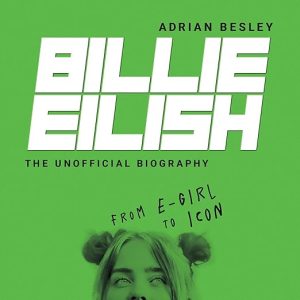
Billie Eilish uploading "Ocean Eyes" to SoundCloud in 2015 for her dance tutor and watching it receive a thousand plays in 24 hours is the kind of origin story that sounds fabricated even though it isn't. This audiobook, Adrian Besley's biography covering her rise from Highland Park, California to global stardom, takes that moment seriously as a cultural inflection point rather than a charming anecdote. The 13-year-old with the ethereal voice who accidentally went viral was not a product of industry machinery but of a close-knit family, a home-schooling education that encouraged self-expression, and a brother who could write and produce.
Besley's framing is accessible, aimed squarely at the audience that already loves Eilish's music and wants the context behind it. The book is not a critical biography. It doesn't distance itself from its subject or apply much skeptical scrutiny. But it does something a pure fan document often fails to do: it places Eilish's rise within a specific cultural and family context that makes the "overnight success" narrative more complicated and more interesting than the headline version suggests.
Where This One Lands
The Finneas factor is the book's most compelling thread. The creative partnership between Billie Eilish and her brother Finneas O'Connell, who still writes and produces her songs, is unusual in the contemporary pop landscape. Most artists of her commercial scale work with a rotating roster of producers and co-writers. The Eilish-Finneas collaboration is a closed circuit, and Besley pays attention to how that dynamic functioned in the Highland Park bedroom studio where the early tracks were made, and how it scaled to arena-level production.
The period between "Ocean Eyes" and Don't Smile at Me is covered with good detail. The tracks "Bellyache," "Idontwannabeyouanymore," and "My Boy" are discussed in terms of their production and the public reaction they generated, and Besley is accurate that the EP's presence in the top 20 of more than a dozen countries represented something unusual for a self-distributed recording by a teenager. The book is at its best when it's specific about the music rather than when it's describing the general contours of internet fame and the emotional toll of rapid celebrity.
What Makes Billie Eilish Worth Hearing
Narrator Angie Kane suits the material well. Eilish's public persona is animated and direct, and Kane matches that energy without overdoing it. She keeps the narration moving at a pace that reflects how quickly the career itself moved, without losing the warmth of the family story at the center. The audiobook runs 4 hours and 36 minutes, which is short enough to listen to in a single afternoon and appropriately sized for the teen biography format.
The reviews skew heavily toward gifting. One reviewer gave it to her 14-year-old niece; another describes her daughter squealing with excitement. That tells you something about the book's primary audience and also about its mode: this is the kind of audiobook biography that celebrates rather than interrogates, that says "here is how she got here" rather than "here is what this means." For fans in that spirit, and for younger listeners discovering an artist they already admire, the format works consistently and warmly throughout.
What Gives Us Pause
The publication timeline is the main caveat. This biography covers Eilish's career up to her early arena years and the first wave of her international recognition. The 53 million Instagram followers and collaborations with Justin Bieber and Khalid that the synopsis mentions place the book's scope in a specific window. Listeners wanting coverage of her debut album When We All Fall Asleep, Where Do We Go?, her Bond theme "No Time to Die," her Happier Than Ever era, or anything beyond the initial stardom period will need supplementary sources.
Besley is an outside author writing about a subject he didn't have direct access to, and the book reflects that. The family material and music history are drawn from interviews and public sources rather than from Eilish's direct accounts. The emotional interiority, what Eilish actually felt during the transition from bedroom recording to Glastonbury headliner, is inferred rather than documented. That's an inherent limitation of the authorized-adjacent biography format, and listeners should calibrate their expectations accordingly. This is a biography built from public sources, not a memoir or an authorized account with insider access.
One aspect the book handles particularly well is Eilish's public articulation of mental health, body image, and independence during years when most of her peers were being groomed into conventional pop product. Besley gives these themes their due without either sensationalizing them or reducing them to talking points. Eilish's decision to perform in baggy clothes to prevent body-shaming, her openness about depression and anxiety, and her refusal to perform a more conventional version of teenage femininity were choices with artistic and commercial dimensions, and the book treats them as such.
Who Should Pick Up Billie Eilish
This audiobook is best suited for fans of Eilish's music who want contextual background on the early career: the "Ocean Eyes" moment, the Don't Smile at Me EP, the relationship with Finneas as creative partner, and the rapid transition from SoundCloud obscurity to arena headliner. It's also well-calibrated as a gift for younger listeners who are passionate about her work and would enjoy a longer-form account than what interviews and documentaries typically provide.
Critical listeners wanting a full biography, a media-studies examination of her cultural impact, or coverage of her later work will outgrow the book quickly. At 4 hours and 36 minutes, it's a biographical sketch rather than a comprehensive account: well-executed for what it is, but deliberately limited in scope. Seek it out for the early-career context. Look elsewhere for the fuller picture of an artist whose most interesting chapters, professionally and personally, may still be unfolding.
The Short Version
- Narrator: Angie Kane brings warmth and pace to Adrian Besley's fan-biography, matching the energy of Eilish's own public presence without overselling it.
- Subjects: Overnight internet fame, sibling creative partnership, Generation Z authenticity
- Tone: Celebratory, fast-paced, and fan-friendly
- Bottom line: A solid audiobook introduction to Eilish's early career, best suited for listeners who already love the music and want the context behind it.
Questions Listeners Ask
How does Angie Kane's narration handle the audiobook format for a music biography?
Kane brings appropriate energy to the material: fast-paced and warm, matching Eilish's own public presence without caricaturing it. For a 4-hour-and-36-minute biography aimed at fans, the narration keeps the momentum without overselling any particular moment. It suits the fan-biography format well.
Is this audiobook appropriate for teenage Billie Eilish fans, or is it written for adults?
The book is well-calibrated for teenage listeners. Several reviewers specifically gave it to teens as a gift, and the writing is accessible and celebratory rather than analytical or critical. The subject matter, including Eilish's public statements about mental health and body image, is handled at an age-appropriate level.