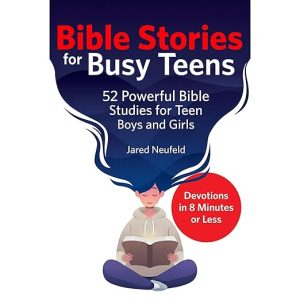
Fifty-two Bible studies, eight minutes or less apiece, and a free companion journal you unlock by scanning a code printed inside the book: that is the offer this audiobook inherits from its print edition, and the last item on the list does not survive the crossing. A code you cannot see is a code you cannot scan. What plays instead is two hours and fifty minutes of retold Scripture aimed at teenagers between thirteen and eighteen, which works out at a little over three minutes for each week of the year.
Is Bible Stories for Busy Teens Worth Your Time?
Structure is the entire product, and it is a sound one. Each week runs a Bible story retold in plain modern language, a reflection tying it to something a teenager is actually dealing with, one practical faith challenge and a guided prayer to close. Identity, peer pressure, anxiety, comparison, self-worth, forgiveness and purpose are the pressures the copy names by name, and the route promised runs from Creation to the Early Church in fifty-two stops. As a shape for building a habit, that is honest about being a shape.
Three of the five responses run to exactly seven words each. One reports that a teen loves the book, one says these are short stories perfect for teenagers, and one says it was just what a Sunday school teacher needed. Praise at that length tells you something real, but what it tells you is that the book is being handed over as a gift and approved of on sight. Approval on sight and sustained weekly use are different measurements.
Amanda Graham files the only detailed account, in November 2025, and it is a good one. A teenage son had outgrown the children's Bible and found an adult one forbidding, and the short studies turned out to match both his attention span and his schedule well enough that he looks forward to them. That is the publisher's own claim about the product, confirmed independently by somebody who tried it on the exact reader it was designed for.
The Best Parts of Bible Stories for Busy Teens
Arithmetic makes the first argument. Two hours and fifty minutes spread across fifty-two studies leaves each week a shade over three minutes, comfortably inside the eight-minute ceiling the copy advertises, and a portion that short removes the single most common reason people abandon a devotional halfway through February. Nobody has to schedule a unit that size. For a teenager who has never finished a faith book of any kind, the unit of commitment is the whole design problem, and this one solves it.
Range is the second argument. Creation to the Early Church across both Testaments is a genuine span rather than a greatest-hits selection, and the retellings are pitched at thirteen to eighteen rather than at children. Plain modern language is the stated method, and the copy takes care to promise that the full weight of Scripture stays intact, which is precisely the reassurance a parent buying this actually wants. Whether it holds is a judgment each household will make for itself.
Gift-buying explains most of what happens on this page. The copy lists birthdays, Christmas, Easter and graduation, names youth groups, Sunday school and confirmation classes as targets, and the written responses read exactly like people buying for somebody else rather than for themselves. That is a perfectly legitimate use, and the audio edition helps it along, because a teenager who will not open a book will sometimes press play on something that short, and something that short is all this ever asks.
Before You Commit to Bible Stories for Busy Teens
Virtual Voice is what the page prints where a performer's name would sit. That means a synthetic reading rather than a person, and on devotional material it carries more weight than it would on a thriller, because the guided prayer closing each week is written to be spoken aloud with intention and a machine brings none. Nobody should arrive surprised. The listing does disclose it, in two words, for anyone who reads the credits before buying.
Bonus material is the other thing that does not make the trip. A free fifty-two-page companion journal comes with the book, unlocked by that printed code, carrying guided reflection prompts, prayer space and personal growth pages for every week of the year. None of it reaches a listener. The reflection questions Emb10 singles out for praise sit in exactly the same position: they were built to be answered on paper, and a recording can only read them aloud and move on.
Publisher and author on this listing are the same two words, jbn Publishing, so the byline names a company rather than a writer, and nobody who worked on the text is credited anywhere. Series reads Faith That Fits a Busy Life with the volume number left blank. The description also quotes a five-star buyer as promotional copy, which is a retail review pressed into service as a blurb. None of that makes the book worse. All of it means the page is marketing rather than disclosure.
Who Should Pick Up Bible Stories for Busy Teens
Parents of thirteen to eighteen year olds who want a faith habit that survives a sports schedule are the buyer this was built for, and the short weekly unit is the entire idea. Youth leaders hunting for an opener rather than a full lesson will get a usable one. Teenagers who genuinely want a way in, and who can accept a synthetic voice reading Scripture to them, get fifty-two entry points and no homework attached to any of them.
Give it a miss if you are shopping for a class text, because a unit of roughly three minutes will not fill a session and was never built to. Anyone who cares about the journal, the prompts or the prayer pages should buy the printed edition instead, since those are the parts that need paper to work at all. A listener who finds machine narration distracting on religious material will find it distracting here too.
What this amounts to, on my reading, is a well-designed print product with an audio edition attached, and the page is honest enough about its own design that a buyer can work that out in advance rather than afterwards. Weigh which of the two things you actually want: the habit, or the workbook. If it is the habit, a few minutes a week will do the job and ask almost nothing of anybody. If it is the workbook, paper is what carries the thing you are paying for.
Who reads the Bible Stories for Busy Teens audiobook?
The listing prints Virtual Voice in the reader slot, which means the reading is machine-generated and nobody is credited for it. No studio or director appears either. Listening to a preview is the only way to judge whether that delivery suits a weekly devotional habit before you commit.
Does the audiobook work through the Bible in order?
Broadly, yes. The copy promises a route that starts at Creation and finishes with the Early Church, drawing on both Testaments across fifty-two weekly studies. Each week stands alone, though, carrying its own story, reflection, challenge and prayer, so nothing prevents you from dipping in wherever the week's pressure happens to fit.
Is this a devotional or a full Bible study?
Not a watered-down devotional, according to the copy, which calls the fifty-two units complete studies built from a retold story, a reflection, a practical challenge and a prayer. In practice each unit is short, so the label depends on what you compare it against and how much you expect a single week to hold.