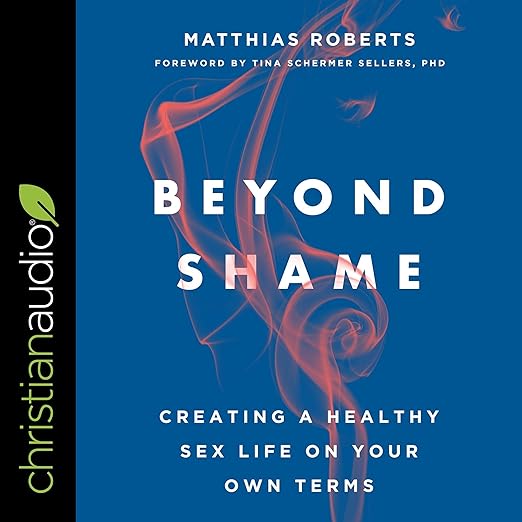
The shame that Matthias Roberts addresses in this audiobook is not a problem belonging only to people who grew up in evangelical purity culture, though the book is attuned to that specific context in particular. Beyond Shame opens with a premise that reframes the subject more broadly: that sexual shame has been distributed widely and unevenly across American life, and that most people have absorbed some version of it without necessarily tracing it to its source. Roberts is a psychotherapist who trained in both theology and counseling psychology, and he writes from inside both the LGBTQ+ community and a Christian faith tradition. That positioning gives Beyond Shame a texture that most shame-focused wellness titles do not have, because it is written by someone who has had to work through these questions with full awareness of the specific harm certain religious frameworks have caused, while still believing there is something worth recovering from those traditions rather than simply abandoning them wholesale.
Between Sex Positivity and Strict Moral Boundaries
Roberts structures the book around three unhealthy coping mechanisms that people use to manage sexual shame, working through each in turn before offering a framework for determining what healthy sexuality looks like on an individual's own terms. The book explicitly steers between what he calls boundary-less sex positivity on one side and strict moralistic boundaries on the other, which is a more honest positioning than either pole typically allows. One reviewer who trained in theology describes Roberts as doing an incredible job laying a foundation of basic shame without shaming the reader in the process, and notes that his dual background in theology and counseling psychology provides enough grounding for listeners to build their own frameworks rather than simply adopting his conclusions wholesale. That generativity is part of the book's explicit design: it offers orientation toward a different relationship with sexuality, not a prescriptive set of rules to replace the prescriptive rules being discarded.
One of the more striking testimonials comes from a cisgender, heterosexual suburban woman who describes beginning the audiobook intending to support LGBTQ+ friends and discovering instead that the same deep shame narratives had been weaponized against her own life and sexuality in ways she had not previously recognized. That kind of reach across intended audiences says something real about the breadth of Roberts' framework. Another reviewer describes the book resonating deeply from the experience of growing up bisexual in Catholic schools, where years of shame had accumulated around an identity kept hidden. The spectrum of responses, from queer listeners validating long-carried shame to straight listeners unexpectedly discovering their own version of it, reflects the book's central argument about the widespread distribution of sexual shame across American religious and cultural life. Roberts' particular contribution to this conversation is the middle path he insists on: not a rejection of all structure around sexuality, which he identifies as its own kind of response to shame rather than a resolution of it, and not a return to restrictive frameworks, but a deliberate, personal process of determining one's own sexual values from inside rather than adopting them from external authority in either direction.
Pabon's Measured Warmth Feels Like a Conversation
Timothy Andres Pabon narrates, and his performance is measured and warm without being performatively soothing or therapeutically artificial. For material this personal, the narration needs to feel like a conversation rather than a lecture, and Pabon achieves that balance consistently across the five hours and three minutes. The audio format is well-suited to Roberts' writing, which moves between case illustration, theological analysis, and practical framework in a way that benefits from spoken delivery with appropriate pacing. Pabon handles the intimate subject matter without either awkwardness or over-emphasis, which allows the content itself to do the work it is designed to do without distraction from the performance layer.
Compressed by Design, More Framework Than Therapy
The book is compressed enough that some sections feel like introductions to ideas that could sustain considerably more development. Roberts raises and works through the three coping mechanisms clearly, but the positive framework for self-determined sexual values, while useful and well-framed, could support another full chapter or two of practical application and case illustration. Listeners who want clinical depth, specific trauma-processing protocols, or extensive case studies will find this serves better as an orienting framework than as a complete therapeutic resource. The book does not claim to be a clinical treatment; it claims to offer a framework and a direction, and on those terms it delivers well. The explicitly Christian theological background is present throughout rather than confined to early chapters, which may be more or less welcome depending on the listener's own relationship to that tradition, and is worth knowing before beginning.
Carrying Early Shame Messages Into Adult Life
The Beyond Shame audiobook is most directly useful for anyone who recognizes the pattern Roberts describes: receiving early messages that sex is inherently immoral or dangerous outside very specific circumstances, and carrying that conditioning into adult life regardless of present religious identification. LGBTQ+ listeners who grew up in religious environments will find the book especially attuned to the specific shape of their experience. The five-hour format makes it accessible in a single weekend. Listeners wanting a secular, clinical deep-dive without theological grounding, or who need extensive practical protocols for working through shame in a structured therapeutic program, will want to pair this with additional resources. But as an orienting framework that is honest about the sources of shame and clear about the direction toward something healthier, Beyond Shame serves a purpose that few books in this space manage as thoughtfully.
Before You Listen
Is this audiobook specifically for LGBTQ+ listeners, or does Beyond Shame address sexual shame more broadly?
Roberts writes from an LGBTQ+-affirming perspective and addresses purity culture's specific harm to queer people directly, but the book explicitly extends its framework to anyone shaped by sexual shame regardless of identity. Multiple reviewers who identify as heterosexual and cisgender found the material equally relevant to their own experience.
How does Timothy Andres Pabon's narration handle the intimate subject matter throughout this audiobook?
Pabon maintains a warm, conversational tone throughout that suits the therapeutic framing Roberts uses. The narration avoids both clinical detachment and awkward over-earnestness, which is exactly the balance the material needs to feel approachable and genuinely supportive rather than clinical or preachy.
At just over 5 hours, does this audiobook give the subject enough depth or does the short runtime leave key ideas underdeveloped?
The book is thorough on its central three-coping-mechanism framework and offers a clear direction toward self-determined sexual values, but compressed enough that some ideas feel like starting points for longer conversations. Listeners wanting clinical depth or extensive case studies should supplement with additional therapeutic resources.